The Anthropological Origins, Folkloric Evolution, and Postmodern Permeation of the Muffin Man
Unpacking the centuries-long journey of a seemingly innocent nursery rhyme, from its gritty Victorian origins to its surprising transformations in modern pop culture and digital myths.
Listen to this article
35 min listen
The Anthropological Origins, Folkloric Evolution, and Postmodern Permeation of the Muffin Man
Introduction to the Folkloric Dichotomy
The nursery rhyme "The Muffin Man" represents one of the most resilient, globally recognized, and culturally adaptable pieces of English folklore in recorded history. Originating as an observational ditty regarding a local street hawker in the early nineteenth century, the song has transcended its humble beginnings to become an elaborate singing game, a subject of internet true-crime mythology, and a remarkably versatile trope within postmodern popular culture. The enduring nature of the rhyme invites rigorous academic inquiry into its origins, its mechanics of transmission, and its subsequent morphing within the digital age.
To thoroughly interrogate the nature of the "Muffin Man," one must first address a fundamental dichotomy that frequently arises in contemporary cultural discourse. The core inquiry often presented by modern audiences is an ontological one: Is the historical Muffin Man a human being who manufactures and sells baked goods, or is the character an anthropomorphic muffin possessing arms, legs, and a face?
The historical reality firmly grounds the Muffin Man as a human occupational title—a flesh-and-blood nineteenth-century street vendor tasked with the door-to-door delivery of bread products. He was an essential fixture of the Victorian urban supply chain, representing the working-class individuals who sustained the population of an overcrowded metropolis. However, as the socioeconomic context of the Victorian street seller faded from collective memory due to industrialization and the advent of modern supermarkets, the linguistic ambiguity of the title provided a fertile landscape for modern artistic reinterpretation. In contemporary media, animation, and digital subcultures, the Muffin Man has frequently been reimagined not as a human baker, but as a sentient, anthropomorphic pastry, or an absurd creator of living food.
This comprehensive report provides an exhaustive analysis of the history, socio-geographic context, game mechanics, and modern cultural permeation of the Muffin Man. By tracing the origins of the rhyme in early theatrical manuscripts, mapping the geography of London's slums, analyzing the psychology of parlor games, debunking modern urban legends, and examining the character's presence in works ranging from Frank Zappa to Shrek and asdfmovie, the following analysis charts the extraordinary trajectory of a historical tradesman who evolved into a ubiquitous cultural archetype.
The Human Baker: The Socioeconomic Reality of the Victorian Street Vendor
To understand the origins of the nursery rhyme, one must construct the economic, acoustic, and social reality of the era in which it was born. The historical Muffin Man possessed no anthropomorphic pastry traits; he was a working-class tradesman navigating the brutal economic realities of nineteenth-century Britain.
The Architecture of Poverty and the Urban Diet
During the Victorian era (1837–1901) and the decades immediately preceding it, London experienced unprecedented population growth, resulting in an overcrowded metropolis teeming with an exploding working-class population. The architecture of poverty dictated the culinary habits of the lower and middle classes. Very few households in densely packed tenement districts possessed a functioning domestic kitchen or a reliable oven. Those who did have access to open fireplaces often found cooking upon them to be a hot, smoky, and dangerously inefficient endeavor.
Furthermore, the grueling demands of the Victorian labor force heavily influenced the urban diet. Working-class individuals frequently endured twelve-hour workdays with only Sundays allocated for rest, leaving them with neither the time nor the physical stamina to prepare meals from scratch. Healthy, nutrient-dense meals were prohibitively expensive, forcing families to rely on cheap, bulky carbohydrate sources to achieve satiety.
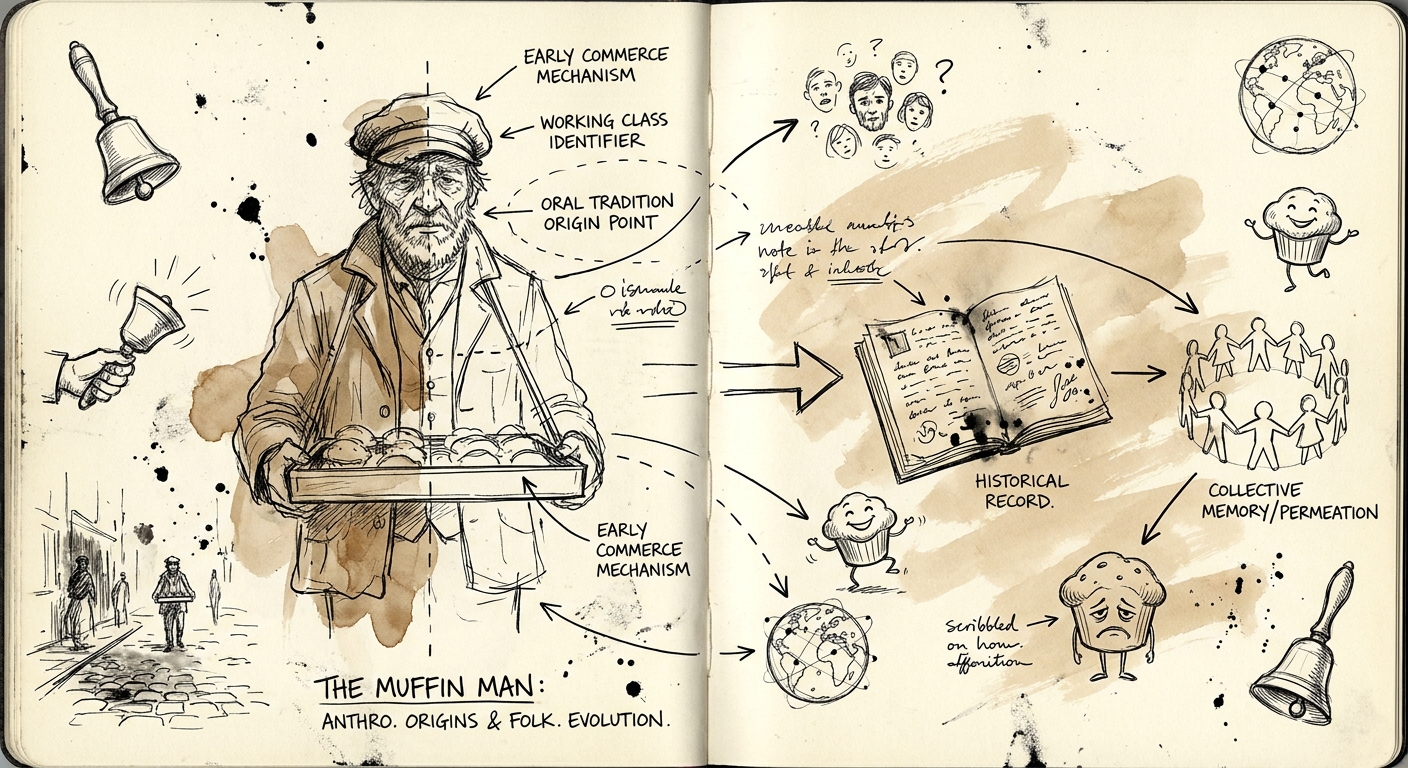
Consequently, a vast and highly complex network of itinerant street vendors emerged to feed the populace. The English journalist and social researcher Henry Mayhew, in his exhaustive 1851 ethnographic study London Labour and the London Poor, painstakingly documented the lives, economics, and struggles of these street sellers. Mayhew noted that the streets of London were filled with the relentless cacophony of hawkers selling fried fish, hot soup, meat pies, baked potatoes, and muffins. Within this highly competitive auditory landscape, vendors relied on specific vocal cries and musical instruments to cut through the din and attract patrons. The muffin men walked through the crowded streets, typically balancing trays or baskets of goods on their heads, shouting traditional cries such as "Muffins and cakes!" or "Muffins and crumpets!" while vigorously ringing a loud handbell.
Demographics of the Trade
Mayhew’s sociological observations revealed that the profession of the street-hawking muffin seller was largely relegated to specific demographics within the baking trade. The individuals walking the streets were generally not the master bakers themselves. Instead, the street sellers were typically the young sons of bakers or elderly, "worn-out" former bakers who lacked the physical stamina to survive the intense, suffocating heat and grueling shifts required at the underground ovens. They functioned as the localized distribution arm of the neighborhood bakeries, acting as the historical precursors to modern food delivery networks. It was a grueling profession that required miles of walking in the damp London winters, which was the peak season for hot baked goods.
The English Muffin versus the Modern Pastry
It is a common modern misconception that the historical Muffin Man sold the sweet, cake-like, high-crowned pastries popular in contemporary American bakeries—such as oversized blueberry or chocolate chip muffins. The baking powder necessary to create the modern, fluffy, cake-like muffin was not invented until the mid-nineteenth century.
Instead, the product vended on the streets was what is known today as the "English muffin". This item is a flat, yeast-leavened bread product typically baked on a griddle, characterized by its internal porous texture—colloquially referred to as "nooks and crannies"—designed to hold melted butter or preserves. While the exact origins of this bread type are debated, with some food historians tracing early iterations to tenth-century Wales, the first known published recipe for them appeared in Hannah Glasse's seminal 1747 cookbook, The Art of Cookery Made Plain and Easy. These bread products were a vital, inexpensive sustenance that helped maintain the working-class labor force.
The Acoustic Dominance of the Muffin Bell
The muffin man's handbell was an iconic, ubiquitous sound of the era. The ringing became so deeply embedded in British culture that the nineteenth-century Conservative Prime Minister Benjamin Disraeli allegedly quipped that the London parliamentary season would be vastly improved if the legislative body simply synchronized its schedule with the first note of the muffin bell in autumn, marking the return from country estates.
However, the noise was not universally beloved. As the trade persisted into the early twentieth century, the acoustic dominance of the vendors became a point of civic contention. Some muffin men rented their bells from local merchant guilds and faced strict municipal fines if they rang them outside of restricted hours, as the incessant ringing was increasingly viewed as a public nuisance in busy thoroughfares. Despite this, the sight of a muffin man in districts like Covent Garden remained a traditional harbinger of winter well into the 1930s, right up until commercial supermarkets rendered the door-to-door service obsolete.
The Geography of Marginalization: Drury Lane
The nursery rhyme famously anchors its protagonist to a highly specific geographic location: "Do you know the muffin man / Who lives in Drury Lane?". Understanding the reputation, demographics, and spatial reality of Drury Lane at the turn of the nineteenth century is absolutely critical to decoding the socio-economic subtext of the song.
Drury Lane is a thoroughfare bordering Covent Garden in the heart of London. The lane derives its name from Sir Robert Drury, a prominent barrister during the reign of Henry VIII who constructed a grand mansion known as Drury House on the site. During the sixteenth and seventeenth centuries, the area was an affluent, highly desirable residential district favored by aristocrats, political figures, and societal elites, including the Marquess of Argyll, Oliver Cromwell, and Nell Gwynne (the famed mistress of King Charles II). It was also the home of the legendary Theatre Royal, establishing the street as an epicenter of British drama and culture.
However, by the late eighteenth century, the neighborhood had experienced a severe, catastrophic socioeconomic decline. As wealthier residents systematically migrated westward to newer, more fashionable districts equipped with modern amenities, Drury Lane deteriorated into one of the most notorious and squalid slums in all of London. By the early 1800s—the precise period when the nursery rhyme first appeared in printed manuscripts—the area was characterized by severe overcrowding, profound poverty, rampant prostitution, unregulated gambling dens, and squalid gin palaces. The neighborhood was frequented by rogues, violent criminals, and desperate individuals attempting to survive the harsh urban environment. So dire was the situation that in the late 1800s, the American philanthropist George Peabody financed the construction of a series of estate houses on the lane in a desperate attempt to upgrade the neighborhood and provide sanitary housing for the poor.
The lyrical placement of the Muffin Man in Drury Lane was, therefore, not a random poetic choice driven merely by meter or rhyme. It firmly established the character as a distinct member of the urban underclass, navigating an environment of vice and poverty. Some historical speculation suggests that the term "muffin" in the rhyme might have originally been a linguistic play on the word "ragamuffin"—a highly derogatory term utilized by the upper classes to describe the impoverished, dirty street urchins inhabiting slums like Drury Lane. It is plausible that the rhyme originated as a mockery of the lower classes. However, the literal interpretation—that the song refers to an actual, identifiable vendor selling cheap bread to the desperate inhabitants of this densely populated slum—remains the most academically supported and historically sound conclusion.
Theatrical Roots and Manuscript History
The evolution of "The Muffin Man" from a localized observation of street commerce to a ubiquitous children's rhyme is documented through a fascinating lineage of early theatrical manuscripts, parlor songbooks, and journalistic accounts. The song currently holds the Roud Folk Song Index number of 7922, officially cementing its status as a recognized piece of traditional folk music.
The "Dandy Muffin-Man" and the Comedic Stage
The earliest clues regarding the melody and the thematic origins of the Muffin Man point directly toward the British comedic stage in the late eighteenth and early nineteenth centuries. A comedic, observational song about the muffin trade was a known staple of stage performances as early as 1796, and a variation of it was even performed for the British King in 1802. While the lyrics of these late-eighteenth-century performances differ entirely from the nursery rhyme known today, they firmly established the street vendor as an acceptable, recognizable, and humorous subject for theatrical performance.
The breakthrough into the modern lyrical structure occurred between 1819 and 1820. For decades, folklorists and encyclopedias cited a British manuscript circa 1820, preserved in the Bodleian Library at the University of Oxford, as the first printed iteration of the rhyme. The Bodleian manuscript presents the lyrics in a format nearly identical to the modern standard: "Do you know the muffin man? / The muffin man, the muffin man. / Do you know the muffin man / Who lives in Drury Lane?".
However, deeper literary archeology traces the exact lyrics back one year earlier to a curious 1819 tome titled Life High and Low. This manuscript, which sought to document the notable characters, eccentrics, and ballads of contemporary London, included a specific footnote referencing "The Dandy Muffin-Man of Drury Lane". The text prints the lyrics exactly as they are sung globally today.
Crucially, the 1819 book provides vital context regarding the specific performer associated with the tune. It describes an anonymous, theatrical singer—characterized as a "migrated coxcomb" and a "leader of fashion in attic entertainments and at cellar-balls, at promiscuous clubs, and at gallows hops". This socio-cultural context is vital; it suggests that "The Muffin Man" did not originate as an innocent, naive children's song. Rather, it began as a slightly trashy, comedic stage ditty performed by eccentrics in seedy, lower-class entertainment venues, pubs, and illicit gatherings.
Pierce Egan and the Prize Ring Scandal
To further underscore the gritty reality of the historical muffin vendor, one of the most fascinating historical footnotes regarding the profession appears in the writings of the famed British sports journalist Pierce Egan. In Volume 5 of Boxiana, his highly influential 1829 contemporary account of the London Prize Ring (bare-knuckle boxing), Egan recounts a widespread corruption scandal that captivated the sporting world.
Egan details an attempted fix (or "cross") of a highly anticipated boxing match scheduled for October 18, 1825, between fighters Reuben Marten and Jonathan Bissel (who fought under the moniker "Young Gas"). Bissel shockingly refused a massive £200 bribe to purposefully throw the fight. One week later, he blew the whistle on the criminal operation, publicly identifying the bagman who offered him the bribe as a "Mr. Smith, a muffin-baker in Gray's Inn Lane". The wealthy "gentlemen" who allegedly financed the bribe categorically denied any involvement, stating defensively on the record that they did not have "the slightest knowledge of the muffin-man".
While Gray's Inn Lane is geographically distinct from Drury Lane, this 1829 journalistic account demonstrates that muffin bakers were not merely quaint deliverers of food; they were intimately woven into the fabric of London's working-class underworld, sporting culture, and criminal enterprises. This perfectly aligns with the gritty, lower-class origins of the rhyme born in the slums.
Folkloric Mechanics: The Evolution of the Singing Game
By the mid-nineteenth century, the song had successfully shed its associations with seedy cellar-balls, boxing scandals, and public executions, transitioning firmly into the realm of domestic children's entertainment. The success and longevity of "The Muffin Man" were driven primarily by its integration into structured, physical play. Renowned folklorists Iona and Peter Opie, in their exhaustive sociological study The Singing Game, documented how the rhyme was utilized as a highly interactive parlor game. The Opies observed that while the lyrics remained highly consistent over the centuries, the physical game associated with it evolved through at least three distinct forms: a forfeit game, a guessing game, and an accumulation dancing ring.
The Psychology of the Forfeit Game
During the nineteenth century, indoor parlor games involving "forfeits" were an immensely popular form of domestic socialization. A "forfeit" was a penalty incurred by a player who made a mistake, hesitated, broke the rhythm, or failed to follow the rules of a given game. When a child erred while singing or playing, they were required to surrender a personal article to the game leader—such as a pocket knife, a handkerchief, a piece of jewelry, or a pencil.
To retrieve their personal item at the conclusion of the evening, the player had to perform a humiliating, amusing, or physically challenging penance, a process known as "crying the forfeits". Typical penances might include blindfolded tasks, kissing neighbors, or holding awkward physical poses. The Muffin Man was frequently played as a rapid-fire memory and repetition game; any child who stumbled over the lyrics, missed a cue, or lost the cadence was forced to pay a forfeit. This mechanic served a distinct sociological purpose, training children in memorization, public speaking, rhythmic adherence, and the graceful acceptance of mild social penalties.
The Accumulation Ring Game
The most enduring and famous form of the game was the accumulation dancing ring, which is still played in various forms today. This version was notably detailed by author Matilda Anne Mackarness in her 1888 publication, The Young Lady's Book. In this version, the participants sit or stand in a circle facing one another. The mechanics are highly structured, relying on mathematical accumulation, call-and-response, and group cohesion.
The gameplay follows a strict sequential pattern:
- Initiation: Player 1 turns to Player 2 and sings the primary verse of inquiry: "Do you know the muffin man... who lives on Drury Lane?".
- Response: Player 2 replies with the affirmative verse: "Yes, I know the muffin man...".
- Chorus & Accumulation: Player 1 and Player 2 join hands and sing in unison, altering the numeric value of the song to reflect the growing group: "Then two of us know the muffin man...".
- Progression: Player 2 then turns to Player 3 and repeats the initial inquiry. Upon receiving the affirmative, all three integrated players join together to sing: "Then three of us know the muffin man...".
This sequence progresses methodically around the room, testing the children's patience, focus, and collective timing. The game concludes in a joyous, high-volume crescendo when the final participant is inducted, and the entire room sings, "We all know the Muffin Man!". This specific mechanism of play—simple, mathematically repetitive, and deeply communal—is the primary reason the rhyme survived the death of the actual muffin-hawking profession.
Modern Educational Adaptations
The utility of the song in child development continues today. Modern adaptations in schoolyards and music classrooms often utilize the song as a spatial awareness and hiding game. In these variations, a small physical representation of the Muffin Man is hidden in the classroom. One child acts as the "hunter," closing their eyes while the class sings the first verse. During the second verse, the child must rapidly search the room to find the figure before the song concludes. This demonstrates the rhyme's remarkable plasticity, seamlessly shifting from Victorian memory tests to modern spatial reasoning exercises.
Global Transmission and Linguistic Morphologies
As the rhyme proliferated throughout the 1800s, its simplicity allowed it to transcend the geographical borders of Great Britain. The rhythmic flexibility of the tune allowed it to travel seamlessly across oceans, taking root in the United States, mainland Europe, and eventually Asia. As is characteristic of oral folklore, the song underwent localized mutations to reflect the familiar geography, linguistic structures, and culinary realities of the adapting cultures.
Regional and International Substitutions
The adaptability of the Muffin Man is best observed through its various substitutions, highlighting that the song is functionally an ode to the universal archetype of the neighborhood food vendor, rather than a strict historical account.
| Region / Language | Character Substitution | Geographic Substitution | Cultural Context |
|---|---|---|---|
| United Kingdom (East London variant) | The Muffin Man | Dorset Lane | Substituted for Drury Lane; Dorset Lane was reputed as one of London's most dangerous streets, site of a Jack the Ripper murder. |
| The Netherlands | De Mosselman (The Mussel Man) | Scheveningen | Reflects the Dutch coastal economy; Scheveningen is a famous fisherman's harbor near The Hague. |
| Singapore | The Satay Man | Tiong Bahru | Reflects Southeast Asian street food culture; Tiong Bahru is a prominent housing estate known for local cuisine. |
| United States (Cultural spin-offs) | The Muffin Lady / State Muffins | Various | While the rhyme remained the same, the U.S. localized the pastry itself, officially designating state muffins (e.g., NY Apple, MA Corn, MN Blueberry). |
Global Media Dubbing
In the modern era of globalized children's television programming, the rhyme has been systematically translated and dubbed to reach international audiences. Networks such as Baby TV have produced remastered versions of the song featuring localized lyrics. Contemporary dubs of the song exist in Spanish ("Conoces al hombre del muffin"), French ("Connaissez-vous le Muffin Man"), Italian ("Conosci l'uomo focaccina"), Japanese, German, Polish, Turkish, Indonesian, Arabic, and Hebrew, among others. In the Italian variation, for instance, the Muffin Man is translated to "l'uomo focaccina" (the little focaccia man), further demonstrating the linguistic necessity to adapt the baked good to local culinary understanding.
The Drury Lane Dicer: The Anatomy of a Digital Myth
In the digital age, a fascinating, macabre, and highly pervasive phenomenon has enveloped "The Muffin Man." Over the past two decades, a detailed urban legend has infected social media platforms, claiming that the cheerful nursery rhyme is actually a grim, historical warning about a prolific sixteenth-century serial killer.
The Legend of Frederic Thomas Lynwood
According to this intricate internet mythology, the original "Muffin Man" was a baker named Frederic Thomas Lynwood, who supposedly lived and operated on Drury Lane between 1589 and 1598. The legend asserts that Lynwood, dubbed the "Drury Lane Dicer," developed a horrific modus operandi: he lured impoverished children into dark alleyways by tying freshly baked muffins to the end of a long string. Once the children followed the trailing pastry into the shadows, Lynwood would violently murder them.
The myth claims he successfully killed fifteen children in this manner. Furthermore, the legend posits that Lynwood was fiercely territorial, allegedly murdering seven rival pastry chefs whom he dispatched using a sharpened wooden spoon. The narrative concludes by asserting that Lynwood evaded capture by the authorities and eventually died of old age by choking on a dumpling.
Fact-Checking and Psychological Drivers
This Sweeney Todd-esque narrative has gained massive traction on platforms like TikTok, Reddit, and various paranormal blogs, where content creators present it as a verified, hidden historical fact to shock their audiences. However, exhaustive historical research, cross-referencing by archivists, and investigations by fact-checking organizations like Snopes have definitively debunked the claim as entirely fictitious.
There are absolutely no historical records, municipal documents, parish registers, or court proceedings indicating that a man named Frederic Thomas Lynwood ever existed in sixteenth-century London. Furthermore, computational linguistic analysis using Google Books n-gram data confirms that the specific terms "Frederic Thomas Lynwood" and "Drury Lane Dicer" do not appear in any digitized literature, newspaper, or book prior to 2007. Tracing the digital footprint of the rumor reveals that the story is a modern fabrication, highly likely originating as a satirical, creative-writing exercise on the wiki-parody website Uncyclopedia around 2007, which was subsequently taken out of context and reported as fact.
The deliberate backdating of the myth to the 1500s also creates an obvious anachronistic paradox. The widespread domestic delivery of muffins, the use of the handbell, and the specific occupational title "muffin man" are distinct features of the late eighteenth and nineteenth centuries, not the Elizabethan era.
The rapid, uncritical acceptance of the Lynwood myth exposes a broader psychological trend within modern culture regarding folklore. Society frequently harbors a subconscious desire to unearth "dark origins" for innocent childhood ephemera. Just as the rhyme "Ring Around the Rosie" is incorrectly but persistently attributed to the gruesome symptoms of the Bubonic Plague, and "Mary, Mary, Quite Contrary" is linked to the murderous reign of Queen Mary I, modern audiences eagerly superimpose true-crime narratives onto "The Muffin Man". This revisionism serves to transform the mundane into the macabre, reflecting a contemporary cultural fascination with serial killers, true crime media, and the allure of hidden historical trauma.
The Anthropomorphic Shift: From Human Baker to Sentient Pastry
To explicitly answer the core question of whether the Muffin Man is a human who makes muffins or an anthropomorphic muffin with appendages and a mouth, one must delineate between historical reality and postmodern conceptualization. Historically, as established, the Muffin Man was undeniably human. However, as the twentieth century progressed and the literal profession of the street-hawking baker vanished, the literal meaning of the rhyme began to erode.
Disconnected from the Victorian reality, the character became a semantic blank slate. In modern animation, television, commercial branding, and internet culture, the linguistic ambiguity of the title "Muffin Man" allowed creators to radically reimagine the character. Is he a man made of muffins, or a man who makes muffins? This linguistic play led directly to the rise of the anthropomorphic Muffin Man.
The trope of "Anthropomorphic Food"—where human-made delicacies come to life, possess faces, walk, and communicate—became a highly successful staple of commercial advertising, surrealist comedy, and children's media. Examples abound in late twentieth-century marketing, such as the Otis Spunkmeyer brand mascots, which featured living muffins with arms and legs to sell baked goods. Thus, while the historical reality is human, the cultural reality of the twenty-first century frequently envisions the Muffin Man as a sentient, biological pastry.
Postmodern Permeation: Cinematic Subversion, Satire, and Television
The Muffin Man’s transition from a polite parlor game to a highly adaptable icon of postmodern pop culture is evidenced by his pervasive appearances across disparate media formats. The character has been repeatedly utilized for cinematic subversion, absurdist musical satire, and television comedy.
Shrek and the Deconstruction of Fairy Tales
The most universally recognized modern iteration of the Muffin Man occurs in DreamWorks Animation's wildly successful 2001 film Shrek. The film, renowned for aggressively deconstructing and satirizing traditional fairy tale tropes, utilizes the Muffin Man nursery rhyme as the centerpiece of a famously absurd, high-stakes interrogation scene.
In the scene, the villainous, dictatorial Lord Farquaad (voiced by John Lithgow) physically tortures a sentient, anthropomorphic Gingerbread Man (voiced by Conrad Vernon) by dunking him in milk and threatening to rip off his gumdrop buttons. Under extreme duress, the Gingerbread Man breaks and agrees to reveal his supplier, leading to a rapid-fire, dramatic recitation of the nursery rhyme disguised as the extraction of high-value intelligence :
- Lord Farquaad: "All right then, who's hiding them?"
- Gingerbread Man: "Okay, I'll tell you. Do you know the muffin man?"
- Lord Farquaad: "The muffin man?"
- Gingerbread Man: "The muffin man."
- Lord Farquaad: "Yes, I know the muffin man. Who lives on Drury Lane?"
- Gingerbread Man: "Well, she's married to the muffin man...".
Shrek plays brilliantly with the dichotomy of the character's nature. While the film embraces the concept of anthropomorphic food (via the Gingerbread Man himself), it ironically maintains the historical lore that the Muffin Man is a human baker residing on Drury Lane who operates as a sort of Geppetto-esque creator of these living pastries. This scene cemented the rhyme in the global consciousness of Millennials and Generation Z, transforming a nineteenth-century ditty into a highly adaptable internet meme and GIF format.
Frank Zappa's Avant-Garde Satire
Decades before Shrek commercialized the joke, the American avant-garde musician Frank Zappa utilized the concept of the Muffin Man for entirely different, highly subversive satirical purposes. The closing track of the 1975 live album Bongo Fury—a celebrated collaborative effort between Zappa and Captain Beefheart—is titled "Muffin Man".
The track opens not with music, but with a bizarre, studio-recorded spoken-word monologue in which Zappa recounts the tale of an obsessive, deranged scientist operating within the "Utility Muffin Research Kitchen". Zappa narrates with intense gravitas: "Arrogantly twisting the sterile canvas snoot of a fully charged icing anointment utensil, he puts forth a quarter-ounce green rosette near the summit of a dense but radiant muffin of his own design". The monologue concludes with the character declaring that there is "nothing so exalted on the face of God's gray Earth as that prince of foods... the muffin!". The song then abruptly erupts into a blistering, Jimi Hendrix-style heavy-rock guitar solo and a catchy chorus containing the lyrics: "Girl, you thought he was a man, but he was a muffin / He hung around till you found that he didn't know nothin'".
Zappa deliberately never provided a definitive, singular explanation for the song's meaning, leading to decades of fan speculation and critical analysis. Some cultural critics interpret the "Muffin Man" character—a man who elevates the mere consumption of muffins to a quasi-religious, pseudo-scientific pursuit—as a biting parody of meaningless bourgeois obsession and the sterile repetition of middle-class consumerism. Others view the lyrics ("thought he was a man, but he was a muffin") as a surreal metaphor for masculine inadequacy, emotional unavailability, or sexual impotence. Regardless of the exact intent, Zappa's piece successfully severed the Muffin Man from the innocent nursery, transforming him into an emblem of surrealistic rock rebellion and anti-establishment humor. The song remained a beloved, high-energy staple used to close Zappa's live concerts for years, eventually being performed posthumously by his son, Dweezil Zappa.
Television Tropes and Seinfeld
The concept of the muffin vendor was also famously utilized in the hit 1990s television sitcom Seinfeld, demonstrating the enduring comedic potential of the baked good. In the Season 8 episode "The Muffin Tops" (1997), the character Elaine Benes realizes that the only palatable part of a modern American muffin is the top, describing it as the place where the muffin "breaks free of the pan and sort of does its own thing". She goes into business opening a specialized bakery called "Top of the Muffin to You!" but immediately faces the logistical nightmare of how to dispose of the unwanted muffin "stumps".
To solve this, she enlists the character Newman to act as a "cleaner" to dispose of the stumps—a direct cinematic spoof of Harvey Keitel's character "The Wolf" from the film Pulp Fiction. While the episode does not directly recite the Drury Lane rhyme, it culturally plays upon the logistical reality of the commercial muffin trade, updating the struggles of the urban baked-goods purveyor for late-twentieth-century New York.
(Note: Within the Seinfeld fandom, a pervasive internet rumor claims that Jerry Seinfeld once told a child on the show, "Yeah I know the muffin man, he's dead." Despite exhaustive fan searches and Reddit sleuthing, this dialogue is generally considered a collective false memory or a conflation with another intellectual property, such as Arrested Development, as it does not appear in official Seinfeld broadcast transcripts ).
The Digital Era: Animation, The Absurd, and Horror
In the twenty-first century, the character has fully embraced anthropomorphism and associative naming in digital animation, viral videos, and independent video games, reflecting the fragmented, surreal nature of modern internet humor.
asdfmovie and "The Muffin Song"
In the wildly popular YouTube web series asdfmovie, created by British animator TomSka (Thomas Ridgewell), the concept of the Muffin Man is entirely inverted. Instead of a man, the character is a literal, sentient muffin ("Mr. Muffin") whose primary defining trait is a severe, existential desire to be eaten, resulting in constant suicide ideation.
This dark, absurdist comedy spawned a massive viral hit in 2018 titled "The Muffin Song" (also known as "Muffin Time"), produced by the musical group The Gregory Brothers (Schmoyoho). Featuring the relentlessly upbeat, autotuned chorus, "It's muffin time! / Actually, it's 12:30 / Somebody kill me!", the song was certified Gold in 2019, accumulating hundreds of millions of views.
Beneath the hyperactive, absurd humor, the creator utilized the suicidal anthropomorphic muffin as a metaphorical vehicle to discuss his own deeply personal feelings of burnout, depression, and the sheer exhaustion of sustaining a decade-long internet comedy franchise. The lore further expanded into a chaotic, highly successful physical card game called Muffin Time, where players attempt to win by accumulating exactly ten cards while avoiding traps like runaway trains, homicidal potatoes, and exploding turtles.
Adventure Time and Bluey
The trend of anthropomorphic food characters named "Muffin Man" extends to critically acclaimed television animation. In the Cartoon Network series Adventure Time, the universe features a character officially named "Muffin Man" (though more commonly referred to by fans as Mr. Cupcake or Todd Cupcake). This character is a large, muscular, anthropomorphic candy person who resides in the Candy Kingdom, completely severing the concept of the muffin man from humanity and placing him entirely in the realm of sentient sweets. Mr. Cupcake serves as a romantic rival to the main character Jake, highlighting the sheer absurdity of the show's world-building.
Furthermore, in the globally dominant Australian preschool series Bluey, the word "muffin" is utilized as an associative naming convention. The character "Muffin Heeler" is not a pastry, but an anthropomorphic Blue Heeler puppy known for her chaotic, high-energy behavior. This demonstrates how the word itself has become a malleable moniker in modern children's media, divorced entirely from the baking trade.
The Muffin Man in Horror Media
Finally, bringing the character full circle from the fabricated true-crime urban legends, the trope of anthropomorphic food has recently been utilized in the independent horror gaming sphere. In co-op horror games such as The Headliners, players are tasked with navigating terrifying environments populated by horrific mascots and monsters, some of which subvert the friendly nature of anthropomorphic food characters into figures of dread. This reflects the ultimate postmodern destination of folklore: taking an innocent childhood concept and twisting it into a vehicle for interactive horror.
Conclusion
The remarkable, centuries-long legacy of "The Muffin Man" serves as an unparalleled case study in the malleability, resilience, and functional utility of folklore. What began in the late eighteenth and early nineteenth centuries as a gritty, observational stage ditty reflecting the harsh economic realities of the London slums—specifically the impoverished, dangerous thoroughfare of Drury Lane—was slowly and methodically sanitized into a polite, domestic Victorian parlor game. As the physical street vendors vanished from the cobblestone streets, taking their iconic ringing bells with them due to modernization, the character was severed from his historical anchor.
This detachment allowed successive generations of modern audiences to project their own cultural anxieties, comedic sensibilities, and artistic inclinations onto the rhyme. The historical reality of the human baker was overshadowed by the creation of the anthropomorphic pastry, transforming a tired Victorian tradesman into an existential, sentient muffin begging for its own consumption on YouTube, or an interrogated asset in a postmodern fairy tale like Shrek. Simultaneously, the innate human desire to seek dark meaning in the mundane birthed the fabricated, anachronistic urban legend of the "Drury Lane Dicer," attempting to turn a baker into a serial killer.
Ultimately, the Muffin Man survives because the structure of his rhyme is functionally perfect for oral transmission, and his title is perfectly ambiguous for comedic subversion. Whether he is understood as an impoverished Victorian baker traversing the gutters of Covent Garden, a symbol of avant-garde rock rebellion, or an anthropomorphic entity navigating the digital landscape, the Muffin Man remains an indelible fixture of the global cultural lexicon. The historical street cries of "Muffins and crumpets!" may have faded into silence, but the echoes of Drury Lane continue to reverberate, adapt, and thrive across all forms of modern media.
Works cited
- The Muffin Man - Wikipedia, https://en.wikipedia.org/wiki/The\_Muffin\_Man 2. The Muffin Man | A History - YouTube, https://www.youtube.com/watch?v=o74h\_JVs3ew 3. The True Origins of “The Muffin Man” Nursery Rhyme - Mental Floss, https://www.mentalfloss.com/literature/nursery-rhymes/muffin-man-nursery-rhyme-meaning 4. The Muffin Man Nursery Rhyme Explained | PDF | Children's Music - Scribd, https://www.scribd.com/document/421469027/The-Muffin-Man 5. The Muffin Man Facts for Kids, https://kids.kiddle.co/The\_Muffin\_Man 6. The Muffin Man lyrics & meaning | London Museum, https://www.londonmuseum.org.uk/visit/families/rhymes-in-time/the-muffin-man/ 7. 1924, a London muffin man was photographed balancing his tray of baked goods on his head while ringing a handbell to announce breakfast delivery door-to-door. : r/OldLondonTown - Reddit, https://www.reddit.com/r/OldLondonTown/comments/1qdcrrp/1924\_a\_london\_muffin\_man\_was\_photographed/ 8. Anthropomorphic Food - TV Tropes, https://tvtropes.org/pmwiki/pmwiki.php/Main/AnthropomorphicFood 9. Muffin Films (Web Animation) - TV Tropes, https://tvtropes.org/pmwiki/pmwiki.php/WebAnimation/MuffinFilms 10. The Muffin Song | Asdfmovie Wiki - Fandom, https://asdfmovie.fandom.com/wiki/The\_Muffin\_Song 11. The “Muffin Man's” Muffins - Genesee Country Village & Museum Blog, https://gcvblogblog.wordpress.com/2020/05/15/the-muffin-mans-muffins/ 12. The Muffin Man - Nursery Rhymes, https://allnurseryrhymes.com/the-muffin-man/ 13. Was 'Muffin Man' Song a Warning to Kids About 16th-Century Serial Killer? | Snopes.com, https://www.snopes.com/fact-check/muffin-man-song-serial-killer/ 14. Victorian Street Sellers - Back In The Day Of, https://backinthedayof.co.uk/victorian-street-sellers 15. No, the Muffin Man was NOT a 16th Century Serial Killer | by Dan R. (@Humble_Squid), https://hsquidreviews.medium.com/no-the-muffin-man-was-not-a-16th-century-serial-killer-7702ebb95546 16. Who Was The Muffin Man Who Lived On Drury Lane? - Londonist, https://londonist.com/london/history/muffin-man 17. Do you Know The Muffin Man? The REAL meaning behind the rhyme - YouTube, https://www.youtube.com/watch?v=1JGgunt4WeY 18. Muffin Man | Public Domain Super Heroes - Fandom, https://pdsh.fandom.com/wiki/Muffin\_Man 19. Drury Lane London and the muffin man - Fodor's Travel Talk Forums, https://www.fodors.com/community/europe/drury-lane-london-and-the-muffin-man-95038/ 20. History of The White Hart, https://www.whitehartdrurylane.co.uk/history 21. You're telling me there's a street in London called Drury Lane and nobody's opened a bakery called Muffin Man yet - Reddit, https://www.reddit.com/r/london/comments/1jbs3kp/youre\_telling\_me\_theres\_a\_street\_in\_london\_called/ 22. Do you know the muffin man? Why or why not? - Quora, https://www.quora.com/Do-you-know-the-muffin-man-Why-or-why-not 23. London, In Six Nursery Rhymes - Londonist, https://londonist.com/london/history/london-in-six-nursery-rhymes 24. The Muffin Man | Nursery Rhymes Wiki - Fandom, https://nursery-rhymes-wiki.fandom.com/wiki/The\_Muffin\_Man 25. The Singing Game. Iona and Peter OPIE (Oxford and New York, Oxford University Press, 1985, pp. 521.) - Érudit, https://www.erudit.org/en/journals/ethno/1985-v7-n1-2-ethno06351/1081332ar.pdf 26. The Project Gutenberg eBook of What Shall We Do Now?, by Dorothy Canfield., https://www.gutenberg.org/cache/epub/31186/pg31186-images.html 27. Cassell's Book of In-door Amusements, Card Games, and Fireside Fun, by Cassell & Company—a Project Gutenberg eBook - ReadingRoo.ms, https://readingroo.ms/4/9/1/3/49137/49137-h/49137-h.htm 28. Full text of "The young lady's book : a manual of amusements, exercises, studies, and pursuits" - Internet Archive, https://archive.org/stream/youngladysbooka00mackgoog/youngladysbooka00mackgoog\_djvu.txt 29. Accès aux livres du domaine public | PDF | Livres | Fichier informatique - Scribd, https://fr.scribd.com/document/640481665/Untitled 30. The Muffin Man - Deborah K. Oakes, https://deborahkoakes.wordpress.com/2013/04/30/the-muffin-man/ 31. The Muffin Lady - Scottish Country Dance of the Day, https://www.scottishcountrydanceoftheday.com/daysoftheyear/the-muffin-lady 32. The Muffin Man | BabyTV Wiki - Fandom, https://babytvchannel.fandom.com/wiki/The\_Muffin\_Man 33. Muffin Man Nursery Rhyme | Learn Words in Spanish Español | From Baby Genius, https://www.youtube.com/watch?v=ZlM4fU7HgXw 34. “Do You Know the Muffin Man?” in different languages | Shrek - YouTube, https://www.youtube.com/watch?v=MNwVcxz\_JQA 35. Do you know the Muffin Man? Multilanguage Shrek Scene - YouTube, https://www.youtube.com/watch?v=o5fXFRm-bec 36. The Muffin Man: Is The Beloved Nursery Rhyme Based On A Serial Killer? | Lethbridge News Now, https://lethbridgenewsnow.com/2023/10/04/the-muffin-man-is-the-beloved-nursery-rhyme-based-on-a-serial-killer/ 37. "Do You Know The Muffin Man" Isn't About What You Think | IFLScience, https://www.iflscience.com/do-you-know-the-muffin-man-isnt-about-what-you-think-76877 38. TIL the muffin man from the kids song was supposedly a 16th century British baker who murdered fifteen children and eight other bakers. I couldn't find any legit sources in a Google search, so I'm wondering...how true is this? : r/AskHistorians - Reddit, https://www.reddit.com/r/AskHistorians/comments/l22vro/til\_the\_muffin\_man\_from\_the\_kids\_song\_was/ 39. Unraveling The Muffin Man: Shrek's Joke & True Backstory - Lemon8-app, https://www.lemon8-app.com/@w3ndylady/7449519765380629038?region=us 40. Product Mascots: The Obscure, The Forgotten and The Failures - YouTube, https://www.youtube.com/watch?v=yP2bLAfTnjg 41. Muffin Man, what's the song about? : r/Zappa - Reddit, https://www.reddit.com/r/Zappa/comments/lzm14s/muffin\_man\_whats\_the\_song\_about/ 42. Shrek (2001) - Do You Know the Muffin Man? Scene (2/10) | Movieclips - YouTube, https://www.youtube.com/watch?v=mFl8nzZuExE 43. I didn't understood this scene of shrek, when farquaad ask gingy who is hiding the rest of the fairy tale creatures, he replied him by saying that she is married to the muffin man , who is she ? What the relation of that with the topic anyway - Reddit, https://www.reddit.com/r/Shrek/comments/1ejyxne/i\_didnt\_understood\_this\_scene\_of\_shrek\_when/ 44. Do You Know The Muffin Man? | Shrek | Mega Moments #doyouknowthemuffinman #shrek #shorts - YouTube, https://www.youtube.com/shorts/sopeYB9Lg\_Q 45. The Muffin Man? ….THE MUFFIN MAN | SHREK - YouTube, https://www.youtube.com/shorts/Rxosq1cW-mw 46. Do You Know The Muffin Man Shrek GIFs - Tenor, https://tenor.com/search/do-you-know-the-muffin-man-shrek-gifs 47. Muffin Man (song) - Wikipedia, https://en.wikipedia.org/wiki/Muffin\_Man\_(song) 48. Frank Zappa-Muffin Man (Live in Austin 1975) - THE ZOO KZEW RADIO PROJECT, https://thezoorocks.com/the-zoo-kzew-radio/frank-zappa-muffin-man-live-in-austin-1975 49. Frank Zappa: "Muffin Man" - Just A Song, http://justasong2.blogspot.com/2010/06/frank-zappa-muffin-man.html 50. Mr. Lippman Steals Elaine's Idea | The Muffin Tops | Seinfeld - YouTube, https://www.youtube.com/watch?v=YYkj2yYaGtU 51. TIL that the writers of Seinfeld stole the Muffin Top idea from Kevin James. - Reddit, https://www.reddit.com/r/todayilearned/comments/6i7vh0/til\_that\_the\_writers\_of\_seinfeld\_stole\_the\_muffin/ 52. The Muffin Tops - WikiSein - Fandom, https://seinfeld.fandom.com/wiki/The\_Muffin\_Tops 53. The Muffin Man is dead : r/seinfeld - Reddit, https://www.reddit.com/r/seinfeld/comments/1e0oore/the\_muffin\_man\_is\_dead/ 54. Do you know The Muffin Man : r/Shrek - Reddit, https://www.reddit.com/r/Shrek/comments/1r0wyz3/do\_you\_know\_the\_muffin\_man/ 55. Who is The Muffin Man : r/arresteddevelopment - Reddit, https://www.reddit.com/r/arresteddevelopment/comments/re05a6/who\_is\_the\_muffin\_man/ 56. "THE MUFFIN SONG" ASDF MOVIE SONG REACTION || IT'S MUFFIN TIME! - YouTube, https://www.youtube.com/watch?v=Wslzo8hZUEg 57. The Muffin Song - asdfmovie ft. Schmoyoho Sheet Music for Piano (Solo) | MuseScore.com, https://musescore.com/xiaomigros/the-muffin-song 58. asdfmovie: Tomska & Schmoyoho. The Muffin Song! Slowed Down & Lyrics ;) - YouTube, https://www.youtube.com/watch?v=Nd\_Rcu8sTpc 59. Muffin-Time-card-game-rules.pdf, https://www.ehgaming.com/wp-content/uploads/2020/10/Muffin-Time-card-game-rules.pdf 60. Muffin Time (card game) - Asdfmovie Wiki - Fandom, https://asdfmovie.fandom.com/wiki/Muffin\_Time\_(card\_game) 61. How to play: Muffin Time — The Utterly Unpredictable Card Game - YouTube, https://www.youtube.com/watch?v=u4rwJb0QR4g 62. Mr. Cupcake | Adventure Time Wiki - Fandom, https://adventuretime.fandom.com/wiki/Candy\_Person\_3 63. Muffin Heeler - Heroes Wiki - Fandom, https://hero.fandom.com/wiki/Muffin\_Heeler 64. List of Bluey characters - Wikipedia, https://en.wikipedia.org/wiki/List\_of\_Bluey\_characters 65. Muffin being my favorite (chaotic) character for 3 minutes - YouTube, https://www.youtube.com/watch?v=AXX6reYyi3E 66. You Must Take Selfies Of Your Friends Dying to Monsters - The Headliners ( With friends ), https://www.youtube.com/watch?v=vuqVsLlsWCs