
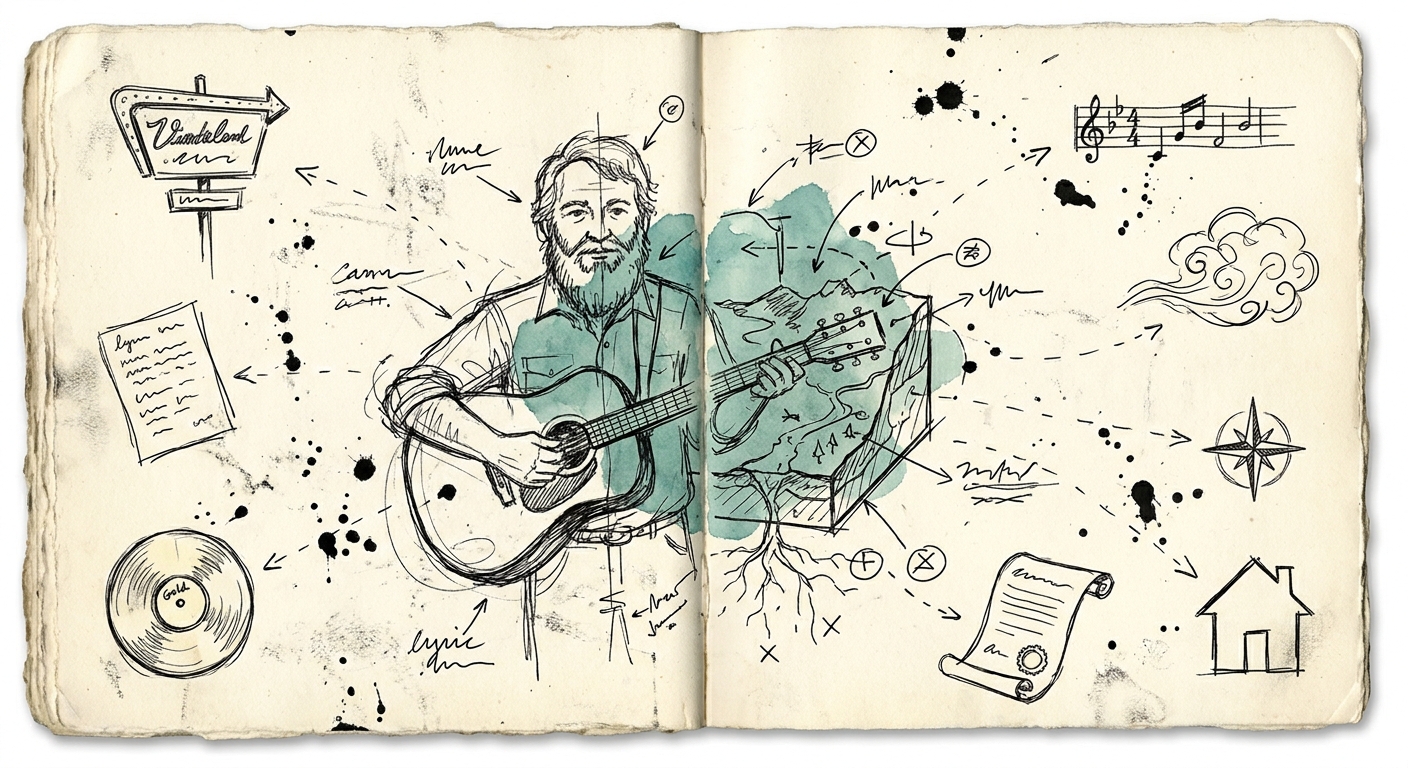
Take Me Home, Country Roads: A Musicological and Anthropological Analysis of a Global Anthem of Belonging
This article explores how John Denver's iconic song transcended its specific geographical origins to become a universal symbol of home and belonging across diverse cultures.
Listen to this article
23 min listen
"Take Me Home, Country Roads": A Musicological and Anthropological Analysis of a Global Anthem of Belonging
The phenomenon of a regional folk-pop song transcending its geographic origins to become a globally recognized anthem of belonging is a rare anomaly in modern music history. Released in the spring of 1971, John Denver’s "Take Me Home, Country Roads" has achieved precisely this exalted status. Despite being explicitly tethered to the topography of a single, frequently overlooked American state—West Virginia—the song has inexplicably embedded itself in the cultural consciousness of disparate societies worldwide. It is belted out by tens of thousands of German American football fans in Munich, forms the thematic and emotional core of a seminal Japanese animated film, has been seamlessly localized into Jamaican reggae, and is utilized as a unifying chant by international soccer managers and supporters.
The enduring resonance of a track about a specific United States geography among demographics that possess no literal connection to its borders presents a profound sociological and musicological paradox. The inquiry into why "Take Me Home, Country Roads" captures the emotion and imagination of the world requires an exhaustive examination of its genesis, the mindset of its creators, its structural and harmonic architecture, the psychological mechanisms of nostalgia it triggers, and its ultimate function as a modern cultural text. This report investigates the origins, commercial trajectory, musicological framework, and anthropological significance of the track, synthesizing perspectives from cultural anthropologists, musicologists, and notable figures to decode its universal appeal.
The Genesis and Topographical Abstraction
The creation of "Take Me Home, Country Roads" is a testament to the serendipitous nature of songwriting and the commercial abstraction required to construct a universally accessible pop anthem. The song was not born in the Appalachian Mountains, nor was it penned by native West Virginians. The track was primarily conceptualized by Bill Danoff and Taffy Nivert, a married folk duo performing under the name Fat City, alongside John Denver, who subsequently popularized the record and injected his own ideological worldview into its final form.
The Clopper Road Inspiration and Geographic Displacement
The foundational inspiration for the track materialized in the summer of 1970. Danoff and Nivert were driving along Clopper Road in Montgomery County, Maryland, en route to a family reunion in Gaithersburg. At the time, Clopper Road was a rural, winding, two-lane blacktop, far removed from the heavily trafficked interstate infrastructure it would later become. Nivert was navigating the vehicle while Danoff sat in the passenger seat, strumming a guitar and experimenting with lyrics intended originally for country music icon Johnny Cash.
Danoff, originally from Springfield, Massachusetts, was struck by a profound sense of nostalgia for his upbringing in western New England. The repetitive phrase "country roads" became an anchor for the melody, echoing his childhood memories of rural landscapes. The geographic displacement at the heart of the song's creation is striking and somewhat ironic: Danoff was driving in Maryland, reflecting on his youth in Massachusetts, yet ultimately centered the song on West Virginia. The choice of state was driven purely by phonetic and metrical utility rather than lived experience. Danoff later explained that he originally considered framing the lyrics around his home state of Massachusetts, but concluded that the word itself lacked the requisite musicality and rhythmic flow.
Searching for what he termed "songwriter words," Danoff landed upon the "Blue Ridge Mountains" and the "Shenandoah River"—features that technically possess a much stronger geographical association with the neighboring state of Virginia, only briefly intersecting with West Virginia’s Eastern Panhandle near Harpers Ferry. Neither Danoff nor Nivert had ever visited West Virginia at the time of the composition. Their knowledge of the state was partially sourced from encyclopedic research and interactions with West Virginians, including their friend, actor Chris Sarandon, and members of a colorful rural hippie commune who attended their shows. Danoff noted that these commune members brought their dogs and distinct subcultural energy to the performances, which is how the aesthetic of West Virginia began "creeping into the song".
The Midnight Session and Denver's Worldview
Danoff and Nivert had been developing the song for roughly a month, still intending to pitch the record to Johnny Cash, when the song's trajectory shifted decisively in late December 1970. Fat City was acting as the opening act for John Denver at the Cellar Door, a prominent nightclub in Washington, D.C.. Denver was actively seeking material for his upcoming fourth studio album, Poems, Prayers & Promises.
Following their performance, the artists agreed to convene for a late-night jam session at Danoff and Nivert’s Georgetown apartment. Denver's arrival was delayed by a car accident in which he fractured his thumb on the windshield, yet he proceeded directly from the George Washington University Hospital emergency room to the apartment, arriving in a highly energized state. When Danoff reluctantly played the incomplete "Country Roads" demo—fearing it was "too country" for Denver's commercial folk sensibilities—Denver was immediately captivated. Recognizing its potential as a massive hit, Denver demanded to record it, prompting Danoff and Nivert to abandon their plans to sell the track. The trio worked through the early hours of the morning, rewriting lyrics and finalizing the bridge to ensure the rhythmic cadence aligned perfectly before debuting it live the next night to a five-minute standing ovation.
What Denver was thinking when penning his contributions to the song can be understood through his broader worldview and autobiography. Raised in a conservative military family and experiencing the transient lifestyle of moving frequently, Denver was deeply preoccupied with the concept of home as a psychological anchor rather than a strict physical location. In his autobiography, Take Me Home, Denver wrote extensively about his search for belonging, stating, "Perhaps love is like a resting place, a shelter from the storm... and in those times of trouble when you are most alone, the memory of love will bring you home". This utopian, quintessentially American worldview heavily influenced his musical output. Denver was a fierce advocate for nature conservation, hunger relief, and global peace, and "Country Roads" aligned perfectly with his ideological desire to provide listeners with a comforting, naturalistic refuge from the anxieties of the modern world.
Commercial Sanitization: The Lost Verse
A critical, yet frequently overlooked aspect of the song's genesis involves the rigorous revision of its original second verse. To transform the track into an anthem capable of dominating conservative AM radio formats in 1971, substantial lyrical sanitization was required.
The original lyrics composed by Danoff were heavily influenced by his interactions with the aforementioned West Virginia commune and contained countercultural, surrealistic imagery. The initial verse read: “In the foothills, hidin' from the clouds / Pink and purple West Virginia farm house / Naked ladies, men who look like Christ / And a dog named Poncho nibbling on the rice”.
Recognizing that lines invoking nudity and religious comparisons would preclude mainstream broadcast, the writers discarded the verse. In its place, they constructed a highly romanticized, pastoral image that conformed tightly to what sociologists term the "Appalachian imaginary"—a constructed, idealized version of the region. The revised verse introduced iconic motifs of working-class struggle and rural tradition: “All my memories gather 'round her / Miner's lady, stranger to blue water / Dark and dusty, painted on the sky / Misty taste of moonshine, teardrop in my eye”.
This revision was a masterstroke of commercial songwriting. By excising the hyper-specific, subcultural elements, the songwriters created an emotional blank canvas, permitting the listener to project their own generalized nostalgia onto the text while maintaining an aura of regional authenticity.
Commercial Trajectory, Reception, and Historical Context
"Take Me Home, Country Roads" was recorded in January 1971 at RCA’s Studios A and B in New York City, with production handled by Milt Okun and Susan Ruskin. The track featured Denver on vocals and 6- and 12-string acoustic guitars, supported by Danoff and Nivert on backing vocals, Eric Weissberg on banjo and steel guitar, Mike Taylor on acoustic guitar, Richard Kniss on double bass, and Gary Chester on percussion.
The single was released on April 12, 1971, initially credited to "John Denver with Fat City". Despite the enthusiasm of its creators, the record was not a hit right off the bat and faced immediate institutional friction. RCA executives initially dismissed the track as "too folky" and temporarily pulled it from circulation, citing a pressing glitch. It was Denver’s steadfast belief in the song and his relentless lobbying of management, facilitated by his manager Jerry Weintraub, that secured a re-release and a renewed promotional push.
The track broke nationally in mid-April but ascended the charts at a highly methodical, slow pace. This slow climb is indicative of grassroots adoption, as the song resonated deeply with American listeners seeking psychological refuge. Set against the tumultuous socio-political backdrop of 1971, defined by the Vietnam War and widespread domestic unrest, the song’s themes of rural simplicity and the desire to return to a safe, familiar haven struck a profound chord. Danoff later reflected that the song proved incredibly popular with soldiers deployed overseas, as the concept of "coming home was a big, big deal" for the hundreds of thousands of troops stationed in Southeast Asia.
By August 28, 1971, the song peaked at number two on the U.S. Billboard Hot 100, held back from the top spot only by the Bee Gees' "How Can You Mend a Broken Heart". It received a Gold certification from the RIAA on August 18, 1971, for shipping one million copies, establishing Denver as an elite pop-folk artist.
| Release Milestone | Date | Achievement / Contextual Detail |
|---|---|---|
| Composition | Late Dec 1970 | Completed overnight in a Georgetown apartment in Washington, D.C. |
| Studio Recording | January 1971 | RCA Studios A and B, New York City |
| Single Release | April 12, 1971 | Released as the A-Side to Poems, Prayers and Promises |
| RIAA Certification | August 18, 1971 | Certified Gold for 1 Million copies shipped |
| Chart Peak | August 28, 1971 | Reached #2 on US Billboard Hot 100 |
| Grammy Hall of Fame | 1998 | Posthumous induction of Denver's recording recognizing its historical significance |
| National Recording Registry | 2023 | Selected by the Library of Congress for permanent preservation |
Musicological Framework: The Architecture of Nostalgia
To understand how a song about a specific U.S. state captures the emotion of anyone who has traveled miles from where they grew up, musicologists analyze its foundational architecture. The song's ability to trigger profound emotional responses across diverse linguistic and cultural barriers relies heavily on its harmonic structure, melodic contour, and strategic use of musical tension.
Harmonic Structure and Diatonic Accessibility
The original recording is performed in the key of A Major at a moderate tempo of 86 beats per minute. The track relies predominantly on a collection of diatonic chords—A (I), F#m (vi), E (V), and D (IV)—which are foundational to Western popular and folk music. The simplicity of these chord changes makes the song highly accessible, lending itself perfectly to communal acoustic performances.
The verse utilizes a standard progression: I - vi - V - IV - I (A - F#m - E - D - A). This cyclical progression creates a sense of steady, rolling forward momentum, directly mimicking the lyrical imagery of continuous motion and "driving down the road". The chorus relies on an incredibly common structural pivot: I - V - vi - IV (A - E - F#m - D) followed by a stabilizing I - V - IV - I (A - E - D - A). The use of the I-V-vi-IV progression is ubiquitous in modern pop music because it provides an optimized balance of tension and resolution, ensuring the chorus acts as an inevitable, satisfying emotional release.
The melody of the chorus is uniquely designed for mass participation. It remains highly diatonic and relies on step-wise motion and gentle leaps that fall comfortably within the vocal range of the average untrained singer. The chorus begins on the downbeat with a strong, declarative statement ("Country roads, take me home"), lacking complex syncopation, which allows large groups of people to synchronize effortlessly.
The Bridge and Modal Mixture
From a strict music theory perspective, the most emotionally arresting moment of the composition occurs during the bridge, a section that Denver actively helped construct. As the lyrics shift to a highly personal, yearning tone—“I hear her voice in the mornin' hour she calls me / The radio reminds me of my home far away / And drivin' down the road I get a feelin' that I should have been home yesterday, yesterday”—the harmonic structure introduces a critical deviation.
The progression transitions through F#m (vi) and E (V) before abruptly introducing a G Major chord. In the key of A Major, the G chord functions as the flat-seven (bVII). This technique, known as modal mixture, borrows a chord from the parallel Mixolydian mode. The introduction of the bVII chord forcefully disrupts the diatonic safety established in the verses, injecting a poignant, bittersweet tension. The G chord sits perfectly beneath the lyric "I get a feelin'," marrying harmonic instability with psychological yearning. This tension resolves elegantly back into the dominant E Major (V) on the word "yesterday," pulling the listener inevitably back into the triumphant, unifying chorus.
The fragility and importance of this exact harmonic structure are occasionally highlighted by musicologists when the song is covered or altered. For instance, analyst Charles Cornell publicly critiqued a cover version utilized in a Rocket Mortgage commercial, noting that the cover inappropriately modulated the chorus to D Major (IV) while attempting to maintain the original melody. Cornell and other theorists observed that forcing a key change into the chorus—progressing to D - A - Bm rather than maintaining the A Major tonic—completely mangled the emotional rise of the melody, creating a jarring, unmusical deviation. This academic debate underscores how deeply ingrained the original I-V-vi-IV structure is in the public consciousness; the song's emotional efficacy is strictly bound to its original harmonic design.
| Section | Chord Progression (Key of A Major) | Musicological Function |
|---|---|---|
| Verse | A - F#m - E - D - A (I - vi - V - IV - I) | Establishes diatonic safety; mimics steady forward momentum. |
| Chorus | A - E - F#m - D (I - V - vi - IV) | Provides massive emotional release; easily sung by crowds. |
| Bridge | F#m - E - A - D - A - E - F#m - G - D - A - E | Introduces modal mixture (G Major / bVII) to create bittersweet tension reflecting homesickness. |
Cultural Anthropology: Hiraeth and the Imagined Landscape
If the musicological structure provides the sonic vehicle for the song, the lyrics provide the emotional payload. However, the true anthropological intrigue of "Country Roads" lies in its ability to evoke profound homesickness in listeners who have no experiential tie to West Virginia. To understand this, cultural anthropologists and academics look beyond standard nostalgia to a more nuanced concept of human belonging.
The Welsh Concept of Hiraeth
In her 2025 monograph, Lessons from "Take Me Home, Country Roads": Identity, (Be)Longing, and Imagined Landscapes, Dr. Sarah L. Morris, an assistant professor at West Virginia University, utilizes the Welsh concept of hiraeth as the governing framework to analyze the song's global impact.
Hiraeth (pronounced here-eyeth) is an untranslatable Welsh term describing a deep, existential longing for an idealized, romanticized, or entirely imaginary home. It encompasses a bittersweet wistfulness for a time, era, or place that may have never existed in reality, or is irrevocably lost to history. Morris argues that "Take Me Home, Country Roads" taps directly into hiraeth; it obscures the literality of the specific place it names, transforming "West Virginia" from a cartographic reality into a highly flexible, imaginary landscape. The song invites a universal sense of belonging, allowing listeners to superimpose their own idealized homeland onto the lyrics.
The "Region of the Mind" and the Appalachian Imaginary
The song's cultural function is further illuminated by the work of sociologist Richard Peterson, who coined the concept of Appalachia as a "region of the mind". Peterson posits that cultural texts regarding this geography rely on fabricated, recycled imaginaries rather than objective reality. Similarly, scholars Jimmie N. Rogers and Stephen A. Smith categorize country music as a "principal cultural text" that fundamentally shapes public views of place through romanticization.
"Country Roads" relies heavily on pastoral tropes identified by historian Brian Hinton, including the portrayal of natural landscapes as possessing ancient wisdom ("older than the trees") and the theme of a restorative journey away from modernity. The West Virginia depicted in the song—majestic, peaceful, and maternal ("mountain mama")—serves as a psychological sanctuary, completely divorced from the complex realities of resource extraction and economic hardship that define the actual region. Thus, when a listener in another country sings the chorus, they are not expressing a desire to visit the geopolitical entity of West Virginia; they are projecting their own desire for a restorative return to innocence, nature, and communal belonging.
Global Transmutations: From West Virginia to the World
The ultimate proof of the song's reliance on hiraeth rather than geographic loyalty is its staggering adoption across international cultures. The anthem has been recontextualized by disparate communities to serve highly specific sociological and emotional needs.
Studio Ghibli and the Japanese Anime Phenomenon
In Japan, "Take Me Home, Country Roads" achieved monumental cultural significance due to its central thematic role in the 1995 Studio Ghibli film Whisper of the Heart (Japanese title: Mimi wo Sumaseba), directed by Yoshifumi Kondo and written by legendary animator Hayao Miyazaki. The film is a coming-of-age narrative centered on Shizuku Tsukishima, a junior high school student grappling with her creative ambitions, impending adulthood, and her search for identity.
In the narrative, Shizuku translates Denver's song into Japanese for her school’s chorus club (the real-life translation was executed by Mamiko Suzuki, daughter of producer Toshio Suzuki, with supplemental lyrics by Miyazaki, and performed by voice actress Yoko Honna). As she struggles with the literal translation, Shizuku pens a cynical, parody version titled "Concrete Road," which mocks the hyper-urbanization of her hometown in western Tokyo, lamenting the "chopped down forests" and paved-over valleys.
In this context, the song operates as a profound meditation on environmentalism and modernization. Miyazaki and Kondo use "Country Roads" to highlight the tension between humanity's spiritual reliance on nature and its destructive exploitation of it. The song also acts as a narrative engine for Shizuku's identity formation; the struggle to find the "right words" mirrors her struggle to tear herself from the protected bubble of childhood and discover her authentic voice. The film's climax, featuring an impromptu acoustic performance of the song alongside her romantic interest, Seiji Amasawa, cements the track in Japanese popular culture as an anthem of creative perseverance and the search for one's path.
The European Stadium Anthem: NFL Germany and Oktoberfest
In Europe, particularly in Germany, the song has evolved into a massive communal drinking and stadium anthem. The track’s straightforward diatonic chord structure and soaring, unsyncopated chorus make it highly conducive to the mass vocalization associated with Oktoberfest and other festivals.
This phenomenon gained international attention during the NFL's inaugural regular-season game in Germany on November 13, 2022, played at the Allianz Arena in Munich between the Tampa Bay Buccaneers and the Seattle Seahawks. During the closing moments of the game, the stadium’s 70,000 predominantly German fans spontaneously erupted into a massive, a cappella rendition of "Take Me Home, Country Roads," illuminating the arena with cell phone lights.
The visual and auditory impact of foreign nationals passionately belting out an American folk song deeply moved the athletes present. Legendary quarterback Tom Brady remarked in the post-game press conference that hearing the crowd sing the track was "pretty epic" and constituted "one of the great football experiences I've ever had. It says a lot for 23 years in the league... I think the fan turnout was incredible". Seattle Seahawks head coach Pete Carroll, absorbing the environment, noted the emotional weight of the game, stating, "This feels like a real opportunity missed" following their loss. Cultural commentators noted that the singalong represented an incredible cross-cultural exchange, proving that the song’s themes of unity and celebration perfectly aligned with the Bavarian tradition of communal sports revelry. The tradition has since become a fixture at subsequent NFL Germany games in Frankfurt and Berlin.
Global Soccer and Post-Colonial Localization
The track's unparalleled adaptability is further evidenced by its integration into global soccer culture and diverse musical genres. Fans of the United States Men’s National Team (USMNT) routinely serenade their squad with the song, creating what journalists describe as "immaculate vibes". Following a victory in Seattle, USMNT players remained on the pitch to sing along with the crowd, an act that distilled a complex American worldview into a unifying promise of belonging. This inclusive, joyful singing stands in stark contrast to the polarizing, militaristic nationalism sometimes seen in international sports, fostering an environment where even foreign-born managers, such as Mauricio Pochettino, are moved to join in the chorus.
Musically, the song's conceptual flexibility allowed it to be entirely localized without losing its emotional resonance. In Jamaica, the legendary reggae ensemble Toots and the Maytals recorded a highly successful cover, altering the lyrics to "Almost heaven, West Jamaica". By mapping the song's themes of rural nostalgia onto the Jamaican landscape, the Maytals demonstrated that the narrative of returning to a simpler, maternal homeland (hiraeth) is a universal psychological construct not bound by the coordinates of the Appalachian Mountains.
| Cultural Context | Notable Figure(s) / Origin | Adaptation / Utilization | Core Thematic Function |
|---|---|---|---|
| Japanese Anime | Hayao Miyazaki, Yoshifumi Kondo, Yoko Honna | Whisper of the Heart ("Concrete Road") | Identity formation, environmentalism, navigating urbanization |
| NFL Germany | Tom Brady, Pete Carroll | 70,000-fan a cappella stadium singalongs at Allianz Arena | Communal effervescence, cross-cultural sporting celebration |
| Jamaican Reggae | Toots and the Maytals | Localized cover ("West Jamaica") | Post-colonial localization, rural island nostalgia |
| Global Soccer | Mauricio Pochettino, USMNT fans | Unofficial supporter anthem and post-match tradition | National unity, non-militaristic patriotism, inclusive belonging |
| Modern Pop/Country | Machine Gun Kelly, Jelly Roll, Brad Paisley | Interpolated in "Lonely Road" (2024); pre-game performances | Bridging generational divides, returning Denver to Billboard Top 40 |
West Virginian Reclamation and Institutionalization
While the song's global resonance is built upon its conceptual detachment from reality, its impact on the actual state of West Virginia has been deeply transformative. Despite the geographical inaccuracies—the Shenandoah River and Blue Ridge Mountains being predominantly located in Virginia—the state enthusiastically claimed the song, utilizing it as a foundational pillar of its modern socio-political identity.
The institutionalization of the track began on September 6, 1980, when then-Governor Jay Rockefeller invited Denver, Danoff, and Nivert to perform at the dedication of the newly constructed Mountaineer Field at West Virginia University (WVU). Rockefeller, a prominent politician who financed Citizens to Abolish Strip Mining (CASM) and actively campaigned against the environmental destruction caused by the coal industry, saw the value in the song's pastoral, pristine depiction of the state. Denver's pre-game acoustic performance was met with overwhelming enthusiasm, with the sold-out crowd drowning out his vocals as they sang along. This event solidified a tradition that continues decades later; the song is performed by the WVU marching band during every pregame show, and it is played over the stadium speakers after every home victory, encouraging fans and players to remain in the stands in a display of collective pride.
In March 2014, recognizing its unmatched role in defining the state's external perception, the West Virginia Legislature passed a resolution officially adopting "Take Me Home, Country Roads" as one of the state's four official anthems. Furthermore, the West Virginia Tourism Office obtained the rights to the song in 2017, integrating the opening phrase "Almost Heaven" as the cornerstone of its global marketing campaigns to attract visitors. The irony of utilizing a song written by a Massachusetts native in Maryland to market West Virginia underscores the power of cultural texts to supersede geographic authenticity. The song effectively rehabilitated the state's image, offering a powerful, globally recognized alternative to negative stereotypes regarding extraction industries and poverty by presenting the region as an ancient, timeless paradise.
Conclusion
"Take Me Home, Country Roads" is a masterclass in the creation of universal folklore through the mechanics of commercial pop-folk. The evidence dictates that its genesis was a fortuitous collision of geographic abstraction, melodic craftsmanship, and necessary lyrical sanitation. By stripping away hyper-specific, polarizing countercultural lyrics regarding "naked ladies" and "men who look like Christ," Bill Danoff, Taffy Nivert, and John Denver constructed an immaculate emotional vessel. Furthermore, Denver’s own utopian worldview regarding the healing nature of home and memory infused the track with an enduring sincerity.
Musicologically, the track succeeds by marrying diatonic accessibility with brilliant moments of harmonic tension, specifically the modal mixture found in the bridge, which perfectly mirrors the psychological ache of nostalgia. Anthropologically, the song's success cannot be attributed to the physical state of West Virginia. Rather, it thrives as the ultimate articulation of hiraeth—the universal, existential yearning for a place of safety, belonging, and maternal comfort that may only exist in the mind of the listener.
Whether serving as a mechanism for adolescent self-discovery in Japanese animation, a unifying chant for 70,000 German sports fans leaving Tom Brady in awe, a localization of Jamaican pride, or the foundational mythos of an American state championed by Jay Rockefeller, the track demonstrates how a specific set of musical and lyrical signifiers can transcend borders. It proves that the most powerful "country road" is not a physical highway in Appalachia or Maryland, but the psychological pathway leading back to the idealized concept of home.
Works cited
1. Take Me Home, Country Roads - Wikipedia, https://en.wikipedia.org/wiki/Take\_Me\_Home,\_Country\_Roads 2. "Take Me Home, Country Roads" | The NFL Germany Anthem | Fans singalong born in Munich 2022 - YouTube, https://www.youtube.com/watch?v=-UTq\_qUh2hA 3. Whisper of the Heart - Wikipedia, https://en.wikipedia.org/wiki/Whisper\_of\_the\_Heart 4. WHISPER OF THE HEART — Hayao Miyazaki takes “Country Roads” - MUBI Podcast, https://mubi.buzzsprout.com/1788738/episodes/19022257-whisper-of-the-heart-hayao-miyazaki-takes-country-roads 5. George Russell Sextet (with Sheila Jordan): You Are My Sunshine - Song of the Day - nyfos, https://nyfos.org/george-russell-sextet-sheila-jordan-sunshine/ 6. Toots and the Maytals - Country Roads [Karaoke] - YouTube, https://www.youtube.com/watch?v=s0nOlXtClww 7. How 'Country Roads' became the soundtrack of the US team's World, https://www.12newsnow.com/article/sports/soccer/world-cup/john-denver-country-roads-usmnt-world-cup/507-82ab77b2-2392-416d-a527-ab988e423fd5 8. Take me home: why Country Roads has struck a chord at the World Cup - The Guardian, https://www.theguardian.com/football/2026/jun/20/take-me-home-country-roads-world-cup-usmnt 9. Take Me Home, Country Roads - Grokipedia, https://grokipedia.com/page/Take\_Me\_Home,\_Country\_Roads 10. Maryland was Almost "Almost Heaven" : The Story Behind "Take Me Home, Country Roads" - Neighborhood Guide, https://neighborhoods.wetaguides.org/neighborhood/maryland/maryland-was-almost-almost-heaven-story-behind-take-me-home-country-roads 11. John Denver's 'Country Roads' Has Local Roots - Montgomery Magazine, https://www.montgomerymag.com/john-denvers-country-roads-has-local-roots/ 12. OTD in 1970, John Denver, Bill Danoff and Taffy Nivert performed the song "Take Me Home, Country Roads" live for the first time at The Cellar Door on M St. in Georgetown. But despite the lyrics, the song was originally inspired not by West Virginia, but Montgomery County, Maryland. - Reddit, https://www.reddit.com/r/maryland/comments/1pzniqy/otd\_in\_1970\_john\_denver\_bill\_danoff\_and\_taffy/ 13. The Original Second Verse Of “Take Me Home, Country Roads” Had To Be Rewritten Because It Was Too Racy For Radio, https://www.whiskeyriff.com/2024/06/24/the-original-second-verse-of-take-me-home-country-roads-had-to-be-rewritten-because-it-was-too-racy-for-radio/ 14. TIL none of the writers of "Take Me Home, Country Roads" had been to West Virginia, and they used an encyclopedia to look up facts about it. The song was mainly inspired by one writer's upbringing in Springfield, MA, but he didn't think the word "Massachusetts" was musical. : r/ - Reddit, https://www.reddit.com/r/todayilearned/comments/1gbzvm5/til\_none\_of\_the\_writers\_of\_take\_me\_home\_country/ 15. THE PLACE IT BELONGS by West Virginia University - WVU Stories, https://stories.wvu.edu/country-roads 16. Take Me Home, Country Roads - WLG - WVU Extension - West Virginia University, https://extension.wvu.edu/files/d/b05ad800-b462-474f-9abf-6b4b207d0fae/wlg-630-take-me-home-digital.pdf 17. Almost Heaven: The Story Behind "Take Me Home, Country Roads" by John Denver, https://americansongwriter.com/almost-heaven-the-story-behind-take-me-home-country-roads-by-john-denver/ 18. Take Me Home, Country Roads — Eber Leadership Group, https://www.kareneber.com/blog/country-roads 19. Take Me Home: An Autobiography by John Denver | Goodreads, https://www.goodreads.com/book/show/1181766.Take\_Me\_Home 20. Quotes by John Denver (Author of Take Me Home) - Goodreads, https://www.goodreads.com/author/quotes/45828.John\_Denver 21. The Original Verse in “Take Me Home, Country Roads” That Was Deemed Too Risqué for Radio Play - American Songwriter, https://americansongwriter.com/the-original-verse-in-take-me-home-country-roads-that-was-deemed-too-risque-for-radio-play/ 22. The Original Second Verse Of “Take Me Home, Country Roads” Was Too Racy For Radio So It Had To Be Rewritten, https://www.whiskeyriff.com/2025/06/26/the-original-second-verse-of-take-me-home-country-roads-was-too-racy-for-radio-so-it-had-to-be-rewritten/ 23. Myth and Place in "Take Me Home, Country Roads" - Project MUSE, https://muse.jhu.edu/article/979733/pdf 24. Bill and Taffy Danoff -Take Me Home Country Roads 1971 Live Performance - YouTube, https://www.youtube.com/watch?v=S6nRw8zKoYI 25. Take Me Home, Country Roads Tutorial(Chords+Melody) | John Denver | Keyboard, https://www.youtube.com/watch?v=Efwpsn92a8s 26. Am I the only one who doesn't hear this supposed key change? : r/musictheory - Reddit, https://www.reddit.com/r/musictheory/comments/1lwf1zh/am\_i\_the\_only\_one\_who\_doesnt\_hear\_this\_supposed/ 27. John Denver – “Country Roads” Chords & Guitar Lesson, https://www.jonmaclennan.com/blog/country-roads-chords 28. Take Me Home, Country Roads by John Denver • Ukulele Chords, https://ukebuddy.com/ukulele-tabs/john-denver/take-me-home-country-roads 29. Guitar Songs To Learn – Take Me Home Country Roads, https://tomasmichaud.com/take-me-home-country-roads/ 30. John Denver – "Country Roads" Begleitakkorde (Tonart: A-Dur) Vers - OpenMusicSchool.de, https://www.openmusicschool.de/wp-content/uploads/2019/04/John-Denver-Country-Roads.pdf 31. JOHN DENVER – TAKE ME HOME, COUNTRY ROADS - Rock Out School, https://www.rockoutschool.com/assets/ugc/docs/country\_roads\_chords.pdf 32. Chord progressions in major keys — Jeffrey Pepper Rodgers | Words and music, https://www.jeffreypepperrodgers.com/blog/songwriting-lesson-chord-progressions-in-major-keys 33. Country Roads Guitar Lesson - Chords and Melody (John Denver) - YouTube, https://www.youtube.com/watch?v=uTvuoTNfqmU 34. The Unlikely Story of John Denver - Woodpecker, https://harveyreid.com/blogs/john\_denver\_saga.html 35. Country Roads John Denver A f#m Almost heaven, West Virginia, E |D - Mark Teaches Music, https://www.dallasmusiclessons.com/documents/chord-chart/country/country-Country-Roads-John-Denver.pdf 36. Chord Progressions | PDF - Scribd, https://www.scribd.com/doc/220233050/Chord-Progressions 37. MTO 17.3: Summach, The Structure, Function, and Genesis of the Prechorus, https://mtosmt.org/issues/mto.11.17.3/mto.11.17.3.summach.html 38. Sommer Singen, https://www.ostercappeln.de/static/medien/km/termine/900001110\_31400\_download\_2025\_06\_21\_liedertexte\_songbook\_sommersingen\_kronensee.pdf 39. Lessons from "Take Me Home, Country Roads" | West Virginia University Press, https://wvupressonline.com/Country-Roads 40. Lessons from "Take Me Home, Country Roads": Identity, (Be)Longing, and Imagined Landscapes - Volume Bookshop, https://volumebookshop.com/products/lessons-from-take-me-home-country-roads-identity-belonging-and-imagined-landscapes 41. Lessons from "Take Me Home, Country Roads": Identity, (Be)Longing, and Imagined Landscapes (9781959000549): Sarah L. Morris - BiblioVault, https://www.bibliovault.org/BV.book.epl?ISBN=9781959000549 42. I feel like a lot of us can relate to this : r/CPTSD - Reddit, https://www.reddit.com/r/CPTSD/comments/ce1yet/i\_feel\_like\_a\_lot\_of\_us\_can\_relate\_to\_this/ 43. Hiraeth and Now - Folkways Nowadays, https://folkwaysnowadays.com/hiraeth-and-now/ 44. Songs that make you feel nostalgic for something unfamiliar : r/MusicRecommendations, https://www.reddit.com/r/MusicRecommendations/comments/1ct7lq9/songs\_that\_make\_you\_feel\_nostalgic\_for\_something/ 45. Almost Heaven Transcript - Today, Explained - Musixmatch Podcasts, https://podcasts.musixmatch.com/podcast/today-explained-01hjz7abr0s9jvzptbvqrevwxr/episode/almost-heaven-01jg4qtrw0pr9k3ttgxbrhjag1 46. Why “Country Roads” feels like home Transcript - Today, Explained, https://podcasts.musixmatch.com/podcast/today-explained-01hjz7abr0s9jvzptbvqrevwxr/episode/why-country-roads-feels-like-home-01j1x06k4r868pc4b5c6ac6z6d 47. Country Roads Went Viral at the FIFA World Cup - Here's Why Soccer Fans are Obsessed!, https://www.youtube.com/watch?v=1-vSER43-GY 48. Whisper of the Heart | Ghibli Wiki - Fandom, https://ghibli.fandom.com/wiki/Whisper\_of\_the\_Heart 49. Whisper of the Heart Staff Review - The Anime Corner Store, https://www.animecornerstore.com/whhe1.html 50. Reflections on Anime & Appalachia - expatalachians, http://expatalachians.com/reflections-on-anime-appalachia 51. What Studio Ghibli Teaches Us About the Environment - Red Oak Rain Garden, https://redoakraingarden.org/ghibli-blogs/ 52. Whisper of the Heart(1995): Full Synopsis, Analysis, Ending Explained & Character Map (Spoilers) - SifrInsight, https://en.sifrinsight.com/whisper-of-the-heart-story-analysis/ 53. Whisper of the Heart is a Tender Journey of Introspection and Conquering the Fear of Failure - Derek Ex Machina, https://www.derekexmachina.com/blog/2024/9/06/whisper-of-the-heart-is-a-tender-journey-of-introspection-and-conquering-the-fear-of-failure 54. 5 Reasons I Don't Like 'Boyhood' But Do Like 'Whisper of The Heart' - Axia ASD, https://axia-asd.co.uk/5-reasons-i-dont-like-boyhood-but-do-like-whisper-of-the-heart/ 55. Miyazaki's Creative Reflections in Film | PDF | Anime - Scribd, https://www.scribd.com/document/714494728/Seeing-With-Eyes-Unclouded-Representations-of-Creativity-in-The 56. Very cool ending to the NFL game, Germany! - Reddit, https://www.reddit.com/r/germany/comments/yu7ycu/very\_cool\_ending\_to\_the\_nfl\_game\_germany/ 57. Why John Denver was the real MVP of the NFL's Germany game - Yardbarker, https://www.yardbarker.com/nfl/articles/why\_john\_denver\_was\_the\_real\_mvp\_of\_the\_nfls\_germany\_game/s1\_13132\_38120455 58. Tom Brady NFL Munich 2022 | Tampa Bay Buccaneers players enjoy crowd with "Sweet Caroline" - YouTube, https://www.youtube.com/watch?v=d-Zt-2UbWsA 59. 72,000 NFL fans singing "Take Me Home, Country Roads"| Berlin Game 2025 | Falcons vs. Colts - YouTube, https://www.youtube.com/watch?v=Mz-ueimgWjo 60. 70,000 NFL fans singing "Take Me Home, Country Roads" | Seahawks vs. Buccaneers | Munich Game 2022 - YouTube, https://www.youtube.com/watch?v=lDFXyIrCmr0 61. Tom Brady leads Buccaneers to victory in Munich: 'One of the great football experiences I've ever had' - NFL.com, https://www.nfl.com/news/tom-brady-leads-buccaneers-to-victory-in-munich-one-of-the-great-football-experi 62. Tom Brady, Buccaneers sink Seahawks 21-16 in Munich | FOX 13 Seattle, https://www.fox13seattle.com/sports/tom-brady-buccaneers-sink-seahawks-21-16-in-munich 63. NFL Munich crowd parties to American classics with 'Country Roads', 'Sweet Caroline' a capella (Video) - FanSided, https://fansided.com/2022/11/13/nfl-munich-crowd-parties-american-music/ 64. "Take Me Home, Country Roads" is becoming the US Soccer's version of "You'll Never Walk Alone" - Reddit, https://www.reddit.com/r/ussoccer/comments/1uc6rzq/take\_me\_home\_country\_roads\_is\_becoming\_the\_us/ 65. Karaoke Take Me Home Country Roads - Video with Lyrics - Toots, https://www.karafun.com/karaoke/toots-and-the-maytals/take-me-home-country-roads/ 66. West Virginia State Anthem - Heritage Real Estate Co., https://www.wvheritagerealestate.com/blog/2020/06/17/take-me-home-happy-birthday-west-virginia-2 67. Milan Puskar Stadium Turns 40 in September - West Virginia University Athletics, https://wvusports.com/news/2020/7/10/football-milan-puskar-stadium-turns-40-in-september 68. The News From Sam's Branch: 50 years of political, social and environmental commentary and analysis by Julian Weldon Martin, https://julianweldonmartin.us/ 69. WVU at 150 | WVU Magazine Past Editions | West Virginia University, https://magazine-archive.wvu.edu/stories/2017/08/08/wvu-at-150