The Crown of Clay and Plastic: The Transnational Evolution of Glasgow’s Statue-Coning Tradition
This article explores how Glasgow's unique tradition of putting traffic cones on public statues, particularly the Duke of Wellington, transformed from local mischief into a global symbol of civic identity and anti-authoritarian humor.
Listen to this article
12 min listen
The Crown of Clay and Plastic: The Transnational Evolution of Glasgow’s Statue-Coning Tradition
Public monuments are traditionally erected to project state power, historical triumph, and civic virtue. They represent a physical freezing of history, capturing figures of imperial, military, or political dominance in enduring materials like bronze and marble. However, the meaning of public space is not dictated solely by municipal authorities; it is constantly negotiated, reclaimed, and redefined by the communities that inhabit those spaces.
The Scottish custom of placing traffic cones on public statues—most famously exemplified by the equestrian statue of the Duke of Wellington in Glasgow—presents a compelling study in the democratization of public art. What began as an ephemeral, late-night act of drunken mischief in the late twentieth century has evolved into an internationally recognized symbol of civic identity, working-class humor, and anti-authoritarian defiance. When the traveling supporters of the Scotland national football team, known as the Tartan Army, draped Boston's historic statues in orange traffic cones during the 2026 FIFA World Cup, they were not engaging in random vandalism. Rather, they were exporting a highly codified, decades-old ritual of urban subversion that challenges the solemnity of institutional memory and reshapes how cities interact with their historical narratives.
The Genesis of the Be-Coned Duke: Deciphering the Origin Myths
To understand the global projection of this tradition, one must trace its roots to its epicenter: Royal Exchange Square in Glasgow. Standing outside the neoclassical building that now houses the Gallery of Modern Art (GoMA) is the bronze equestrian statue of Arthur Wellesley, the 1st Duke of Wellington. Sculpted by the Italian-born French artist Carlo Marochetti and completed in 1844, the monument commemorates the British military leader who defeated Napoleon at the Battle of Waterloo in 1815. Funded by public subscription, the statue depicts the Duke sitting atop his favorite charger, Copenhagen, wearing the uniform of a Field Marshal. For more than a century, the monument stood as a conventional, dignified tribute to imperial victory and aristocratic authority.
The transformation of the statue occurred in the mid-to-late 1980s. While the dominant narrative attributes the first "coning" to this decade, several competing oral histories and localized myths exist regarding the precise origin of the practice:
- The Late-1960s Teenage Prank: Some local accounts suggest that the very first cone was placed on the Duke's head in the late 1960s by a drunken teenager who scaled the plinth simply to provoke a laugh among friends.
- The Mid-1970s Student Charity Day: Another prominent oral history asserts that the tradition began following a student charity day in the mid-1970s. University students in Glasgow had a long-standing history of staging elaborate public stunts to raise funds, and the fusty military monument provided an ideal target for harmless subversion.
- The Dennistoun Parking Dispute Myth: A highly localized, alternative oral tradition claims the cone's original purpose was entirely utilitarian. According to this narrative, the cone was stolen from Alexandra Parade in the Dennistoun neighborhood, where it had been used to illegally reserve a parking space, and was mounted on the statue to commemorate a successful night out at a local establishment known as "Bennys".
Despite these alternative theories, the consensus among historians and urban sociologists is that the practice solidified into a persistent, continuous cultural ritual during the 1980s. Sometime during this decade, unidentified late-night revelers scaled the 21-foot monument and placed an orange-and-white plastic traffic cone atop the Duke's head. The height of the monument required considerable physical effort and coordination to scale, turning the act of coning into a display of physical bravado. Although Glasgow City Council workers promptly removed the unauthorized accessory, a new cone would inevitably reappear within days, if not hours. This established a classic "cat-and-mouse" dynamic between the public and municipal authorities that persisted for nearly thirty years.
Socio-Political Meaning and Functional Evolution: More Than a Sporting Ritual
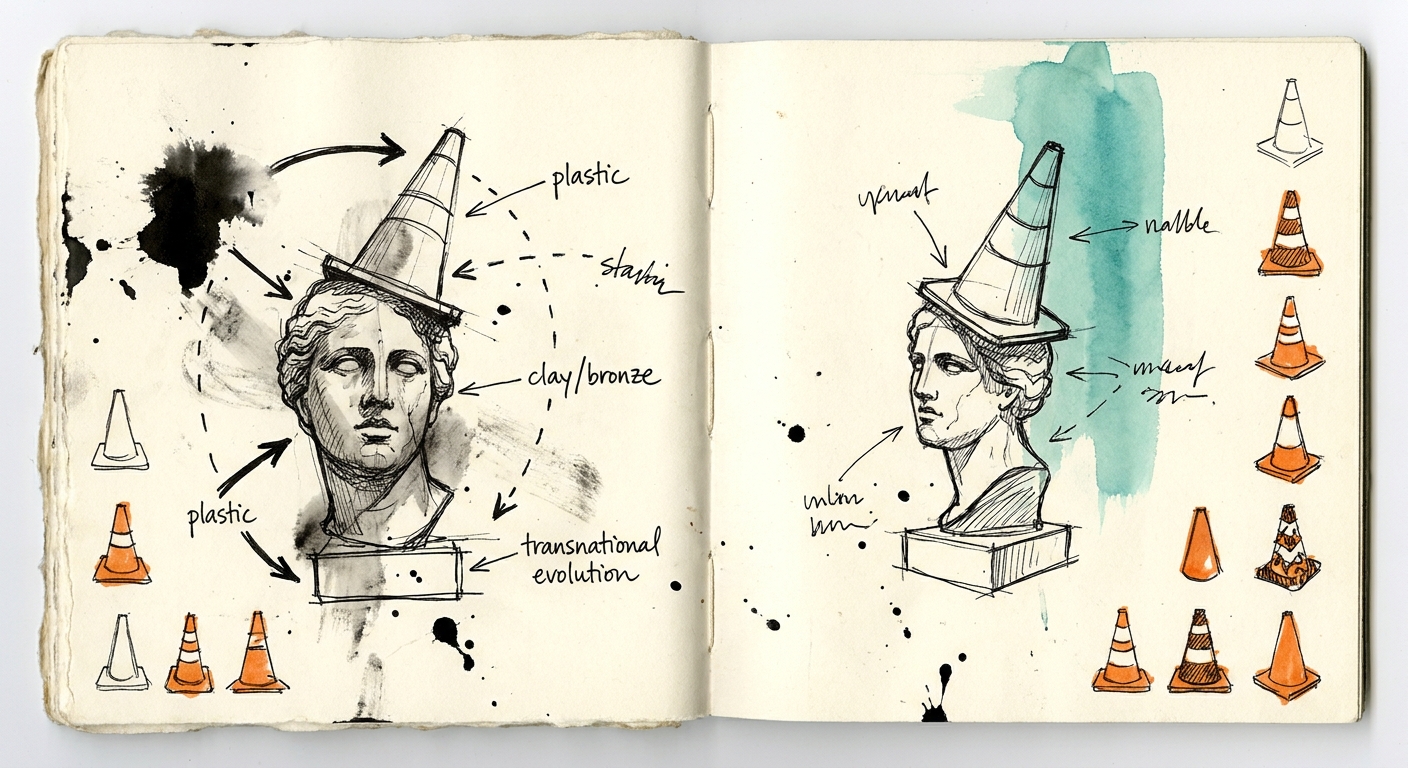
At its core, the coning of the Duke of Wellington is an act of Bakhtinian carnivalesque—a sociological concept wherein the established rules, hierarchies, and serious tones of everyday life are inverted through absurdity, humor, and play. The Duke of Wellington represents the peak of British imperial dominance, military hierarchy, and aristocratic privilege. Placing a cheap, mass-produced, utilitarian object of modern road safety—the traffic cone—upon his head serves to "prick the pomposity" of this grand historic figure. It is a visual equalizer, transforming a symbol of imperial statehood into a comical, approachable figure of fun.
This practice is deeply tied to the specific socio-economic history of Glasgow. As an industrial city that experienced severe deindustrialization and class struggle during the mid-to-late twentieth century, Glasgow developed a distinct cultural identity characterized by self-deprecating wit, skepticism of authority, and working-class solidarity. The cone became a physical manifestation of this identity—a refusal to take the state, historical elites, or even oneself too seriously.
Crucially, the act of coning is not destructive. Pranksters did not seek to tear down, deface, or permanently damage the monument. Instead, they chose to accessorize it. This "victimless vandalism" allowed the public to engage with the statue, reclaiming it from the distant realm of institutional history and integrating it into the living, breathing fabric of contemporary urban life.
Contrary to popular belief among outside observers, the tradition is not rooted in sports. While international football fans have recently popularized the image abroad, the coning of statues in Scotland began as a product of nightlife, student culture, and civic play. Over forty years, its functional meaning has expanded far beyond simple drunken tomfoolery, evolving into a highly dynamic canvas for political commentary, national celebration, and international solidarity.
| Year | Event/Occasion | Cone Modification/Aesthetic | Cultural/Political Context |
|---|---|---|---|
| 2002 | UEFA Champions League Final | Football-patterned hat bearing the Amstel logo | Celebration of hosting elite European sport in Glasgow. |
| 2012 | London Summer Olympics | Gold-painted traffic cone | Celebration of Scotland’s contribution to Team GB's medal haul. |
| 2014 | Scottish Independence Referendum | "Yes" branded cone with a saltire flag in the stirrup | Direct political expression of national sovereignty and constitutional debate. |
| 2014 | Glasgow Commonwealth Games | Gold cone; replica statue featured in opening ceremony | Full state validation of the icon during global television broadcast. |
| 2020 | Brexit Day (January 31) | European Union flag-patterned cone | Civic protest expressing Glasgow’s pro-European solidarity. |
| 2020 | COVID-19 Pandemic | Orange cone paired with a blue surgical face mask | Visual reflection of public health measures and collective civic endurance. |
| 2022 | Russian Invasion of Ukraine | Blue-and-yellow crocheted cover with sunflowers | Expression of international solidarity and anti-war sentiment. |
| 2026 | Commonwealth Games | Unicorn mascot "Finnie" designed with a traffic-cone horn | Integration of the subversive folk symbol into official corporate branding. |
This functional evolution demonstrates that the cone is no longer a static joke but a highly responsive civic medium. By modifying the cone, Glaswegians use their most famous landmark to communicate collective values, political dissent, and global empathy.
The Keep the Cone Campaign: Citizen Mobilization and the 2013 Democratic Reclamation
The transition of the coning tradition from tolerated nuisance to officially protected heritage was finalized during a dramatic civic confrontation in November 2013. Tired of the perceived "vandalism" and citing an estimated annual removal cost of £10,000 (£100 per cherry-picker callout), Glasgow City Council submitted a £65,000 planning application to restore the monument. The centerpiece of this proposal was a plan to double the height of the statue’s plinth to approximately six feet, a structural modification designed to make it physically impossible for members of the public to scale the monument and place cones on the Duke’s head.
The municipal backlash was immediate, fierce, and highly organized. Within twenty-four hours of the council's announcement, Scottish musician Raymond Hackland and photographer Steven Allan launched a Facebook campaign titled "Keep the Cone". The page accumulated over 72,000 likes in a single day, serving as a digital rallying point for public outrage. Concurrently, an online petition launched by researchers Donna Yates and Gavin Doig opposing the plinth-raising project amassed more than 10,000 signatures in less than twenty-four hours.
The campaign did not rely solely on nostalgic or comedic sentiment; it successfully mounted a serious critique of the council’s administrative logic and financial accountability. Activists exposed two major flaws in the council's business case:
- Structural Damage Misattribution: Independent physical assessments of the Category-A listed monument revealed that its structural damage was caused by poor-quality paint jobs, bird droppings, water ingress, and high-pressure power washing—not by the physical acts of climbing or coning.
- Fabricated Financial Data: A Freedom of Information Act (FOIA) request filed by Gavin Doig revealed that the council did not actually track the specific cost of removing the cones. The removals were conducted opportunistically during routine municipal lighting maintenance, exposing the claimed £10,000 annual cost as a fabricated figure designed to justify the controversial construction project.
Confronted with overwhelming public opposition, international media coverage, and the collapse of its financial arguments, Glasgow City Council suffered a humiliating defeat. Within twenty-four hours of introducing the proposal, Council Leader Gordon Matheson ordered the immediate withdrawal of the planning application. A planned protest outside the GoMA turned into a celebratory street party, with citizens carrying banners reading, "We Came, We Saw, We Cone-quered". This event marked a historic milestone: the formal democratic reclamation of a public monument by the citizenry, establishing that the lived culture of a community holds greater value than formal, state-imposed dignity.
The Domestic and International Diaspora: Crossing Borders
While the coned Duke of Wellington remained a stationary geographic anchor in Glasgow, the subcultural practice of using the traffic cone as an instrument of play migrated across municipal and national borders.
To analyze whether this tradition is being seen outside Scotland for the first time, a clear distinction must be made between domestic replication within the United Kingdom and international exportation to foreign soil. Prior to the 2026 World Cup, the physical coning of statues had occurred outside Glasgow, but almost exclusively within the British Isles. The table below maps this geographic progression, tracing how the custom expanded from its Scottish origins into England and eventually across the Atlantic.
| Stage of Diaspora | Target Location | Statues Targeted | Method of Expression | Cultural and Receptive Context |
|---|---|---|---|---|
| Domestic (Scotland) | Edinburgh | Sir Walter Scott, David Hume | Physical coning of heads and hands. | Spread of the Glaswegian custom to the Scottish capital, adopting a more literary and philosophical focus. |
| Domestic (UK / England) | Kent, Leeds, Leamington Spa | Sailor Thomas Waghorn, Queen Victoria, Duke of Wellington | Physical coning of regional historical figures. | Early domestic migration into England, tolerated as a quirky British collegiate prank. |
| International (Europe) | Munich, Cologne, Stuttgart (Germany, Euro 2024) | None (Local monuments remained untouched) | Tartan Army supporters wearing novelty orange-and-white cone hats. | Fans adopted the cone as personal attire rather than decorating German civic monuments, earning praise for their behavior. |
| International (North America) | Boston (USA, World Cup 2026) | Samuel Adams, Bill Russell, George Washington, Kevin White | Systematic physical coning of civic and cultural monuments. | The first major, coordinated physical transplantation of the coning ritual onto foreign municipal monuments outside the UK. |
As the data indicates, the 2026 World Cup in Boston represents a major milestone. While Scottish supporters had brought "cone culture" to Germany during Euro 2024, it was expressed through personal costuming—wearing cone-shaped hats in beer gardens—rather than scaling local heritage sites. The systematic, physical scaling and coning of foreign municipal monuments in Boston was the first time this specific urban intervention had been exported at scale outside the United Kingdom.
The Transatlantic Transplantation: Boston 2026 and Sister-City Diplomacy
The primary vehicle for this international migration has been the "Tartan Army"—the collective name for the traveling supporters of the Scotland national football team. Known for their kilts, bagpipes, and philanthropic activities, the fanbase has spent decades cultivating a peaceful, colorful reputation, defining their excursions with the slogan, "No Scotland, No Party".
During the 2026 FIFA World Cup, an estimated 50,000 Scottish supporters descended upon Boston, Massachusetts, where the national team played its initial group matches. In the days surrounding their matches, Scottish fans engaged in a highly coordinated campaign of "monument coning" across the city. This was a deliberate cultural translation: taking a highly localized symbol of Glaswegian defiance and applying it to the revolutionary landscape of New England.
Rather than reacting with hostility or treating the acts as criminal vandalism, Boston's public, media, and municipal authorities embraced the "tomfoolery". The city was charmed by the celebratory atmosphere, even as traveling fans depleted local beer supplies. At Hennessy's Bar in central Boston, trade following Scotland's opening victory over Haiti was reported to be three times higher than St. Patrick's Day—traditionally the venue's busiest day of the year—causing the bar to run entirely out of beer. Similarly, the Sam Adams Boston Taproom reported unprecedented demand, with its flagship lager taps running dry over the opening weekend.
The climax of this cultural exchange occurred on June 18, 2026, when Boston Mayor Michelle Wu met with Scottish First Minister John Swinney at The Haven in Jamaica Plain—Boston's only dedicated Scottish bar and the unofficial headquarters of the Tartan Army. Mayor Wu signed an official letter of intent to formalize a "Sister City" partnership between Boston and Glasgow, celebrating the shared values, educational excellence, and vibrant sporting cultures of the two cities.
In a highly symbolic gesture that fully legitimized the carnivalesque ritual, Mayor Wu publicly joked to reporters that she had personally placed a traffic cone on the head of the Bill Russell statue outside City Hall, showing that the spirit of playful subversion had bridged the Atlantic to unite two historic cities.
Conclusion: The Democratic Reclamation of Urban Space
The journey of the traffic cone from a late-night joke in deindustrialized Glasgow to an instrument of international diplomacy in twenty-first-century Boston represents a remarkable cultural trajectory. It illustrates how communities can reclaim public monuments, stripping them of their cold, imperial isolation and weaving them into a living, democratic culture of play and humor.
By transforming grand historic figures like Arthur Wellesley and Samuel Adams into temporary, cone-wearing figures of fun, the public asserts its ownership over the urban landscape. This tradition proves that public monuments are not static, untouchable relics of the past; they are dynamic, conversational spaces belonging to the people who walk among them. As the Tartan Army demonstrated in Boston, a simple plastic traffic cone can serve as a powerful tool of cultural exchange, disarming host communities, subverting authority, and building lasting international connections through the universal language of absurdity.
Works cited
1. Duke of Wellington Statue Glasgow: Traffic Cone Tradition... - Questo, https://questoapp.com/glasgow/places-to-visit/duke-of-wellington-statue-glasgow 2. Equestrian statue of the Duke of Wellington, Glasgow - Wikipedia, https://en.wikipedia.org/wiki/Equestrian\_statue\_of\_the\_Duke\_of\_Wellington,\_Glasgow 3. The Controversial History of a Famous Scottish Statue and Its Traffic Cone Hat, https://www.mentalfloss.com/article/88935/brief-controversial-history-famous-scottish-statue-and-its-traffic-cone-hat 4. Scottish fans are putting traffic cones on statues as they enjoy the World Cup in America : r/MadeMeSmile - Reddit, https://www.reddit.com/r/MadeMeSmile/comments/1uaozt9/scottish\_fans\_are\_putting\_traffic\_cones\_on/ 5. Here's why Scotland fans are putting traffic cones on Boston statues during the World Cup, https://www.cbsnews.com/boston/news/scotland-world-cup-boston-traffic-cones/ 6. Why are Scotland fans putting traffic cones on statues during the World Cup? The quirky tradition explained - AS USA, https://en.as.com/soccer/world-cup/why-are-scotland-fans-putting-traffic-cones-on-statues-during-the-world-cup-the-quirky-tradition-explained-f202606-n/ 7. Tartan Army brings Glasgow traffic cone tradition to Boston as World Cup party goes on, https://www.independent.co.uk/sport/football/tartan-army-traffic-cone-statue-world-cup-boston-b2998415.html 8. Scotland Fans Place Traffic Cones on Local Statues | 101 WIXX | Your Hit Music Station, https://wixx.com/2026/06/18/1054064/ 9. What is the historical significance of the traffic cone on the Duke of Wellington's head in Glasgow? - Quora, https://www.quora.com/What-is-the-historical-significance-of-the-traffic-cone-on-the-Duke-of-Wellingtons-head-in-Glasgow 10. Why is there always a traffic cone on the head of the Duke of Wellington's statue in Glasgow? - Quora, https://www.quora.com/Why-is-there-always-a-traffic-cone-on-the-head-of-the-Duke-of-Wellingtons-statue-in-Glasgow 11. Duke of Wellington Statue in Glasgow - Atlas Obscura, https://www.atlasobscura.com/places/duke-of-wellington-statue 12. Equestrian statue of the Duke of Wellington, Glasgow | Military Wiki - Fandom, https://military-history.fandom.com/wiki/Equestrian\_statue\_of\_the\_Duke\_of\_Wellington,\_Glasgow 13. Why are Scottish World Cup fans putting traffic cones on Boston's statues? | ITV News, https://www.itv.com/news/2026-06-18/why-are-scottish-world-cup-fans-putting-traffic-cones-on-bostons-statues 14. How Glasgow's Wellington statue got its iconic traffic cone hat and has kept it on ever since, https://www.glasgowlive.co.uk/news/history/how-glasgows-wellington-statue-iconic-23637421 15. Story about Glasgow's Traffic Cone Statue - YouTube, https://m.youtube.com/shorts/RXGUmjKxhY8 16. No tam o'shanter for this fellow - Travel with Intent, https://travelwithintent.com/2017/07/20/glasgow-duke-wellington-monument-traffic-cone-tam-oshanter/ 17. Scottish Soccer Fans Are Putting Traffic Cones on Boston Statues. Here's Why., https://www.vice.com/en/article/scottish-soccer-fans-are-putting-traffic-cones-on-boston-statues-heres-why/ 18. Tartan Army bring Glasgow tradition to Boston as traffic cones appear on statues, https://www.thenational.scot/news/26207357.tartan-army-bring-glasgow-traffic-cone-tradition-boston/ 19. The best images as Scotland fans gather in Munich ahead of Euro 2024 opener, https://www.edp24.co.uk/sport/national/24389284.best-images-scotland-fans-gather-munich-ahead-euro-2024-opener/ 20. The best images as Scotland fans gather in Munich ahead of Euro, https://www.dailyecho.co.uk/sport/national/24389284.best-images-scotland-fans-gather-munich-ahead-euro-2024-opener/ 21. Tartan Army - Wikipedia, https://en.wikipedia.org/wiki/Tartan\_Army 22. Boogieing, booze and traffic cones: How Scotland fans are bringing the party to the World Cup | CBC Radio, https://www.cbc.ca/radio/asithappens/scotland-fans-tartan-army-bringing-the-party-to-the-world-cup-9.7242197 23. Scottish Fans Win Boston's Heart as Mayor Plans Sister City Partnership - Ground News, https://ground.news/article/glasgow-and-boston-to-become-twin-cities-as-tartan-army-takes-us-by-storm\_6a2bcf 24. Why are Scotland fans putting traffic cones on statues in Boston?, https://www.reddit.com/r/unitedkingdom/comments/1u93v6j/why\_are\_scotland\_fans\_putting\_traffic\_cones\_on/ 25. Disgraceful scenes as England fans enjoy themselves today : r/ThreeLions - Reddit, https://www.reddit.com/r/ThreeLions/comments/1u828co/disgraceful\_scenes\_as\_england\_fans\_enjoy/ 26. Glasgow and Boston to become twin cities during World Cup 2026, https://www.glasgowtimes.co.uk/news/scottish-news/26208674.glasgow-boston-become-twin-cities-world-cup-2026/?ref=rss 27. Scotslove: Boston, Glasgow to work toward official Sister City status, https://www.universalhub.com/2026/scotslove-boston-glasgow-work-toward-official-sister-city-status 28. Glasgow welcomes Boston's plans to strengthen international partnership, https://www.glasgow.gov.uk/article/15484/Glasgow-welcomes-Boston-s-plans-to-strengthen-international-partnership 29. Boston, Glasgow to be twinned after Scottish World Cup fan takeover, https://www.sportsbusinessjournal.com/Articles/2026/06/19/boston-glasgow-to-be-twinned-after-scottish-world-cup-fan-takeover/ 30. So, what's with the traffic cones? The Tartan Army explains the trend being seen around Boston - WHDH, https://whdh.com/news/so-whats-with-the-traffic-cones-the-tartan-army-explains-the-trend-being-seen-around-boston/ 31. Glasgow and Boston made sister cities as mayor adopts traffic cone tradition, https://www.glasgowlive.co.uk/news/glasgow-news/glasgow-boston-made-sister-cities-34148294