Navigating the Night: The 21 Drinking Age, Enforcement Intensity, and Youth Nightlife in Mobile, Alabama
This article explores how Mobile, Alabama's stringent curfew enforcement and high minimum legal drinking age clash with its vibrant night-time economy and deep-seated cultural norms, often at the expense of youth safety and civic engagement.
Listen to this article
20 min listen
Navigating the Night: The 21 Drinking Age, Enforcement Intensity, and Youth Nightlife in Mobile, Alabama
Introduction: The Core Tension in Mobile’s Night-Time Economy
Mobile, Alabama, sustains one of the most vibrant and historically entrenched alcohol-centered cultures in the United States. As the birthplace of American Mardi Gras and home to the densely populated Dauphin Street entertainment district, the city relies heavily on its night-time economy (NTE) for cultural identity, tourism, and municipal revenue. Simultaneously, Mobile possesses a deeply ingrained social tradition wherein affluent parents frequently host supervised drinking parties for high school and college-aged youth. This operates under a tacit social consensus that prioritizes localized harm reduction over strict legal compliance, creating a complex duality in how underage drinking is perceived and managed across different socioeconomic strata.
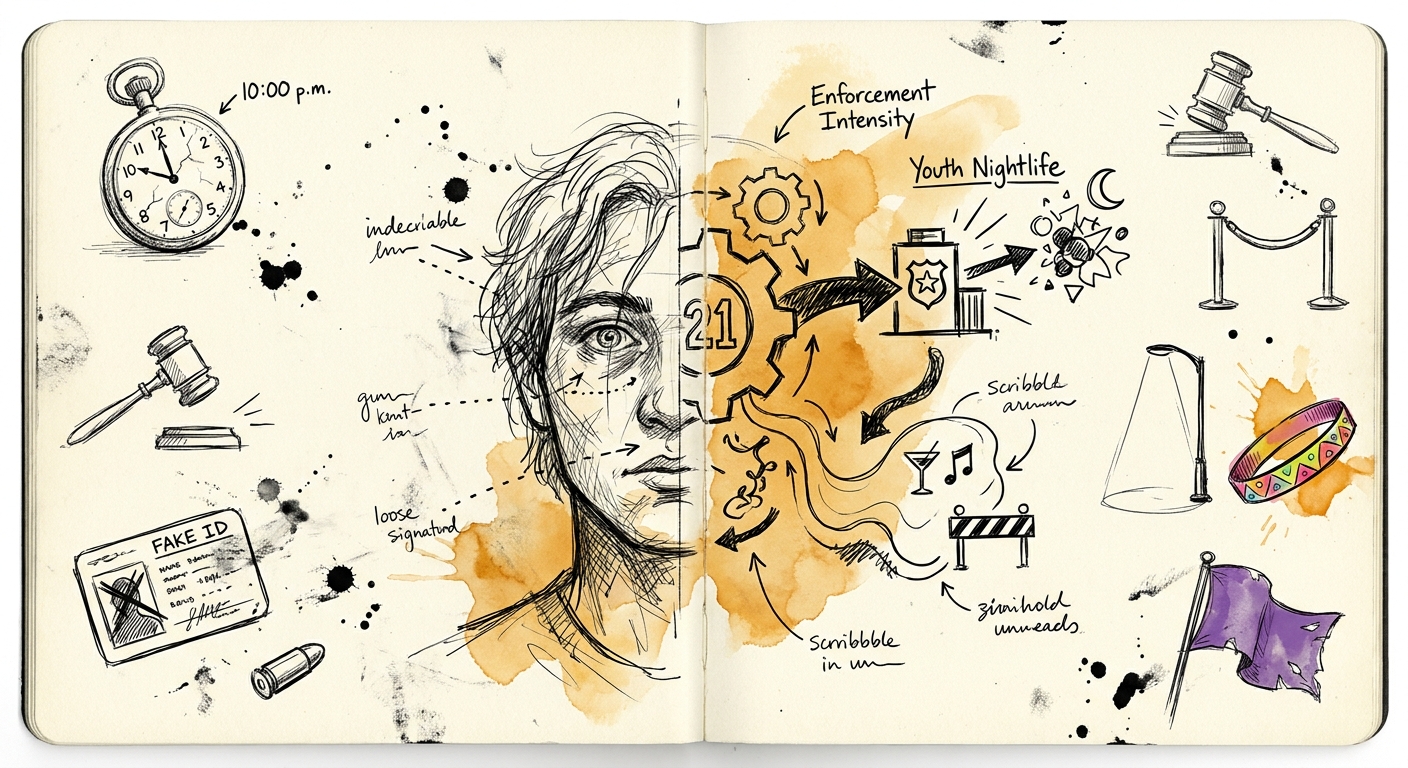
Recent escalations in late-night downtown violence have catalyzed a drastic paradigm shift in municipal governance. Following back-to-back shootings in the downtown corridor—including a highly publicized incident resulting in the death of a juvenile hours after Fourth of July celebrations, and homicides near the Dauphin Street Circle K and Maitre Park—city leadership has adopted a highly punitive enforcement posture. The administration of Mayor Spiro Cheriogotis, a former District Court Judge who assumed office in November 2025, alongside City Councilmembers such as Councilmember Ingram, has pivoted toward a zero-tolerance approach regarding youth presence downtown. This strategy relies heavily on policing interventions, specifically the strict enforcement of a 10:00 p.m. to 5:00 a.m. curfew for individuals under eighteen within the Downtown Entertainment District—bounded by Government, Water, Dearborn, and Conti Streets—accompanied by rigorous identification checks and the immediate detainment of violators.
The friction between Mobile’s permissive cultural norms, its desire to foster a thriving commercial entertainment district, and its increasingly stringent public safety policies presents a multidimensional urban governance challenge. City council meetings routinely feature approvals for noise ordinance waivers to support events like Mobile's "Tiki Week" for adult venues, highlighting the administration's desire for a robust NTE, provided it excludes young people. This comprehensive, evidence-based evaluation analyzes the interplay between the minimum legal drinking age (MLDA), enforcement intensity, and youth nightlife. By examining the history of the 21 MLDA, analyzing the socio-legal mechanisms of Alabama's liquor laws, evaluating international NTE frameworks, and deconstructing the criminological data on juvenile curfews, this analysis determines whether strict spatial exclusion is the optimal approach for Mobile, or if harm-reduction alternatives would better serve the public safety and socio-economic health of the city.
The National Minimum Drinking Age: History, Efficacy, and Psychological Reactance
The Genesis of the 1984 Act and Coercive Federalism
The contemporary landscape of American youth nightlife is entirely constrained by the historical scaffolding of the National Minimum Drinking Age Act of 1984. Prior to 1984, the MLDA was determined strictly at the state level. During the Vietnam War era, the ratification of the 26th Amendment lowered the voting age to 18, prompting many states to concurrently lower their drinking ages to 18, 19, or 20 to align with the age of conscription and enfranchisement. However, a fragmented national map led to the emergence of "blood borders"—jurisdictional boundaries where youth would drive across state lines to purchase alcohol legally, resulting in a documented surge in fatal motor vehicle accidents. This phenomenon prompted aggressive, highly effective lobbying by organizations such as Mothers Against Drunk Driving (MADD).
The 1984 Act did not directly mandate a national drinking age, as doing so would likely violate the Tenth Amendment. Instead, Congress utilized the federal spending power, stipulating that the Secretary of Transportation withhold a percentage (initially five percent, later ten percent) of federal highway funding from any state that permitted persons under 21 to purchase or possess alcoholic beverages. This legislative mechanism, a hallmark of coercive federalism, was challenged by South Dakota, which permitted 19-year-olds to purchase 3.2 percent beer. The Supreme Court upheld the law in South Dakota v. Dole (1987), with Chief Justice William Rehnquist writing for the 7-2 majority that the conditional withholding of funds pursued the "general welfare" and did not represent an unconstitutionally coercive mandate, thereby cementing 21 as the universal national standard.
The Amethyst Initiative and the "Forbidden Fruit" Hypothesis
Despite the universality of the MLDA 21, its efficacy, enforceability, and sociological consequences have been continually scrutinized. The most prominent institutional critique materialized in 2008 with the Amethyst Initiative, spearheaded by John McCardell, former president of Middlebury College, and his nonprofit organization, Choose Responsibility. Signed by over 135 college and university presidents, the Amethyst Initiative argued that the 21 MLDA has systematically failed to prevent underage consumption and has instead created a toxic, clandestine drinking culture.
The core of the Amethyst argument relies on psychological reactance theory—commonly referred to as the "forbidden fruit" effect. The Initiative posits that criminalizing alcohol for 18- to 20-year-olds removes them from supervised, publicly regulated environments (such as bars, restaurants, and civic festivals) and displaces their consumption into highly dangerous, unsupervised settings like fraternity houses, dormitories, and private residences, or in the case of Mobile, unmonitored outdoor spaces. Proponents argue that this policy architecture breeds a culture of heavy episodic (binge) drinking, where the primary objective is rapid, high-volume intoxication to avoid detection, rather than social moderation. Choose Responsibility advocated for a "learner's permit" model, combining mandatory alcohol education with provisional licensing for 18- to 20-year-olds to foster mature consumption habits and integrate them into the formal economy.
Empirical Defenses: Mortality, Regression Discontinuity, and Systems Modeling
While the Amethyst Initiative presents a compelling sociological narrative, longitudinal public health data, economic evaluations, and robust statistical modeling strongly defend the retention of the MLDA 21. Proponents of the current law emphasize that while it does not eliminate underage drinking, it drastically reduces the overall volume of consumption and the subsequent acute harms associated with youth intoxication. The National Highway Traffic Safety Administration (NHTSA) and comprehensive meta-analyses, such as the seminal 2002 review by Wagenaar and Toomey, provide foundational defenses. Reviewing 241 high-quality studies, Wagenaar and Toomey found that 46 studies explicitly linked higher MLDAs to substantial drops in traffic crashes, whereas zero studies found the opposite effect.
The most robust modern empirical defenses originate from regression discontinuity (RD) designs, most notably the extensive research conducted by health economists Christopher Carpenter and Carlos Dobkin. Because a citizen's 21st birthday creates a sharp, exogenous shock in their legal access to alcohol, RD models can isolate the true causal effect of legal alcohol access on morbidity, mortality, and criminality by comparing individuals just days before their 21st birthday to those just days after.
Carpenter and Dobkin’s analyses reveal staggering outcomes: legal access to alcohol at age 21 results in an immediate 21 percent increase in recent drinking days and a discrete 9 percent jump in the overall mortality rate among young adults. This spike is driven predominantly by motor vehicle fatalities, alcohol poisonings, and suicides. Furthermore, their research into criminality demonstrates that individuals just over age 21 are 5.9 percent more likely to be arrested than those just under 21. When disaggregated by crime type, access to alcohol drives a 12 percent increase in violent crime arrests (assault and robbery) and significant increases in nuisance crimes and driving under the influence. By lowering the MLDA to 18, public health analysts project a massive downstream increase in these negative externalities, severely compromising the safety of cities like Mobile.
Systems dynamics modeling of college populations further dismantles the Amethyst Initiative's claims. Epidemiological models developed by Scribner and colleagues tested the specific Amethyst hypothesis that lowering the drinking age would decrease misperceptions of peer drinking norms and thus reduce heavy episodic drinking by removing the "forbidden fruit" allure. The simulations concluded that while public consumption might slightly correct social norm misperceptions, this negligible behavioral benefit is overwhelmingly negated by the massive increase in the sheer availability (termed "wetness") of alcohol to 18- to 20-year-olds.
| Outcome Metric | Amethyst Initiative Hypothesis (MLDA 18) | Empirical Evidence (Carpenter & Dobkin / Scribner / Wagenaar) |
|---|---|---|
| Binge Drinking | Would decrease as the "forbidden fruit" allure diminishes and consumption normalizes in public settings. | Overall consumption and heavy episodic drinking drastically rise due to increased total availability and "wetness." |
| Supervision Effects | Youth would drink in safer, regulated environments (bars), reducing acute harms like poisoning. | Supervised environments do not offset the increased volume of consumption; overall mortality rises 9% at age 21. |
| Criminality & Arrests | Reductions in fake ID usage and clandestine parties would lower secondary criminal behaviors. | Arrests jump 5.9% immediately upon legal access to alcohol, heavily driven by violent assaults and nuisance crimes. |
| Social Norms | Public drinking corrects extreme misperceptions of peer drinking habits, leading to moderation. | Minor corrections in norm perception are statistically overwhelmed by the gross increase in total alcohol access. |
De Jure vs. De Facto: Enforcement Discretion and Liability Landscapes
Tolerated Illegality and the Limits of Discretion
The enforcement of alcohol regulations and youth curfews in mid-sized Southern cities like Mobile frequently exists in a liminal space between the strict letter of the law (de jure) and the pragmatic reality of street-level policing (de facto). In public policy philosophy, this mirrors the Dutch model of gedoogbeleid—the formal and informal practice of tolerating certain illegal acts (such as minor substance use) to minimize broader, more destructive social harms. In many college towns and entertainment districts, police have historically exercised significant discretionary enforcement. Officers often ignore minor alcohol infractions or spatial violations by youth in favor of maintaining public order and preventing violent crime, operating under the premise that aggressive, zero-tolerance enforcement of underage drinking generates undue community friction, strains municipal resources, and drives youth further underground into riskier environments.
However, zero-tolerance policies—which remove discretionary judgment from street-level bureaucrats—are increasingly favored by administrations eager to project an image of absolute order and control following high-profile incidents of violence. The recent crackdown in downtown Mobile reflects this abrupt shift, abandoning discretionary harm reduction for rigid, uncompromising curfew enforcement.
Server Penalties and the Responsible Vendor Program
In Alabama, the regulatory burden of enforcing the MLDA falls disproportionately on commercial vendors and their frontline staff. Under Ala. Code § 28-1-5, purchasing, possessing, or consuming alcohol under 21 is a first-degree misdemeanor, carrying maximum penalties of six months imprisonment and a $1,000 fine. For commercial establishments, serving a minor is a strict liability offense. The Alabama Alcoholic Beverage Control (ABC) Board dictates severe financial and administrative penalties for licensees: $250 for a first offense, $500 for a second, and $1,000 for a third or subsequent offense, alongside the existential threat of license suspension or total revocation.
To mitigate this crushing liability, Alabama instituted the Responsible Vendor Program (RVP) under Ala. Code § 28-10. Overseen by the ABC Board, the RVP is a voluntary training framework that certifies businesses—rather than individual bartenders or servers—in proper identification verification, intoxication assessment, and state law compliance. Certification offers venues a vital legal shield: if an errant employee unknowingly serves a minor despite the venue's compliance with RVP strictures, the venue's liquor license is generally protected from revocation. While this theoretically encourages compliance and training, the catastrophic financial risk of losing a liquor license incentivizes downtown Mobile operators to enact blanket bans on under-21 patrons. The regulatory environment effectively forces businesses to act as an extension of the state's exclusionary apparatus, contributing directly to the spatial banishment of youth from the downtown core.
Dram Shop Laws and Social Host Liability Loopholes
Alabama's civil liability framework further bifurcates the nightlife experience based on socioeconomic status, creating a dual-tiered system of accountability. The Alabama Dram Shop Act (Ala. Code § 6-5-71) holds commercial retailers strictly liable if they knowingly sell or furnish alcohol to an underage drinker or a visibly intoxicated person who subsequently causes injury or death. This statute permits injured parties to pursue both compensatory and punitive damages against the business, though punitive damages are capped at $1.5 million or three times the compensatory damages, whichever is greater.
In stark contrast, Alabama's social host liability is exceedingly narrow and highly protective of private property owners. A private individual cannot be held liable for furnishing alcohol to an adult, even if that adult is visibly intoxicated and subsequently causes a fatal accident. Social host liability only attaches if the host knowingly furnishes alcohol directly to a minor. However, the legal threshold for "furnishing" allows affluent families to easily circumvent liability. In upper-middle-class enclaves throughout Mobile, parents frequently host massive graduation or post-Mardi Gras parties for high schoolers. By remaining on the premises to monitor for physical safety but claiming they did not directly purchase or furnish the alcohol (which is often brought by the youths themselves or sourced via older siblings), these parents exploit a massive legal loophole.
This legal architecture dictates that affluent youth are afforded safe, private, quasi-legal spaces to consume alcohol and socialize, heavily insulated from police scrutiny and the violence of the street. Conversely, youth without access to large private homes, country clubs, or permissive parents are pushed into the public sphere—parks, downtown streets, and commercial parking lots—where they are immediately subject to Mobile's stringent curfew enforcement, zero-tolerance policing, and the heightened risk of interpersonal violence.
The Psychological and Social Effects of Age-21 Segregation
Pregaming, Fake IDs, and Extreme Intoxication
The strict enforcement of the 21 MLDA and the resultant spatial segregation of under-21 youth from the formal NTE generates highly predictable, heavily documented, and extraordinarily dangerous behavioral adaptations. Chief among these is "pregaming" (or prepartying)—defined as the rapid consumption of large quantities of alcohol in a private, unsupervised setting before attending a public event, concert, or bar where alcohol access is restricted or prohibitively expensive.
Research tracking college student behavior indicates that over 64 percent of students engage in pregaming, and that drinking events involving pregaming result in significantly higher blood alcohol concentrations (BAC) and far more severe negative externalities. Men report engaging in heavy episodic drinking on 84 percent of the days they pregame, compared to only 63 percent on non-pregaming days, consuming an average of 8.15 drinks versus 5.80. By aggressively restricting 18- to 20-year-olds from downtown Mobile venues through cover charges and ID bans, the city inadvertently incentivizes them to pregame heavily in unsupervised environments before venturing downtown. They subsequently arrive in the public sphere highly intoxicated, demonstrating impaired judgment, and disproportionately vulnerable to victimization or instigation.
Simultaneously, spatial exclusion sustains a booming, normalized illicit market for fraudulent identification. Fake ID ownership is pervasive among the 18- to 20-year-old demographic, actively serving as a catalyst for heavy drinking rather than merely a consequence of it. Longitudinal studies demonstrate a reciprocal relationship, particularly within networks like Greek life: students who obtain fake IDs drink more heavily, and the intense social desire to participate in the NTE drives the procurement of the IDs. This normalization of fraud undermines civic respect for the law and forces venue security in Mobile into an adversarial, rather than hospitable, posture with the city's youth population.
Retarded Social Development and Civic Disenfranchisement
Beyond immediate physiological harms, the total segregation of 18- to 20-year-olds from the downtown entertainment district severely retards their social development. The ages of 18 to 21 represent a critical developmental window for socialization, networking, romantic engagement, and integrating into the civic fabric of a broader community. According to the Monitoring the Future (MTF) panel study, while overall underage alcohol consumption has seen a long-term decline over the last two decades, binge drinking remains acutely concentrated among college-aged youth, with 28 percent of college students reporting binge drinking in the past two weeks.
By utilizing curfews and blanket venue bans, municipal leaders signal to young adults that their presence in the city center is inherently criminogenic and unwelcome. This fosters a profound sense of disenfranchisement, stripping young residents of their sense of belonging and civic ownership of Mobile’s cultural spaces. When youth feel categorically rejected by the formal NTE, they retreat into hyper-segregated, insular subcultures—such as Greek life networks, unsupervised street congregations, or private house parties—which lack the moderating, civilizing influence of older, mature patrons and professional venue staff.
| Behavior / Adaptation | Mechanism Driven by Spatial Exclusion | Consequence for Public Safety |
|---|---|---|
| Pregaming | High cost or total lack of access to alcohol in formal venues incentivizes rapid, pre-event consumption. | Dramatically elevated BACs; higher incidence of alcohol poisoning; increased likelihood of erratic public behavior. |
| Fake ID Procurement | Blanket bans on 18-20 year olds in entertainment districts drive demand for illicit access. | Normalization of fraud; adversarial relationships between youth and venue security; increased risk of heavy drinking. |
| Subculture Retreat | Rejection from civic spaces forces youth into unmonitored private networks (fraternities, street corners). | Loss of cross-generational behavioral moderation; increased susceptibility to sexual assault and localized violence. |
Race, Space, and the Southern Context
Disparate Enforcement in Public Spaces
In Southern cities like Mobile, the impacts of curfews, loitering laws, and zero-tolerance nightlife policing do not fall evenly across racial demographics. The bifurcation of public and private space heavily penalizes Black and lower-income youth. As previously outlined, affluent white youth frequently have access to heavily insulated private homes, exclusive country clubs, and private school networks where drinking and socializing occur well beyond the gaze of municipal law enforcement and the reach of the Dram Shop Act.
Black youth, lacking equitable access to these private sanctuaries, frequently utilize the public streetscape as their primary locus of socialization. Consequently, policies that criminalize sheer presence in public space—such as the 10:00 p.m. to 5:00 a.m. juvenile curfew strictly enforced within Mobile's Downtown Entertainment District—disproportionately target minority youth. Police officers tasked with enforcing these curfews are granted exceptionally wide discretion to initiate stops, demand identification, and detain individuals, creating a structural mechanism for racial profiling and vastly increasing the frequency of adversarial, potentially escalatory encounters between Black youth and the state.
Dress Codes as Proxies for Exclusion
The commercial NTE also employs semi-formal mechanisms of racial exclusion through the implementation of rigid bar dress codes. In many downtown entertainment districts nationwide, venue operators draft dress codes that explicitly prohibit attire heavily associated with urban, hip-hop, or Black culture. Common prohibitions include long white t-shirts, athletic wear, sweatpants, excessively baggy pants, work boots (e.g., Timberlands), bandanas, and specific styles of headgear.
While venue operators, such as those managing Kansas City's Power & Light District, vehemently deny racial animus, civil rights advocates and human relations departments note that these codes are practically enforced with extreme subjectivity. A white college student wearing a slightly oversized shirt or athletic sneakers may be admitted without comment, while a Black patron is barred by security for violating the exact same technical rule. In Mobile, the legacy of downtown policing and the deployment of these highly subjective dress codes by Dauphin Street venues serve to systematically filter the demographics of the NTE. This soft enforcement engineers interior spaces that are overwhelmingly white and affluent, while explicitly pushing Black youth out onto the street, where they are subsequently targeted by the city's curfew crackdowns and loitering ordinances.
International Comparisons: Managing the Night-Time Economy
To properly evaluate the viability of Mobile's punitive, exclusionary approach, it is instructive to examine international frameworks for managing the NTE, particularly in jurisdictions that attempt to balance economic vibrancy with public safety, and where the drinking age is set at 18 or lower.
While countries with lower drinking ages (such as the UK, Australia, and continental Europe) do integrate youth into their formal NTE, they are not immune to youth nightlife problems. In fact, opponents of lowering the US drinking age frequently cite European data demonstrating that prevalence rates of binge drinking and alcohol-related morbidity among youth are often higher in Europe than in the United States. However, these international jurisdictions differ radically from the US in how they manage the spatial and civic dynamics of their night-time economies.
The Catastrophic Failure of Sydney’s Lockout Laws
The closest international analogue to Mobile's current crackdown impulse is Sydney, Australia's disastrous implementation of "lockout laws" in 2014. Prompted by a series of high-profile, fatal alcohol-fueled assaults (known locally as "coward punches") in the Kings Cross and central business district (CBD) precincts, the New South Wales (NSW) government imposed draconian restrictions. These included a 1:30 a.m. lockout (after which no new patrons were allowed into venues), a 3:00 a.m. cessation of alcohol service, mandates for plastic cups, and severe restrictions on the promotion of certain drinks after midnight.
While the laws succeeded in their narrowest, most localized epidemiological goal—reducing non-domestic assaults in the targeted areas by 26 to 32 percent—they unleashed total devastation upon the broader economic and cultural ecosystem of the city. The strictures functionally destroyed Sydney's live music scene and youth culture, resulting in the closure of over 176 venues in the CBD alone, and an estimated 418 closures across adjacent precincts. The restrictions cost the city an estimated $16 billion in forgone economic activity, decimated foot traffic (with a drop of nearly 500,000 under-35 visitors annually), and severely damaged Sydney's reputation as a global, vibrant cultural hub.
Recognizing that blanket spatial and temporal exclusions are economically suicidal and merely displace crime to adjacent suburbs, the NSW government completely abolished the last vestiges of the lockout laws between 2020 and January 2026. Sydney has since pivoted toward a growth-oriented, harm-reduction model, appointing a 24-Hour Economy Commissioner and focusing on vibrant, diverse offerings rather than punitive exclusion. Mobile’s reliance on curfews and strict policing risks replicating Sydney's fundamental mistake: utilizing a blunt instrument that hollows out the downtown economy rather than managing its complexities.
The Purple Flag Accreditation and Night Mayors
Conversely, the United Kingdom has pioneered the "Purple Flag" accreditation, a holistic management program run by the Association of Town and City Management (ATCM) that has successfully expanded to Ireland, Sweden, New Zealand, and Australia. Akin to the Blue Flag for clean beaches, the Purple Flag recognizes urban precincts that achieve excellence in managing the NTE between 5:00 p.m. and 5:00 a.m..
The Purple Flag criteria explicitly reject the notion that a safe NTE must be heavily policed, highly restricted, or strictly age-segregated. Instead, accreditation demands diversity of attractions (non-alcohol led venues, late-night cafes, theatres), inclusion (accessibility for all ages, income brackets, and demographics), and proactive urban design (excellent lighting, reliable late-night transit, and coordinated place management). The framework insists that nobody should be excluded from the NTE on the grounds of age or wealth, advocating for a collaborative approach rather than relying solely on reactive liquor licensing enforcement or police crackdowns.
To facilitate these complex ecosystems, many cities have instituted the role of a "Night Mayor" or Nightlife Director. In Washington, D.C., Shawn Townsend served as the inaugural director of the Mayor’s Office of Nightlife and Culture, successfully navigating the city's pandemic reopening and balancing industry needs with resident concerns. These officials act as vital intermediaries between law enforcement, venue operators, and youth populations, translating the needs of the NTE into actionable civic policy, mitigating noise complaints without defaulting to venue closures, and averting the necessity for heavy-handed police interventions.
The Public Safety Tradeoff: Curfews, Crackdowns, and Gun Violence
Mayor Cheriogotis and the Mobile Police Department have doubled down on the 10:00 p.m. juvenile curfew for the Downtown Entertainment District, rationalizing the policy as a necessary, common-sense shield to "protect our community's youth". However, empirical criminological research unequivocally demonstrates that juvenile curfews are not only ineffective, but frequently exacerbate the exact types of violence they intend to prevent.
The Campbell Collaboration: Evidence of Ineffectiveness
A comprehensive, rigorous systematic review conducted by the Campbell Collaboration (Wilson et al., 2016) evaluated the efficacy of juvenile curfews across the United States. The meta-analysis of high-quality quantitative studies concluded that curfews have zero statistically significant effect on reducing either juvenile crime or juvenile victimization.
The theoretical mechanisms that typically justify curfews—opportunity reduction, deterrence via police stops, and forced parental supervision—routinely fail in practice. Criminological data shows that juvenile crime is heavily concentrated in the late afternoon hours immediately following school dismissal, not deep in the night when curfews are active. Furthermore, enforcing curfews requires immense, sustained police resources. Officers become bogged down stopping, interrogating, transporting, and processing non-violent youth who are simply out in public spaces, severely diverting critical law enforcement bandwidth away from investigating actual violent crimes or responding to emergency calls.
"Keep the Kids Inside": Curfews and the Amplification of Gun Violence
Far more alarming for Mobile's policy trajectory is the robust economic research conducted by Jillian Carr and Jennifer Doleac (2018), which utilized highly accurate acoustic gunshot detection data (ShotSpotter) to measure the true impact of juvenile curfews in Washington, D.C..
Using a triple-differences estimation strategy that exploited exogenous changes in the curfew hours (shifting between midnight and 11:00 p.m.), their findings were counterintuitive but profound: during the marginal hours when the curfew went into effect, actual gun violence increased by 150 percent. Carr and Doleac attribute this catastrophic backfire to the removal of "eyes on the street"—a foundational urban design concept pioneered by Jane Jacobs.
By legally forcing law-abiding youth (and, by extension, the adults who accompany or monitor them) indoors, curfews systematically clear the streets of bystanders and natural guardians. The absence of a civilian presence drastically lowers the risk of apprehension for violent offenders, who no longer fear witnesses. Thus, rather than protecting youth, clearing Dauphin Street of general pedestrian traffic creates a desolate, unmonitored environment highly conducive to violent, retaliatory gang violence, drug disputes, or robberies.
Interestingly, Carr and Doleac noted that when cities rely on traditional 911 calls to track crime, curfews appear to work, because the very witnesses who would normally call 911 have been forced inside, artificially suppressing the reported crime rate while the actual violence rises. Mobile’s reliance on the downtown curfew is highly likely achieving the exact opposite of its stated intent, imperiling public safety by systematically hollowing out the downtown core of its natural, passive guardians.
Cultivating Youth-Oriented Nightlife: Alternatives to Exclusion
If blanket exclusion and punitive crackdowns increase harm and displace violence, the necessary alternative is the intentional cultivation of supervised, youth-oriented nightlife. Young adults between 18 and 20 are legally adults, active members of the workforce, and university students; they inherently require venues for socialization, dating, and entertainment that do not revolve around clandestine house parties or street loitering.
Viable Models for 18+ and All-Ages Venues
Cities that successfully integrate their youth into the NTE do so by intentionally supporting 18+ and all-ages venues. Common operational models include:
- Wristband and Stamp Systems: Venues admit 18+ patrons but utilize heavily monitored, non-transferable wristbands, UV hand stamps, and separate colored cups to clearly demarcate those of legal drinking age from minors.
- Under-21 Specific Nights: Venues restrict specific nights of the week (e.g., Wednesdays or Thursdays) entirely to the 18-20 demographic. Alcohol service is entirely suspended, and the venue focuses exclusively on music, dancing, and non-alcoholic mocktails.
- Hybrid Entertainment Spaces: Venues centered around physical activities rather than pure alcohol consumption—such as arcade bars, bowling lounges, or live music halls—that welcome all ages but segregate alcohol service to specific, highly monitored enclosed areas.
Business Viability and Regulatory Barriers
Despite the undeniable social utility of these spaces, they face extreme hostility from both market forces and municipal regulations. Economically, admitting an 18-year-old patron carries a distinct opportunity cost for a venue owner; the physical space taken by a non-drinking youth could be occupied by a 25-year-old purchasing high-margin cocktails. To remain financially viable, 18+ venues must rely heavily on steep cover charges and the aggressive pricing of non-alcoholic beverages, which can quickly price out lower-income youth.
Regulatory barriers are even more formidable. In Alabama, the strict liability imposed by the Dram Shop Act and the fragile, easily voided protections of the Responsible Vendor Program make venue owners highly risk-averse. Allowing 18-year-olds into a venue where alcohol is served risks catastrophic liability if a minor secretly acquires a drink or uses a sophisticated fake ID. Furthermore, cities often utilize zoning laws and specialized licensing restrictions to deliberately prevent the establishment of 18+ clubs, viewing them preemptively as magnets for loitering, noise, and disorder.
To resolve this, municipal governments must actively de-risk youth venues. This involves creating specialized licensing tiers that protect venues hosting 18+ events from disproportionate ABC penalties, providing municipal police support for crowd egress without criminalizing the attendees, and offering tax incentives or grants—similar to the NSW Purple Flag Readiness grants that distribute $50,000 to $100,000 for safety and inclusivity audits—to venues that provide safe, non-alcohol-centric late-night programming.
The Mobile Context: Policy Synthesis and Future Directions
The City of Mobile stands at a crucial juncture in its urban development. The recent downtown shootings are undeniably tragic, and the instinct of Mayor Cheriogotis, his administrative cabinet, and the City Council to exert control via curfews and crackdowns is a standard, highly visible political reflex. However, as the totality of the empirical evidence demonstrates, attempting to arrest and exclude one's way to a safe night-time economy is fundamentally flawed and empirically counterproductive.
Mobile’s current downtown ecosystem provides virtually nothing in terms of structured entertainment for the 18-to-20 demographic. Excluded from the bars on Dauphin Street by strict age policies, these young adults are forced into a binary choice: either illegally consume alcohol in private, unregulated environments (where the risks of binge drinking, alcohol poisoning, and sexual assault multiply exponentially) or congregate aimlessly on the public streets, where they are harassed by police enforcing a curfew that data proves actually increases the likelihood of fatal gun violence by removing civilian bystanders.
Strategic Policy Recommendations for Mobile
To cultivate a safe, vibrant, and genuinely inclusive downtown, Mobile leadership should consider abandoning spatial exclusion in favor of strategic, holistic management:
- Establish an Office of the Night Mayor: Mobile must transition from a reactive policing model to a proactive management model. Appointing a dedicated Nightlife Director would bridge the current adversarial gap between Dauphin Street business owners, the Mobile Police Department, and youth advocates. This office could coordinate lighting, waste management, and late-night transportation, mirroring the successes of Washington D.C., and mediate issues like the Tiki Week noise waivers without defaulting to punitive police action.
- Pursue Purple Flag Principles: Mobile should formally adopt the framework of the Purple Flag accreditation, aiming to deliberately diversify the downtown offerings beyond alcohol consumption. The city council should incentivize late-night cafes, food trucks, street performances, and retail to remain open late, thereby naturally increasing the "eyes on the street" that are statistically necessary to deter violent crime.
- Repeal or Radically Revise the Juvenile Curfew: Recognizing the definitive conclusions of the Campbell Collaboration and the ShotSpotter data analysis, Mobile should immediately cease the blanket enforcement of the 10:00 p.m. curfew. Law enforcement resources currently wasted on detaining and processing non-violent teenagers should be redirected entirely toward targeted interventions against known violent offenders and illegal firearms.
- De-Risk 18+ Entertainment Spaces: The city should collaborate closely with the ABC Board to create a safe-harbor legal provision for downtown venues willing to host 18+ or non-alcoholic nights. By significantly reducing the catastrophic liability risk for operators who demonstrate best practices in crowd control and ID verification, Mobile can bring its youth indoors, out of the crossfire, and into supervised, civilizing environments.
Maintaining the status quo of rigid age segregation and punitive curfews will only further stratify Mobile along racial and economic lines, hollowing out the downtown core while categorically failing to deliver tangible public safety. By embracing harm reduction, expanding supervised spaces, and treating young adults as vital civic stakeholders rather than inherent criminal suspects, Mobile can protect its youth and secure the long-term vitality of its cultural and economic heart.
Works cited
1. Witnesses recall back-to-back shootings in Downtown Mobile, https://www.youtube.com/watch?v=V\_nOLWmlIdM 2. Juvenile killed in downtown Mobile shooting hours after Fourth of, https://www.youtube.com/watch?v=Yw-eNM08HkE 3. Downtown Curfew Reminder - Mobile Police Department, https://www.mobilepd.org/downtown-curfew-reminder/ 4. Spiro Cheriogotis - Wikipedia, https://en.wikipedia.org/wiki/Spiro\_Cheriogotis 5. Mayor Spiro Cheriogotis : City of Mobile, Alabama, https://www.cityofmobile.gov/government/mayor/ 6. Mobile, Alabama Meetings - Open Publica, https://www.openpublica.com/mobile-alabama/meetings 7. Downtown Curfew Reminder Ahead Of July 4th, https://www.mobilepd.org/downtown-curfew-reminder-ahead-of-july-4th/ 8. Downtown Mobile Teen Curfew Still In Effect, https://www.mobilepd.org/downtown-mobile-teen-curfew-still-in-effect/ 9. National Minimum Drinking Age Act - Wikipedia, https://en.wikipedia.org/wiki/National\_Minimum\_Drinking\_Age\_Act 10. Amethyst Initiative - Wikipedia, https://en.wikipedia.org/wiki/Amethyst\_Initiative 11. South Dakota v. Dole | Oyez, https://www.oyez.org/cases/1986/86-260 12. South Dakota v. Dole - Teaching American History, https://teachingamericanhistory.org/document/south-dakota-v-dole/ 13. South Dakota v. Dole - Wikipedia, https://en.wikipedia.org/wiki/South\_Dakota\_v.\_Dole 14. Heavy Episodic Drinking on College Campuses: Does Changing the, https://pmc.ncbi.nlm.nih.gov/articles/PMC3001676/ 15. The Minimum Legal Drinking Age and Public Health - PMC, https://pmc.ncbi.nlm.nih.gov/articles/PMC3182479/ 16. Choose Responsibility - Wikipedia, https://en.wikipedia.org/wiki/Choose\_Responsibility 17. Underage Drinking and the Drinking Age - Hoover Institution, https://www.hoover.org/research/underage-drinking-and-drinking-age 18. From recreational to functional drug use: the evolution of drugs in, https://pmc.ncbi.nlm.nih.gov/articles/PMC4972325/ 19. Forecasting the Effect of the Amethyst Initiative on College Drinking, https://www.researchgate.net/publication/221876150\_Forecasting\_the\_Effect\_of\_the\_Amethyst\_Initiative\_on\_College\_Drinking 20. Amethyst Initiative: College Presidents and Alcohol Abuse, https://www.alcoholproblemsandsolutions.org/amethyst-initiative/ 21. “Choose Responsibility” to Reduce Underage Alcohol Abuse, https://www.alcoholproblemsandsolutions.org/choose-responsibility-to-reduce-underage-alcohol-abuse/ 22. The Public Health Argument for the Age 21 Minimum Legal Drinking, https://www.researchgate.net/publication/267730818\_When\_Enough\_Is\_Enough\_The\_Public\_Health\_Argument\_for\_the\_Age\_21\_Minimum\_Legal\_Drinking\_Age 23. Tutorial #4: Minimum Legal Drinking Age, https://www.treatment-effects.com/basics-lab-04-drinking-age-rd 24. The Effect of Alcohol Consumption on Mortality: Regression ... - PMC, https://pmc.ncbi.nlm.nih.gov/articles/PMC2846371/ 25. The Minimum Legal Drinking Age and Crime, https://people.ucsc.edu/\~cdobkin/Papers/MLDA\_Crime.html 26. The Minimum Legal Drinking Age and Public Health, https://masteringmetrics.com/wp-content/uploads/2015/01/Carpenter-and-Dobkin-2011.pdf 27. The Minimum Legal Drinking Age and Morbidity in the United States, https://ideas.repec.org/a/tpr/restat/v99y2017i1p95-104.html 28. The minimum legal drinking age and public health - PubMed, https://pubmed.ncbi.nlm.nih.gov/21595328/ 29. validating models in public health research - Journals ISSS, https://journals.isss.org/index.php/proceedings58th/article/download/2320/785 30. (PDF) A Systems Approach to College Drinking: Development of a, https://www.researchgate.net/publication/26796354\_A\_Systems\_Approach\_to\_College\_Drinking\_Development\_of\_a\_Deterministic\_Model\_for\_Testing\_Alcohol\_Control\_Policies 31. The Zero Tolerance Law Means, https://sanandres.uep.edu.py/filedownload.ashx/TFlEcb/704551/The%20Zero%20Tolerance%20Law%20Means.pdf 32. Full article: Co-opting the 'public' in public health: homelessness and, https://www.tandfonline.com/doi/full/10.1080/09581596.2025.2455492 33. Policing Social Marginality: Contrasting Approaches, https://lsj.washington.edu/sites/lsj/files/documents/research/lsi\_policing\_social\_marginality\_2017.pdf 34. Alcohol & The Law - Alabama A&M University, https://www.aamu.edu/campus-life/student-support/drug-and-alcohol-abuse-prevention/alcohol-the-law.html 35. Alabama Code § 28-1-5 (2025) - Minimum Age for Purchase, Etc., of, https://law.justia.com/codes/alabama/title-28/chapter-1/section-28-1-5/ 36. Alabama Liquor License: Cost & Requirements (2026), https://startbusinessbystate.com/alabama/liquor-license/ 37. Frequently Asked Questions - SSC® Seller Server Classes, https://sellerserverclasses.com/alabama/faq?category=4 38. Alabama Alcohol Seller-Server Training | Online Certificate, https://www.360training.com/learn2serve/alcohol/alabama 39. Part VII: Overview of ABC's Responsible Vendor Training Program, https://csattorneys.com/2022/05/25/part-vii-overview-of-abcs-responsible-vendor-training-program/ 40. Alabama Dram Shop and Social Host Liability: A Legal Guide - Nolo, https://www.nolo.com/legal-encyclopedia/dram-shop-laws-social-host-liability-alcohol-related-accidents-alabama.html 41. Dram Shop Laws In Alabama - Salter Ferguson, LLC, https://www.salterferguson.com/dram-shop-laws-in-alabama/ 42. What is Alabama's social host law? | Mark A. Jackson PC, https://www.jacksonlegalteam.com/blog/2024/01/what-is-alabamas-social-host-law/ 43. Partying Before the Party: Examining Prepartying Behavior Among, https://pmc.ncbi.nlm.nih.gov/articles/PMC2532497/ 44. Turning 21 and the Associated Changes in Drinking and Driving, https://pmc.ncbi.nlm.nih.gov/articles/PMC2925119/ 45. UChicagoDisOrientationBook2016.pdf - GitHub Pages, https://jmithani.github.io/disorientation2016/UChicagoDisOrientationBook2016.pdf 46. Alcohol Use in the Greek System, 1999–2009: A Decade of Progress, https://pmc.ncbi.nlm.nih.gov/articles/PMC3746189/ 47. underage drinking laws: Topics by Science.gov, https://www.science.gov/topicpages/u/underage+drinking+laws 48. How is drinking culture so prevalent in American universities if the, https://www.reddit.com/r/AskAnAmerican/comments/wl9pbu/how\_is\_drinking\_culture\_so\_prevalent\_in\_american/ 49. Statistics on Underage Drinking - Responsibility.org, https://www.responsibility.org/alcohol-statistics/underage-drinking-statistics/ 50. A Look at College Campus Drinking and Drug Use - Narconon, https://www.narconon.org/blog/a-look-at-college-campus-drinking-and-drug-use.html 51. 2026 National data on substance use among adults ages 19 to 65, https://monitoringthefuture.org/wp-content/uploads/2026/07/mtfpanel2026.pdf 52. Youth curfews - College of Policing, https://www.college.police.uk/research/crime-reduction-toolkit/youth-curfews 53. Keep the Kids Inside: Juvenile Curfews and Urban Gun Violence, https://batten.virginia.edu/wp-content/uploads/2019/09/Carr\_Doleac\_Curfew\_Gunfire\_Sep2015.pdf 54. Player's Sports Bar_Liquor License Renewal_Attorney Handouts, https://weblink.cityofdubuque.org/WebLink/DocView.aspx?id=209809\&dbid=0\&repo=City-of-DBQ 55. The End of an Era: NSW Lockout Laws Abolished and What It ... - eBev, https://www.ebev.com/news/ebev-trade-suppliers-m4n6h-ta549-apxp4-yskbc-2xg8x 56. Sydney lockout laws - Wikipedia, https://en.wikipedia.org/wiki/Sydney\_lockout\_laws 57. Sydney scraps lockout laws after 12 years | 7NEWS - YouTube, https://www.youtube.com/watch?v=o9E6XpBvw58 58. Sydney Lockout Laws: How the City's Nightlife Changed, https://obriensolicitors.com.au/from-lockouts-to-last-drinks-how-sydneys-nightlife-has-changed-and-what-it-means-for-your-festive-season/ 59. 'Make Sydney fun again!': can government policies really resuscitate, https://www.theguardian.com/australia-news/2025/nov/14/make-sydney-fun-again-can-government-policies-really-resuscitate-the-citys-nightlife 60. End of an era: last drinks for remaining lockout laws, https://www.nsw.gov.au/departments-and-agencies/dciths/ministerial-media-releases/end-of-an-era-last-drinks-for-remaining-lockout-laws 61. Sydney ends 12-year lockout laws in nightlife revival move, https://electronicgroove.com/sydney-ends-12-year-lockout-laws-in-nightlife-revival-move/ 62. Reviving the night: How city centres are transforming after dark, https://urbact.eu/articles/reviving-night-how-city-centres-are-transforming-after-dark 63. Purple Flag | Fairfield City Business, https://business.fairfieldcity.nsw.gov.au/Visitor-Economy/Night-Time-Economy/Purple-Flag 64. More precincts to wave Purple flag as program expands across NSW, https://www.nsw.gov.au/business-and-economy/office-of-24-hour-economy-commissioner/news/more-precincts-to-wave-purple-flag-as-program-expands-across-nsw 65. More NSW precincts wave purple flag, https://www.destinationnsw.com.au/newsroom/more-nsw-precincts-wave-purple-flag 66. Derby wins Purple Flag safety award for 13th year running, https://www.derby.gov.uk/news/2026/june/derby-wins-purple-flag/ 67. 15th Purple Flag award for Bournemouth Town Centre, https://towncentrebid.co.uk/15th-purple-flag-award-for-bournemouth-town-centre/ 68. MANIFESTO FOR THE NIGHT TIME ECONOMY, https://cornerstonebarristers.com/wp-content/uploads/old/night-time-economy-final.pdf 69. The Crisis in the UK's High Streets: can the Evening and Nighttime, https://journals.openedition.org/articulo/3035 70. The Partnership Charter for the Night Time Economy, https://instituteoflicensing.org/wp-content/uploads/2025/11/The-Partnership-Charter-for-the-Night-Time-Economy-26112025.pdf 71. Advisors - 24HourNation, https://24hournation.com/advisors/ 72. Why SC is Home To All these Modern-day BlackTrailblazers, https://www.theroot.com/the-mystery-of-why-so-many-of-these-black-superstars-ha-1851728385 73. Week in Review – 6/20/21 - 17° Cork by Northwest, https://17degreesdc.com/week-in-review-6-20-21/ 74. Juvenile Curfew Effects on Criminal Behavior and Victimization, https://resaud.net/wp-content/uploads/2024/03/Wilson-et-al.-2016-Juvenile-Curfew-Effects-on-Criminal-Behavior-and-V.pdf 75. (PDF) Juvenile Curfew Effects on Criminal Behavior and Victimization, https://www.researchgate.net/publication/307819368\_Juvenile\_Curfew\_Effects\_on\_Criminal\_Behavior\_and\_Victimization\_A\_Systematic\_Review 76. Practice Profile: Juvenile Curfew Laws - CrimeSolutions, https://crimesolutions.ojp.gov/ratedpractices/juvenile-curfew-laws 77. Keep the Kids Inside? Juvenile Curfews and Urban Gun Violence, https://apps.it.purdue.edu/sites/Home/DirectoryApi/Files/48446b14-bba7-4810-a0d4-c84407e8f050/Download 78. News - Mobile Police Department, https://www.mobilepd.org/news/ 79. Mayor Spiro Cheriogotis Announces Administrative Cabinet, https://www.cityofmobile.gov/news/mayor-spiro-cheriogotis-announces-administrative-cabinet/