
The I-10 Mobile River Bridge and Bayway Project: Infrastructure, Economics, and the Future of Gulf Coast Mobility
This article details the complex I-10 Mobile River Bridge and Bayway project, examining its economic impact, political hurdles, and implications for regional development and future mobility.
Listen to this article
38 min listen
The I-10 Mobile River Bridge and Bayway Project: Infrastructure, Economics, and the Future of Gulf Coast Mobility
1. Executive Overview
After decades of planning, exhaustive environmental impact studies, and intense political gridlock, the Interstate 10 (I-10) Mobile River Bridge and Bayway Project has officially been green-lighted for construction. Representing one of the most consequential and heavily capitalized infrastructure investments in the history of Alabama, the megaproject is designed to alleviate a severe national freight bottleneck, support the expansion of maritime commerce at the Port of Mobile, and provide reliable coastal evacuation routes during severe weather events.
The latest iteration of the project utilizes a phased construction approach, with Phase One estimated to cost approximately $3.2 billion. The financial architecture of this endeavor relies on a complex, multi-tiered capital stack. It integrates federal grants authorized under the Biden administration's 2021 Bipartisan Infrastructure Law, strategic federal loan programs, direct state equity allocations, and the implementation of end-user tolls, which are projected to reach nearly $8 per vehicle for out-of-state drivers lacking local transponders. While the project promises to resolve critical safety and capacity deficiencies in the existing George Wallace Tunnel, it simultaneously raises profound questions regarding regional urban planning, demographic trajectories, and modal equity.
An investment of $3.2 billion into pure highway expansion inevitably embeds car-centric infrastructure into the region's future, heavily influencing geographic mobility, suburban sprawl, and the distribution of the municipal tax base between the industrial core of Mobile County and the rapidly expanding residential exurbs of Baldwin County. This comprehensive analysis evaluates the project's extended timeline, the underlying infrastructural failures necessitating urgent action, the history of political contention surrounding its tolling structure, and the broader macroeconomic implications of prioritizing highway expansion over mass transit and high-speed ferry alternatives.
2. The Urgent Need: Pain Points Necessitating Action
The green-lighting of the $3.2 billion project is driven by a confluence of compounding crises along the I-10 corridor. The existing coastal highway infrastructure is operating decades beyond its engineered design life and volumetric capacity, creating localized safety hazards and national supply-chain friction.
2.1 The George Wallace Tunnel Bottleneck
The centerpiece of the current I-10 crossing is the George C. Wallace Tunnel, a dual-tube immersed structure completed in 1973. Constructed by sinking prefabricated steel tubes into a dredged trench in the Mobile River, the tunnel was originally engineered to accommodate a maximum of 35,000 to 36,000 vehicles per day. Today, the tunnel forces between 75,000 and 78,000 vehicles through its narrow corridors daily, with peak holiday weekend traffic frequently exceeding 100,000 vehicles.
This operational load is more than double the infrastructure's intended capacity. The western approach to the tunnel exacerbates this volume stress through critical geometric flaws. The approach features a notoriously sharp curve and a steep grade, which severely limits sightlines and forces high-speed interstate traffic to abruptly decelerate. This configuration, combined with the loss of an emergency shoulder and aggressive lane-merging friction, transforms the I-10 corridor into a massive parking lot on a daily basis. The resulting traffic flow consistently degrades to a Level of Service (LOS) F—a state defined by transportation engineers as functional gridlock with prolonged, systemic delays.
The environmental and safety implications of this gridlock are severe. Inside the confined space of the tunnel, idling vehicles generate massive concentrations of carbon dioxide and volatile organic compounds (VOCs). Environmental studies indicate that during peak hours, westbound traffic alone emits between 2,300 and 3,000 pounds of CO2 per hour inside the tunnel. While the tunnel features a ventilation system capable of moving up to 700,000 cubic feet of air per minute, the sheer volume of stationary, combusting engines frequently overwhelms the ambient air quality, posing risks to both commuter health and structural safety in the event of a fire. Furthermore, the tunnel's strict 16-foot vertical clearance regularly results in strikes from oversized commercial vehicles, paralyzing the interstate for hours while debris is cleared. By 2040, traffic volumes crossing the Mobile River are projected to reach between 95,000 and 173,000 vehicles per day, moving the corridor from chronic congestion to total systemic failure without intervention.
2.2 Hazardous Materials Rerouting and Environmental Justice
Because the Wallace Tunnel is a confined, submerged space, the transport of hazardous materials—including flammable, corrosive, and explosive freight—through it is strictly prohibited under federal safety guidelines. Consequently, commercial trucks carrying hazardous cargo across the Gulf Coast are forced to detour off the interstate. They are routed through the Mobile Central Business District and across the Cochrane-Africatown USA Bridge, effectively turning local surface streets into an industrial bypass.
This detour routes heavy, highly polluting diesel trucks directly through Africatown, a historic Black community founded by the survivors of the Clotilda, the last known slave ship to illegally enter the United States in 1860. The community already suffers from a legacy of environmental racism and disproportionate industrial pollution, with three of the five largest industrial polluters in Mobile County located along its waterfront. The continuous flow of diverted hazardous freight exacerbates local air quality degradation, increases ambient noise, and creates dangerous pedestrian conditions on residential streets. Advocacy groups, such as the Clean, Healthy, Educated, Safe and Sustainable (CHESS) coalition, have long argued that the truck traffic generates alarming increases in stroke and asthma risks for residents breathing diesel exhaust. The construction of a new interstate bridge is therefore viewed not merely as a traffic mitigation strategy, but as an urgent environmental justice priority, providing a direct, elevated route for hazardous materials that permanently removes them from vulnerable residential neighborhoods.
2.3 Maritime Commerce and the Port of Mobile
The Port of Mobile is the ninth-largest port in the United States by tonnage, generating an estimated $85 billion in economic impact and supporting tens of thousands of regional jobs across the aerospace, chemical, and logistics sectors. To remain competitive in the global shipping and cruise industries, the port requires unobstructed navigational access for increasingly massive vessels.
The 1997 feasibility studies for a new bridge originally recommended an air draft clearance of 190 feet. However, as the maritime industry transitioned to post-Panamax container ships and towering luxury cruise vessels, this height became insufficient. The proposed design was subsequently revised to a 215-foot air draft clearance, calibrated specifically to allow ships with air drafts up to 210 feet to access terminals without navigational hindrance. This height ensures Mobile can compete directly with deep-water ports in Gulfport and Houston. Macroeconomic analyses conducted during the project's Environmental Impact Statement (EIS) phase concluded that a "No Build" scenario threatens to cap the economic potential of the port, leading to an estimated economic loss of up to $200 million per year to the local maritime industry due to navigational bottlenecks and supply chain inefficiencies.
3. Anatomy of a Megaproject: Timeline and Phased Execution
The sheer magnitude of the Mobile River Bridge and Bayway Project, coupled with nationwide construction inflation, supply chain volatility, and complex environmental regulations, forced the Alabama Department of Transportation (ALDOT) to abandon a single-phase construction model. The project has been bifurcated into two distinct phases to maintain fiscal viability while delivering immediate relief to the most stressed segments of the corridor.
3.1 Phase One Execution (Target Completion: 2031)
Phase One, which carries the current $3.2 billion price tag, focuses on eliminating the primary river bottleneck. Pending the finalization of a federal Transportation Infrastructure Finance and Innovation Act (TIFIA) loan, ground is expected to be broken by the end of 2026. The construction timeline spans approximately five years, placing the anticipated opening of the new infrastructure in 2031.
Phase One encompasses three primary deliverables:
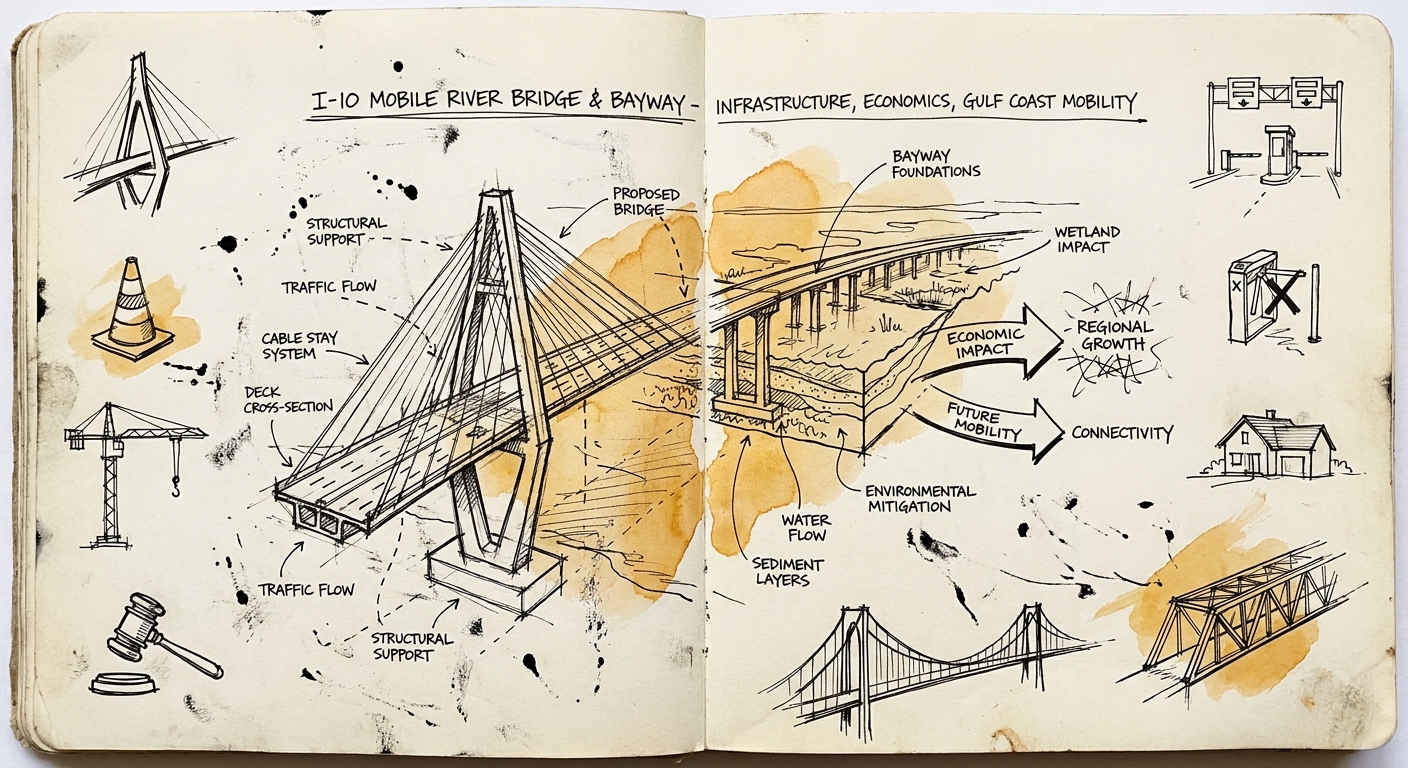
- The Mobile River Bridge: Construction of a new six-lane, cable-stayed bridge spanning the Mobile River. The structure will provide the necessary 215-foot air draft clearance for maritime traffic while allowing interstate vehicles to bypass the Wallace Tunnel entirely at highway speeds.
- Bayway Capacity Expansion: The original Environmental Impact Statement envisioned replacing the entire 7.5-mile Bayway immediately. To control costs, Phase One will instead focus on restriping the existing dual Bayway bridges to provide six lanes of traffic (three in each direction), eliminating the lane-drop bottleneck that currently triggers massive traffic backups at the tunnel approach.
- Interchange Reconfiguration: Comprehensive geometric improvements to major interchanges and intersections throughout the corridor in both Mobile and Baldwin counties. This includes the redesign of highly congested ramps to facilitate smooth merging and continuous traffic flow.
The project is being procured via progressive design-build contracts. This delivery method allows the state to collaborate directly with the prime contractors (such as Michael Baker International and Mott MacDonald) during the design phase to identify cost-saving engineering modifications and maintain aggressive scheduling.
3.2 Phase Two Deferment and Environmental Realities
The deferment of Phase Two represents a calculated engineering and financial compromise. The existing I-10 Bayway is a low-level causeway highly vulnerable to Gulf Coast storm surges. Following catastrophic hurricane damage to similar low-level interstate bridges in Florida, Mississippi, and Louisiana over the last decade, updated storm surge analyses indicated that the Mobile Bayway must be entirely replaced and elevated at least 8 feet higher to survive a 100-year storm event.
However, updated geotechnical analyses revealed that constructing an entirely new, elevated Bayway concurrently with the cable-stayed river bridge would push the project's total cost well beyond $5 billion—a threshold deemed financially unsustainable by state auditors. Furthermore, environmental mitigation for a new Bayway requires complex logistics, including the dredging of approximately 325,000 cubic yards of material from the bay floor to allow construction barges access to shallow waters, with the dredged material repurposed to create marsh island mitigation sites. Consequently, Phase Two (the total replacement of the Bayway) has been indefinitely deferred. It will be constructed as additional federal funding becomes available, with future toll revenues from Phase One earmarked to help finance its eventual completion.
4. Points of Contention and Historical Delays
The Mobile River Bridge project has been debated and studied for nearly 30 years, transitioning through numerous feasibility studies and route alignments since 1997. However, its most dramatic setback occurred in 2019, creating a political shockwave that fundamentally altered how the project would be financed and presented to the public.
4.1 The 2019 Toll Revolt
In 2019, ALDOT presented a comprehensive $2.1 billion plan to build the bridge and replace the Bayway simultaneously. The state intended to finance the megaproject through a Public-Private Partnership (P3), wherein a private concessionaire would design, build, finance, operate, and maintain the facility in exchange for toll revenues.
The fatal flaw in the 2019 proposal was the aggressive tolling structure. ALDOT proposed a toll of up to $6 each way for passenger vehicles, which would have cost daily commuters traversing the bay over $200 per month. Critically, the state proposed placing this toll not only on the new infrastructure but also on the existing George Wallace Tunnel, effectively forcing local residents to pay a toll to use a tunnel that had been free for decades.
The proposal sparked a fierce, localized populist revolt. Residents of Baldwin County, tens of thousands of whom commute into Mobile for work daily, viewed the toll as a punitive, unavoidable tax on working-class citizens. Grassroots organizations mobilized rapidly, and politicians across the ideological spectrum, including State Auditor Jim Zeigler and the Common Sense Campaign tea party group, organized massive public resistance.
Under federal highway regulations, state transportation departments cannot expend federal funds without the formal approval of local Metropolitan Planning Organizations (MPOs), which consist of local mayors and county commissioners. Bowing to overwhelming public pressure, the Eastern Shore MPO voted 8-1 in August 2019 to completely strike the controversial bridge project from its Transportation Improvement Plan (TIP). The sole dissenting vote attempting to save the project was cast by an ALDOT engineer. With local approval revoked, the project lost its eligibility for federal funding, prompting Governor Kay Ivey to declare the project unequivocally "dead" and canceling the state Toll Road, Bridge and Tunnel Authority meetings.
4.2 The Path to Political Resurrection
The project remained dormant until the physical realities of escalating traffic volumes forced a revival. A new framework was negotiated in 2021 and 2022, built upon strict parameters specifically designed to appease the local voting base.
The primary political concession was an absolute guarantee that all existing routes—including the Wallace Tunnel, the Bankhead Tunnel, the US 90-98 Causeway, and the Africatown Bridge—would remain entirely toll-free. ALDOT also committed to maintaining full state ownership of the asset, explicitly rejecting the P3 private concessionaire model that had stoked fears of corporate profiteering.
The political alignment was further smoothed by highly unusual, synergistic federal interventions across two vastly different presidential administrations. Under the Biden administration, the 2021 Infrastructure Investment and Jobs Act (IIJA) established the Bridge Investment Program. The US Department of Transportation subsequently awarded the Mobile project a monumental $550 million discretionary grant—one of the largest in the program's history.
Simultaneously, the Trump administration designated the project for the federal Interstate System Reconstruction and Rehabilitation Pilot Program. This obscure federal initiative granted ALDOT the rare legal authority to use toll revenue to reconstruct an existing interstate corridor, a practice normally prohibited by federal highway codes. Furthermore, political maneuvering during the Trump administration cleared significant regulatory red tape, eliminating costly mandated additions such as dedicated pedestrian and bicycle observation overlooks. While cycling advocates decried the loss of active transportation infrastructure, federal senators argued that stripping the project down to its core vehicular and freight functions saved hundreds of millions of dollars, ensuring its survival.
5. Financial Architecture and the Revised Toll Structure
To construct a $3.2 billion infrastructure asset without a private concessionaire, the state engineered a robust capital stack relying on federal largesse, state equity, and highly structured debt.
5.1 The Funding Stack
The Phase One capital requirements are financed through a blend of instruments:
- Federal Grants: The $550 million Bridge Investment Program grant and a $125 million Infrastructure for Rebuilding America (INFRA) grant.
- Federal Loans: A TIFIA loan intended to finance up to 49% of the total project costs. TIFIA loans offer states highly favorable borrowing rates and flexible repayment schedules backed by future toll revenues.
- State Equity: A direct cash investment of at least $250 million from ALDOT's highway funds.
- Revenue Bonds: Additional state-issued bonds backed by the tolling projections.
5.2 The 2031 Toll Framework
Because the state honored the demand to keep existing routes free, the new Mobile River Bridge will operate effectively as an express bypass. No tolls will be collected anywhere in the system until the new facility officially opens in 2031. The tolling system will be entirely all-electronic to maintain highway speeds, utilizing overhead gantries rather than traditional toll booths.
The revised toll structure represents a careful balancing act between maximizing revenue from interstate commerce and minimizing the financial burden on local voters.
| User Category | Proposed Toll Rate (Per Trip) | Financial Impact & Mechanics |
|---|---|---|
| Frequent Commuter (Unlimited Pass) | ~$1.36 (based on 44 trips/month) | A flat $60 unlimited monthly use pass designed specifically for daily commuters traveling between Baldwin and Mobile counties. |
| ALGO Pass Holder | $3.00 | Requires a state-issued transponder, which will be provided free of charge during the initial rollout to encourage adoption. |
| Interoperable Transponder (Out-of-State) | $7.70 | For users with compatible regional transponders (e.g., SunPass, E-ZPass) traversing the I-10 corridor from Florida to Texas. |
| Pay-by-Plate (No Transponder) | Variable (Highest Rate) | Vehicles lacking transponders will be billed via automated license plate readers, bearing the highest administrative cost burden. |
As noted in the user prompt, the toll for transient, out-of-state drivers approaches $8 per vehicle (specifically $7.70). This tiered structure intentionally shifts the heaviest financial burden onto commercial freight and out-of-town travelers crossing the Gulf Coast, effectively subsidizing the local workforce who can opt into the $60 monthly pass or utilize the toll-free Wallace Tunnel.
6. Evaluating Alternative Solutions: Why Not Mass Transit?
The commitment of $3.2 billion to pure highway expansion naturally invites intense scrutiny regarding alternative urban mobility solutions. As the user query asks: Could this massive sum have procured a regional light rail network, a robust bus rapid transit (BRT) system, or high-speed commuter ferries? Furthermore, would these alternatives have mitigated the regional pain points without embedding car culture into the Gulf Coast's future?
The analysis reveals that while the funds are vast, transit megaprojects in the modern United States are prohibitively expensive, and more importantly, passenger transit does not solve the heavy industrial and maritime bottlenecks intrinsic to the Mobile corridor. Finally, structural and constitutional realities in Alabama actively inhibit the viability of non-highway transit.
6.1 The Staggering Cost of US Transit Infrastructure
There is a widespread misconception that $3.2 billion is sufficient to build expansive regional rail networks. In the modern United States, transit capital costs have skyrocketed to unprecedented levels. For context, the 13-mile Blue Line Light Rail Extension in Minnesota—a modest suburban rail expansion—was originally budgeted at $1.5 billion but is currently estimated to cost $3.58 billion, or roughly $275 million per mile. Heavy rail and subway projects routinely exceed $1 billion to $2 billion per mile, and even dedicated Bus Rapid Transit (BRT) lines frequently cost between $40 million and $90 million per mile.
If applied to rail transit, $3.2 billion would likely yield a single, relatively short light rail line connecting the Daphne suburbs to downtown Mobile. While this might serve a fraction of white-collar commuters, it would entirely fail to accommodate the 75,000 to 100,000 personal vehicles crossing the bay daily, and it would do absolutely nothing to move the thousands of heavy freight trucks transporting timber, steel, and chemicals to and from the Port of Mobile. A passenger train cannot carry a hazardous materials tanker.
6.2 High-Speed Ferries: The Capital vs. Operating Cost Paradox
High-speed passenger-only ferries (POF) were explicitly evaluated during the project's EIS Alternative Screening. From a capital expenditure perspective, ferries are highly attractive. Feasibility studies conducted for the Potomac River in Virginia and the Puget Sound in Washington indicate that procuring ferry vessels and constructing floating docks can be accomplished for tens of millions of dollars rather than billions. For instance, the preliminary design for a 150-passenger electric fast ferry in Washington estimated capital construction costs at just $14.1 million per hull.
However, the economics of ferry transit are severely inverted; the capital costs are low, but the operating costs are ruinous. Ferries require massive, perpetual operating subsidies for specialized maritime crews, fuel or high-capacity electrical charging, constant hull maintenance, and terminal operations. A feasibility study for Potomac River ferries revealed a projected farebox recovery ratio (the percentage of operating costs covered by passenger fares) of only 19% in its base year, operating at a net loss of over $1.6 million annually and requiring an $18.59 per-passenger subsidy.
Furthermore, high-speed ferries operating in shallow, ecologically sensitive estuaries like Mobile Bay face severe wake-related speed restrictions to prevent shoreline erosion and damage to marine habitats. They are also highly vulnerable to weather cancellations. Ultimately, while ferries could serve as a niche tourist attraction, they cannot replace the continuous, high-volume, 24/7 throughput required by an interstate highway carrying national freight.
6.3 The Alabama Constitutional Barrier
Perhaps the most insurmountable hurdle to regional mass transit in Mobile is not engineering, but the Alabama State Constitution. Alabama holds the unique distinction of being the only state in the United States that provides virtually zero state funding for public transportation.
A 1952 amendment to the Alabama Constitution strictly mandates that state gasoline tax revenues and vehicle license fees can only be allocated toward the construction, maintenance, and policing of highways, roads, and bridges. This creates a structural paradox for regional planners: ALDOT possesses a dedicated, constitutionally protected revenue stream capable of matching billions in federal highway grants, but it possesses no legal mechanism to utilize state gas tax funds to match federal mass transit grants.
Any public transit initiative in Alabama—whether it is a BRT system in Birmingham or a theoretical ferry system in Mobile—must be funded entirely through localized municipal taxes and federal grants, perpetually starving the system of reliable state-level operating capital. In Mobile, the local transit network (The Wave) struggles with ridership and funding, operating purely as a lifeline service for dependent populations rather than a competitive commuting alternative.
Consequently, highway expansion is not merely a preference of ALDOT; it is the path of least resistance hardwired into the state's legal framework. When evaluating the 14 Build Alternatives during the EIS, mass transit, rail, and ferry options were eliminated early in the screening process because they failed the primary "Purpose and Need" requirement: they could not remove hazardous trucks from Africatown, nor could they meaningfully absorb the 95,000 projected daily vehicular trips required to relieve the national freight bottleneck.
7. Sprawl, Car Culture, and "Eastern Shore Flight"
The user prompt astutely observes that massive highway infrastructure embeds car culture into a region's future. Transportation economists widely recognize the principle of induced demand: expanding highway capacity temporarily lowers the "time cost" of commuting, which in turn encourages more people to live further away in sprawling suburbs. Over time, this migration fills the new capacity, eventually recreating the original congestion in a wider geographic footprint. The I-10 bridge project is poised to serve as an accelerant for this exact phenomenon in southern Alabama.
7.1 Divergent Demographic Trajectories: Mobile vs. Baldwin County
The I-10 corridor connects two counties on fundamentally divergent demographic and economic trajectories.
- Baldwin County (the Eastern Shore) is experiencing explosive, sustained growth. Driven almost entirely by inbound migration, it was recently ranked the sixth fastest-growing metropolitan statistical area in the United States, with a population increasing over 30% from 2014 to 2024. Municipalities such as Daphne, Fairhope, and Foley are rapidly expanding, consuming agricultural and timber lands to build residential subdivisions.
- Mobile County, conversely, has historically struggled with population stagnation. The urban core has experienced slight population declines over the last decade, even as it remains the undisputed regional powerhouse for heavy industry, hosting major employers like Airbus, Austal USA, the University of South Alabama, and the Port of Mobile.
7.2 The Mechanics of Tax Flight
The construction of a $3.2 billion, high-speed, six-lane conduit across Mobile Bay will drastically reduce the friction of the daily commute. While this solves immediate congestion, it effectively subsidizes "Eastern Shore flight."
Workers can secure high-paying industrial, aerospace, and logistical jobs in Mobile County, but choose to purchase homes and raise families in Baldwin County. This choice is heavily influenced by quality-of-life perceptions and, crucially, property taxes. Baldwin County features one of the lowest effective property tax rates in the nation (approximately 0.31% to 0.35%), whereas Mobile County's rates are noticeably higher (around 0.59%). Under Alabama law, single-family owner-occupied homes are assessed at only 10% of their market value, meaning a typical homeowner in Baldwin County pays a median annual property tax of just $557.
When high-income earners commute into Mobile for work but return to Baldwin County to live, they take their property tax, sales tax, and vehicle registration revenues with them. This capital flight starves the City of Mobile of the municipal revenue required to fund urban amenities, public schools, infrastructure maintenance, and its own local transit system. By easing the commute without concurrently investing in urban core livability, the new I-10 bridge facilitates a one-way extraction of wages from Mobile into the Baldwin County real estate market.
This sprawl is not without consequences for Baldwin County itself. Rapid suburbanization is straining local infrastructure, overcrowding schools (prompting fiercely debated property tax referendums to build new facilities), and triggering localized "NIMBY" (Not In My Back Yard) pushback against aggressive annexation and subdivision development.
8. Comparative Urban Case Studies
To understand how other regions handle similar geographical bottlenecks, one can look at peer infrastructure projects across North America. Coastal cities separated by vast bodies of water face unique engineering, environmental, and political challenges.
8.1 Tampa Bay, Florida: The Howard Frankland Bridge
The closest geographic and operational analog to the Mobile Bayway is the I-275 Howard Frankland Bridge over Old Tampa Bay in Florida. Connecting two distinct economic centers (St. Petersburg and Tampa) separated by three miles of shallow estuarine water, the original bridge suffered from immense daily congestion (carrying roughly 139,000 vehicles per day) and severe vulnerability to storm surge.
To address this, the Florida Department of Transportation (FDOT) executed an $865 million bridge replacement, creating a new structure featuring four general-purpose lanes and two tolled express lanes in each direction. Notably, FDOT learned from past infrastructural myopia regarding modal lock-in. They consciously spent an additional $25 million during construction to structurally over-engineer the foundations of the new bridge to accommodate the future weight and vibration of a Light Rail Transit (LRT) system, should the region ever decide to build one. Furthermore, they included a 12-foot, barrier-separated shared-use path for pedestrians and cyclists, complete with scenic overlooks.
By contrast, the Mobile River Bridge project prioritized absolute fiscal constraint over multimodal future-proofing. Early designs included pedestrian paths and observation decks, but these were explicitly stripped out to cut costs and appease federal auditors under the Trump administration, who viewed them as "unnecessary extras". Furthermore, there is no indication in the engineering documents that the Mobile River Bridge is being structurally rated to support future heavy rail transit. Mobile is prioritizing immediate vehicular and freight throughput, sacrificing the potential for future transit corridors in the name of political expediency and budget control.
8.2 The Pacific Northwest: Puget Sound and Vancouver
In regions like Seattle (which relies on the SR-520 floating bridge across Lake Washington) and Vancouver, British Columbia (which traverses the Burrard Inlet), alternative approaches have been tested with varying success. Seattle's recent SR-520 replacement included high-occupancy toll (HOT) lanes and dedicated transit infrastructure, integrating bus rapid transit directly into the highway footprint.
Vancouver famously rejected the construction of urban freeways through its downtown core in the 1970s, preventing massive highway interchanges from gutting its urban fabric. Instead, Vancouver relies heavily on the SeaBus passenger ferry and the SkyTrain automated light rail network to traverse its water bottlenecks.
However, Vancouver's model relies on extreme urban residential density and the absence of a heavy industrial port requiring daily transit by thousands of 18-wheelers directly through the city center. Mobile's fundamental economic reliance on the chemical, aerospace, and maritime industries dictates a freight-first approach that passenger ferries and light rail simply cannot fulfill.
9. Strategic Conclusions and Policy Implications
The green-lighting of the $3.2 billion I-10 Mobile River Bridge and Bayway Project represents a pragmatic, if inherently compromised, triumph of engineering and political negotiation over decades of stagnation. The project's phased approach successfully isolates the most pressing vulnerabilities—the functionally obsolete and dangerous Wallace Tunnel, the crippling economic congestion, and the environmental injustice of routing hazardous materials through Africatown—while deferring the multibillion-dollar replacement of the Bayway.
The analysis of the project yields several critical takeaways regarding the future of infrastructure in the region:
- The Permanence of Tolling: The transition from the 2019 political failure to the 2026 success proves that the public will accept highway tolls, provided they are framed as a choice rather than a captive tax. By preserving the free routes through the old tunnels, politicians successfully shifted the optics of the toll from a "penalty" to an "express convenience fee," establishing a precedent for how future infrastructure will be financed in tax-averse states.
- The Inviability of Mass Transit Equivalency: The assertion that $3.2 billion could have been better spent on rail or ferries ignores three vital realities. First, the exorbitant capital costs of US rail mean the funds would yield minimal geographic coverage. Second, ferries require perpetual operating subsidies that bleed transit agencies dry. Third, and most importantly, the Alabama Constitution's strict mandate tying gas tax revenues exclusively to road infrastructure makes state-funded transit practically illegal, cementing highway expansion as the only legally viable mechanism to capture federal transportation funds.
- The Acceleration of Exurban Sprawl: By drastically increasing vehicular capacity and maintaining a heavy toll subsidy for daily commuters ($60/month unlimited), the project will undoubtedly accelerate demographic and capital flight from Mobile County to Baldwin County. The City of Mobile must urgently pivot its economic development strategy toward urban livability and downtown retention, lest it become merely an industrial pass-through for high-income workers residing on the Eastern Shore.
Ultimately, the Mobile River Bridge will not alter the region's car-centric culture, nor will it pioneer new modes of sustainable transit. Instead, it fulfills a base-level macroeconomic necessity: unblocking a vital artery of the American supply chain, modernizing a dangerously outdated corridor, and ensuring the Port of Mobile remains a dominant engine of 21st-century global shipping.
Works cited
1. Mobile River Bridge construction expected to start later this year - Alabama Daily News, https://aldailynews.com/mobile-river-bridge-construction-expected-to-start-later-this-year/ 2. Mobile River Bridge and Bayway Project advances toward construction - ALDOT News Hub, https://www.aldotnews.com/2026/07/09/mobile-river-bridge-bayway-project-construction/ 3. Alabama plans new I-10 bridge over Mobile Bay, but MS drivers will have to pay, https://www.sunherald.com/news/local/traffic/article316461354.html 4. Five Things to Know About the Mobile River Bridge and Bayway Project, https://mobilechamber.com/2018/07/five-things-to-know-about-the-mobile-river-bridge-and-bayway-project/ 5. Tuberville, Britt: Trump administration clearing final obstacles for Mobile River Bridge, groundbreaking expected this year - Yellowhammer News, https://yellowhammernews.com/tuberville-britt-trump-administration-clearing-final-obstacles-for-mobile-river-bridge-groundbreaking-expected-this-year/ 6. The Mobile River Bridge and Bayway Project is Now a 2-Phase Project - Reddit, https://www.reddit.com/r/MobileAL/comments/1urwvau/the\_mobile\_river\_bridge\_and\_bayway\_project\_is\_now/ 7. 2023-07-18-approved-final-master-plan.pdf - Baldwin County, https://baldwincountyal.gov/docs/default-source/plannin-zoning/ordinances-and-regulations/2023-07-18-approved-final-master-plan.pdf?sfvrsn=ac7595ba\_5 8. alabama's growth leader - Baldwin Alliance, https://baldwineda.com/wp-content/uploads/2024/02/BBTN\_2023.pdf 9. Advanced design for Mobile River Bridge and Bayway - Mott MacDonald, https://www.mottmac.com/en-us/projects/mobile-river-bridge-and-bayway-bridge/ 10. I-10 Mobile River Bridge and Bayway Combined FEIS/ROD, FHWA-AL-EIS-19-01-F, https://mobileriverbridge.com/wp-content/uploads/2019/09/I-10-Mobile-River-Bridge-and-Bayway-Combined-FEIS-ROD\_Signed-08-15-2019.pdf 11. George Wallace Tunnel - Grokipedia, https://grokipedia.com/page/George\_Wallace\_Tunnel 12. Work moves ahead on Mobile River I-10 bridge - Gulf Coast Media, https://www.gulfcoastmedia.com/stories/work-moves-ahead-on-mobile-river-i-10-bridge,129219 13. Draft Environmental Impact Statement - Mobile River Bridge, https://mobileriverbridge.com/wp-content/uploads/2019/09/Draft\_EIS.pdf 14. Capturing CO2 Emissions in the George C. Wallace Tunnel: A Case Study - Scirp.org., https://www.scirp.org/journal/paperinformation?paperid=135554 15. I-10 Mobile River Bridge and Bayway Supplemental DEIS, https://mobileriverbridge.com/wp-content/uploads/2020/09/Mobile-River-Bridge-and-Bayway-SDEIS-Volume-I.pdf 16. Historic Black Community Put at Risk by Truck Bridge - Union of Concerned Scientists, https://blog.ucs.org/cecilia-moura/historic-black-community-put-at-risk-by-truck-bridge/ 17. On Proposed Tolling on the I-10 Bridge, Tunnel, and Bayway | MEJAC, https://www.mejacoalition.org/2019/05/07/i10bridgecomment/ 18. Mobile-Baldwin County Report - The Kirkland Company, https://thekirklandco.com/market\_reports/mobile-baldwin-county\_nov2023/ 19. State to announce major steps forward with Mobile River Bridge and Bayway project - Alabama Daily News, https://aldailynews.com/state-to-announce-major-steps-forward-with-mobile-river-bridge-and-bayway-project/ 20. Mobile River Bridge and Bayway Project - Michael Baker International, https://mbakerintl.com/projects/mobile-river-bridge-and-bayway-project/ 21. ALDOT, other agencies announce timeline for long-running Mobile River Bridge and Bayway Project - Alabama Political Reporter, https://www.alreporter.com/2026/07/10/aldot-other-agencies-announce-timeline-for-long-running-mobile-river-bridge-and-bayway-project/ 22. OP-ED: U.S. Senators Katie Britt, Tommy Tuberville – 'President Trump Is Delivering for Alabama and the Gulf Coast', https://www.britt.senate.gov/news/press-releases/op-ed-u-s-senators-katie-britt-tommy-tuberville-president-trump-is-delivering-for-alabama-and-the-gulf-coast/ 23. Britt and Tuberville praise Trump as ALDOT announces $3.2 billion Mobile River Bridge will break ground this year - Alabama Trucking Association, https://www.alabamatrucking.org/britt-and-tuberville-praise-trump-as-aldot-announces-3-2-billion-mobile-river-bridge-will-break-ground-this-year/ 24. Ivey: “There is no pathway forward” for Mobile River Bridge and Bayway replacement - Alabama Political Reporter, https://www.alreporter.com/2019/08/29/ivey-there-is-no-pathway-forward-for-mobile-river-bridge-and-bayway-replacement/ 25. Mobile River Bridge and Bayway Project Moves Forward, https://mobilechamber.com/2022/03/mobile-river-bridge-and-bayway-project-moves-forward/ 26. I-10 Mobile River Bridge and Bayway Combined FEIS/ROD - Appendix B, https://mobileriverbridge.com/wp-content/uploads/2019/09/Appendix-B-Disposition-of-Substantive-Comments-on-SDEIS.pdf 27. ALDOT defends I-10 Mobile River Bridge and Bayway revised toll standard, encourages ALGO Pass use - 1819 News, https://1819news.com/news/item/aldot-defends-i-10-mobile-river-bridge-and-bayway-revised-toll-standard-encourages-algo-pass-use 28. Bellator President Troy Wilson asks for your support in Build Baldwin Now property tax increase, https://www.gobellator.com/blog/2015/02/13/bellator-president-troy-wilson-asks-for-your-support-in-build-baldwin-now-property-tax-increase 29. 'More details to share in the weeks ahead': Tuberville, Britt tout Trump administration contributions to proposed I-10 Mobile Bridge and Bayway in AL(dot)com op-ed - 1819 News, https://1819news.com/news/item/more-details-to-share-in-the-weeks-ahead-tuberville-britt-tout-trump-administration-contributions-to-proposed-i-10-mobile-bridge-and-bayway-in-aldotcom-op-ed 30. Alabama Department of Transportation, https://www.dot.state.al.us/business/pdf/2024\_1007\_TollingProposal\_RFP\_Cancellation.pdf 31. GOP Caucus - RELEASE: Blue Line Extension Rail Cost Skyrockets to $3.58 Billion, Koznick Urges to Scrap LRT for Bus Alternatives - Minnesota House of Representatives, https://www.house.mn.gov/Caucus/View/GOP/52208 32. Estimated cost of Blue Line light rail extension jumps to nearly $3.6 billion | MPR News, https://www.mprnews.org/story/2026/06/17/estimated-cost-blue-line-light-rail-extension-jumps 33. Blue Line light rail extension now estimated to cost over $3.5 billion - FOX 9, https://www.fox9.com/news/blue-line-light-rail-extension-now-estimated-more-than-3-billion 34. What Makes a Successful Transit Investment? | US Department of Transportation, https://www.transportation.gov/utc/what-makes-successful-transit-investment 35. Transit Agencies Go Insane – The Antiplanner - The Thoreau Institute, https://ti.org/antiplanner/?p=20762 36. Appendix B: Alternatives Screening Evaluation - Mobile River Bridge, https://mobileriverbridge.com/wp-content/uploads/2019/09/Appendix\_B-G.pdf 37. Passenger Ferry Boat Feasibility Study - Northern Virginia Regional Commission, https://novaregion.org/DocumentCenter/View/13224/VDOT-Passenger-Ferry-Boat-Feasibility-Study-2000-PDF?bidId= 38. puget sound passenger- only ferry study, https://www.psrc.org/sites/default/files/2022-03/210127-pof-study-report-only.pdf 39. Foil Ferry Preliminary Design Report - Federal Transit Administration, https://www.transit.dot.gov/sites/fta.dot.gov/files/2023-10/FTA-Report-No-0257.pdf 40. GSGP FERRY ELECTRIFICATION PRIORITIZATION - Council of Great Lakes Governors, https://gsgp.org/media/uznhzltv/prime-focus-ferry-report-final-7-26-24.pdf 41. Birmingham Public Transit Inches Forward With Federal Help, and No State Funding, http://capitalbnews.org/birmingham-public-transit-inches-forward-with-federal-help-and-no-state-funding/ 42. The Alabama Constitution's Impact on Taxes and Spending, https://parcalabama.org/wp-content/uploads/2025/01/The-Alabama-Constitutions-Impact-on-Taxes-and-Spending.pdf 43. Municipalities and State-Shared Fuel Taxes and Inspection Fees, https://almonline.org/Assets/Files/LegalSelectedReadings/31.Municipalities-and-State-Shared-Fuel-Taxes-and-Inspection-Fees\_REVISED-02-24-2025.pdf 44. ALABAMA TREASURY GAS TAX DISTRIBUTION Section 40-12-270 Disbursement of net proceeds from license taxes and registration fees, https://treasury.alabama.gov/wp-content/uploads/2024/07/GAS-TAX-law-update.pdf 45. Mobile Area Demand- Response Transit System Feasibility Study, https://www.mobilempo.org/Planning%20Studies/Mobile%20Area%20Transit%20Feasibility%20Study\_DRAFT\_8\_10\_2020.pdf 46. Mobile's Transit Future | The Wave Transit System, AL, https://www.thewavetransit.com/1281/Mobiles-Transit-Future 47. Baldwin County, Alabama - Wikipedia, https://en.wikipedia.org/wiki/Baldwin\_County,\_Alabama 48. Baldwin County now has the 6th fastest-growing metro in U.S. - Gulf Coast Media, https://www.gulfcoastmedia.com/stories/baldwin-county-now-has-the-6th-fastest-growing-metro-in-us,262832 49. Are We Going to See a Shift in Population Growth From Baldwin County to Mobile County in the Next Few Years? - Reddit, https://www.reddit.com/r/MobileAL/comments/x6ig47/are\_we\_going\_to\_see\_a\_shift\_in\_population\_growth/ 50. Baldwin County Property Taxes: A Comprehensive Guide, https://localpropertyinc.com/baldwin-county-property-taxes/ 51. Alabama Counties with the Largest Property Tax Payments in 2018 - ACRE, https://acre.culverhouse.ua.edu/2019/04/17/alabama-counties-with-the-largest-property-tax-payments-in-20180/ 52. Personal Property - Baldwin County, https://baldwincountyal.gov/government/revenue-commission/divisions/personal-property 53. The Boom of Baldwin County | Alabama Public Radio, https://www.apr.org/news/2015-06-01/the-boom-of-baldwin-county 54. town of elberta, https://www.townofelberta.com/media/226 55. I-275 (Howard Frankland Bridge) new southbound bridge between Pinellas and Hillsborough counties 422904-2-52-01 - FDOT Tampa Bay, https://www.fdottampabay.com/project/417/422904-2-52-01 56. Howard Frankland Bridge Construction Engineering & Inspection - AtkinsRéalis, https://www.atkinsrealis.com/en/projects/howard-frankland-bridge-construction-engineering-inspection 57. I-275/Howard Frankland Bridge PD&E Study - Consor Engineers, https://www.consoreng.com/project/i-275-howard-frankland-bridge-pde-study/ 58. Howard Frankland Bridge Replacement — Tampa, FL - Parsons Corporation, https://www.parsons.com/project/howard-frankland-bridge-replacement-tampa-fl/ 59. Project Details | Howard Frankland Bridge (I-275/SR 93) PD&E Study and Regional Transit Corridor Evaluation, https://www.fdotd7studies.com/projects/hfbs/project-details/ 60. Unclogging America's Arteries - Effective Relief for Highway Bottlenecks, https://www.highways.org/wp-content/uploads/2004/04/bottleneck2004.pdf 61. Washington State DOT's Ultra High-Speed Ground Transportation Business Case Analysis (UHSGT) is a promotional brochure riddled, https://www.washingtonpolicy.org/library/doclib/Frost-WSDOT-UHSGT-1-.pdf 62. The Case for Rapid Transit…in 1970 - Voony's Blog, https://voony.wordpress.com/2010/03/21/the-case-for-rapid-transit-in-1970/ 63. Kay Ivey: For Mobile Bayway Project, The Cost of Doing Nothing is Too High - Alabama Daily News, https://aldailynews.com/kay-ivey-for-mobile-bayway-project-the-cost-of-doing-nothing-is-too-high/ 64. PLAN SUMMARY - Build Mobile, https://www.buildmobile.org/uploads/01newplanplansummaryfrommainreport.pdf