
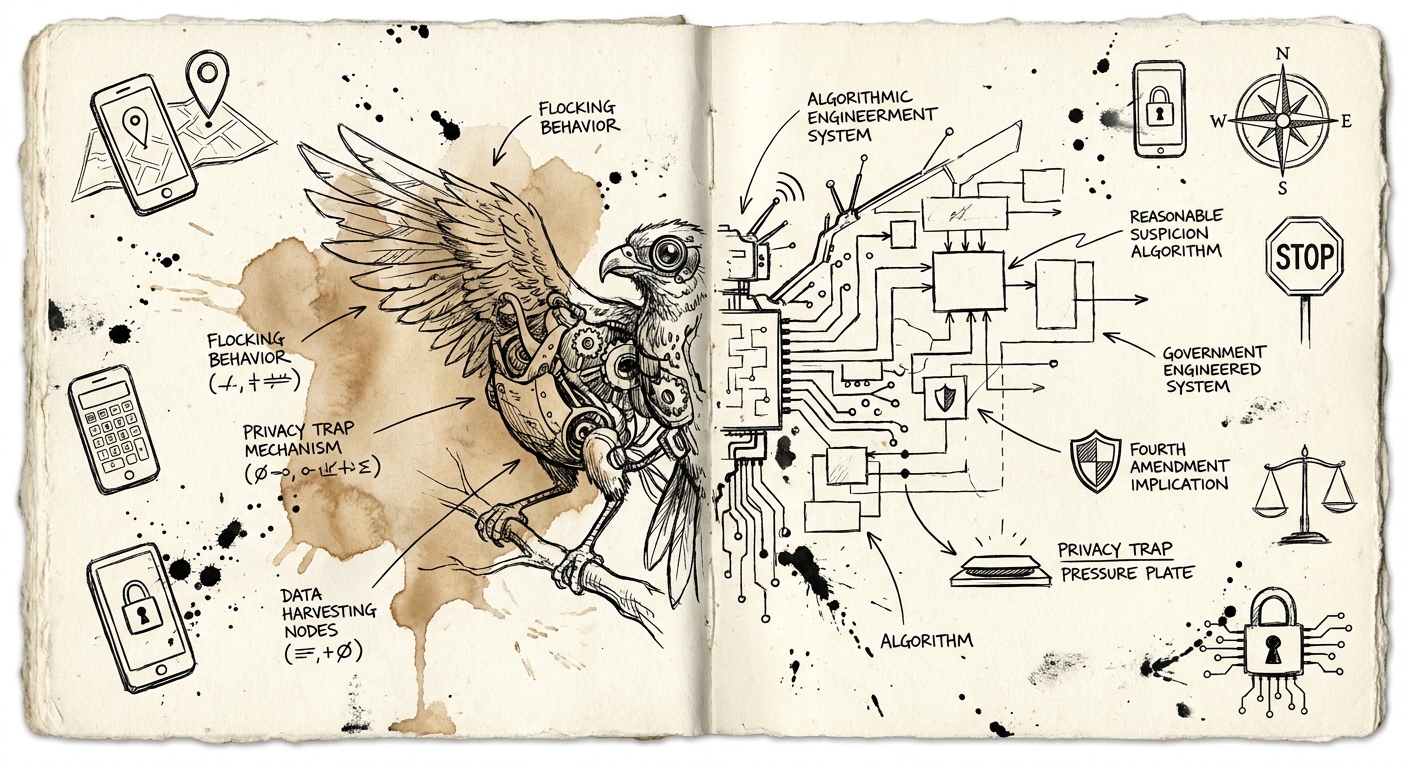
The "Flock Hopper" Paradox: Fourth Amendment Implications of Government-Engineered Privacy Traps and Algorithmic Reasonable Suspicion
This article explores a hypothetical government-engineered privacy app, "Flock Hopper," and its profound constitutional challenges concerning digital surveillance, the Fourth Amendment, and the legality of algorithmic suspicion.
Listen to this article
23 min listen
The "Flock Hopper" Paradox: Fourth Amendment Implications of Government-Engineered Privacy Traps and Algorithmic Reasonable Suspicion
The rapid proliferation of digital surveillance technologies, most notably Automated License Plate Recognition (ALPR) systems, has fundamentally altered the landscape of public privacy and law enforcement. Networks of cameras, such as those deployed by vendors like Flock Safety, possess the capability to continuously monitor vehicular movement across municipalities, creating vast, searchable databases of historical location data. As a thought experiment to probe the boundaries of modern constitutional law, consider the hypothetical deployment of a mobile application dubbed "Flock Hopper." Marketed to the public as a privacy-enhancing navigation tool, the application purportedly routes users around known ALPR camera locations, allowing citizens to travel without being logged in government or corporate surveillance databases.
However, in this scenario, the application is a covert creation of law enforcement agencies or the ALPR vendor acting as an agent of the state. Unbeknownst to the user, the app continuously siphons real-time location data and routing patterns directly to the police. When the application's algorithm identifies a user taking highly circuitous, evasive routes explicitly designed to bypass surveillance architecture, law enforcement initiates a physical traffic stop. This stop is based entirely on the "suspicious" behavior of avoiding cameras, leading to the discovery of contraband, an arrest, and subsequent prosecution.
This scenario forces a profound collision between the physical realities of Terry stops, the digital evolution of the mosaic theory, and the complex, often contradictory doctrines surrounding undercover ruses and contractual consent. To determine whether the state could successfully prosecute an individual based on evidence derived from this application—given the absence of traditional probable cause and the presence of an expressed expectation of privacy—one must systematically deconstruct the legality of the initial digital search (the app's covert data collection), the legality of the physical seizure (the traffic stop), and the broader constitutional theories governing algorithmic suspicion.
Part I: The Technological and Precedential Foundation of Government Stings
Before evaluating the legality of the physical traffic stop, the legal inquiry must begin with the acquisition of the digital location data. The state's case rests entirely on the premise that the data harvested by the Flock Hopper app was legally obtained. The creation of a "privacy" device or application by law enforcement to trap targets is not a work of science fiction; it is an established, highly successful tactic in international law enforcement, though its application to domestic citizens on public roads raises unprecedented constitutional challenges.
Operation Trojan Shield and the ANOM Precedent
The closest technological and operational parallel to the Flock Hopper thought experiment is Operation Trojan Shield, a watershed international law enforcement sting executed in 2021. For years, criminal syndicates relied on "hardened" encrypted devices from companies like Phantom Secure and Sky Global to orchestrate illicit activities away from prying eyes. Following the FBI's takedown of Phantom Secure in 2018 and the indictment of its founder, Vincent Ramos, a massive void was created in the encrypted communications market.
To exploit this vacuum, the Federal Bureau of Investigation (FBI), in coordination with the Australian Federal Police (AFP) and Europol, pursued an audacious strategy: they secretly established and operated their own encrypted messaging network, branded as ANOM. The FBI collaborated with a confidential human source—a former Phantom Secure distributor known in court filings as "Afgoo"—who provided a prototype of a new encrypted device in exchange for $120,000 annually and a reduced sentence. The ANOM devices were essentially standard Google Pixel smartphones stripped of all normal functionality, including voice calling, email, location services, and third-party app installation. The devices ran a custom Android ROM called ArcaneOS. Users accessed a hidden encrypted messaging client by opening a functional calculator app and entering a specific mathematical sequence.
Marketed through the criminal underworld as a platform "built by criminals for criminals," ANOM boasted absolute reliability and features such as the ability to remotely wipe devices if seized by law enforcement. In reality, the FBI had attached a hidden routine within the application that copied every single message and forwarded it in real-time to a third-party server accessible by law enforcement. Over the course of thirty-three months, law enforcement distributed more than 12,000 devices across 100 countries, intercepting an intelligence haul of over 27 million messages. The confidence criminals placed in the application led to open discussions of smuggling routes, money laundering, and violent crimes, culminating in June 2021 with the arrest of over 800 suspects, and the seizure of 32 tons of illegal drugs, 250 firearms, and $48 million in cash and cryptocurrency.
Operation Trojan Shield demonstrated unequivocally that law enforcement possesses both the technical acumen and the strategic willingness to engineer vast surveillance networks operating under the guise of private, privacy-centric enterprises. When extradited defendants, such as Alexander Dmitrienko, filed motions to dismiss their indictments and suppress the ANOM evidence, the district courts swiftly denied the motions. The legal viability of ANOM, however, hinged on a critical jurisdictional reality: the vast majority of the targets were foreign nationals operating transnational criminal syndicates outside the sovereign borders of the United States. The district courts concluded that the Fourth Amendment did not apply to these foreign defendants, and thus, the ANOM data collection did not violate the U.S. Constitution.
The Flock Hopper scenario transplants this exact methodology—a government-engineered digital ruse designed to exploit a target's desire for privacy—into a purely domestic context involving everyday citizens. If local law enforcement engineered the Flock Hopper application, they could not rely on the jurisdictional shields that protected Operation Trojan Shield. The data collection would be subject to strict, localized Fourth Amendment scrutiny.
| Parameter | Operation Trojan Shield (ANOM) | The "Flock Hopper" App |
|---|---|---|
| Target Demographic | Transnational organized crime syndicates, international drug cartels, mafia cells. | Domestic citizens seeking location privacy on public thoroughfares within the United States. |
| Mechanics of Deception | Modified Google Pixel hardware running ArcaneOS; hidden app disguised as a calculator. | Standard smartphone application disguised as a privacy-centric, anti-surveillance navigation tool. |
| Primary Legal Defense | Fourth Amendment protections are inapplicable to foreign targets operating abroad. | User consent via Terms of Service, contractual waiver, and the Third-Party Doctrine. |
| Nature of the Suspicion | Direct, explicit communication regarding the commission of felonies (e.g., drug importations). | Lawful behavior (driving on public roads) deemed "suspicious" entirely via algorithmic routing patterns. |
Part II: Fourth Amendment Implications of the Digital Ruse
In the Flock Hopper hypothetical, the prosecution would undoubtedly argue that no search warrant was required for the initial data collection because the user voluntarily downloaded the application and consented to share their GPS location data, likely by accepting an End User License Agreement (EULA) or Terms of Service. The legal theory tested here is whether digital consent is vitiated when it is obtained through a government ruse that fundamentally misrepresents the nature, intent, and operator of the application.
The Limits of the Undercover Consent Doctrine
The Fourth Amendment permits law enforcement to utilize decoys, concealed identities, and ruses in criminal detection. The foundational precedent for this doctrine is the 1966 Supreme Court case Lewis v. United States. In Lewis, an undercover federal narcotics agent named Edward Cass falsely identified himself over the telephone as "Jimmy the Pollack" to gain entry into the petitioner's home for the express purpose of purchasing marijuana. After the consummation of two illegal drug transactions within the home, the petitioner sought to suppress the evidence, arguing that a fraudulently induced invitation cannot constitute a valid waiver of Fourth Amendment protections.
Chief Justice Earl Warren, delivering the opinion of the Court, held that the deceptive entry did not violate the Fourth Amendment. The Court reasoned that when a home is opened as a place of illegal business to which outsiders are invited for commercial purposes, an undercover agent's entry via deception remains reasonable, provided the agent's activities remain strictly within the scope of the business invitation. The state relies heavily on Lewis to argue that the involvement of an undercover officer—or in this case, a digital undercover application—is an acceptable stratagem that does not inherently vitiate consent.
However, the Flock Hopper scenario drastically departs from the protections afforded to law enforcement in Lewis. In the 1966 case, the target invited the agent into his home specifically to consummate a felony. In stark contrast, downloading a navigation application to protect one's privacy and avoid ALPR cameras is a fundamentally legal, non-criminal act. The Supreme Court provided a critical boundary to the ruse doctrine in Gouled v. United States (1921), which the Lewis Court explicitly distinguished. In Gouled, an intruder acting on behalf of federal officers obtained entry into a suspect's office by falsely representing that he intended only to pay a social visit. Once inside, he secretly ransacked the office and seized private papers in the owner's absence. The Court held that this initial intrusion, occasioned by a fraudulently obtained invitation rather than stealth, violated the Fourth Amendment because it constituted a secret and general ransacking outside the scope of the consent.
Lower courts have consistently reinforced this boundary. If a law enforcement officer obtains consent to enter a protected space by "trick, ruse, or subterfuge," the consent is considered involuntary if the officer misrepresents their authority or their ultimate purpose. For example, if an officer falsely claims to have a search warrant, the resulting consent is invalid because the occupant believes they have no right to resist. Similarly, if an officer claims to be conducting a routine code inspection when their true purpose is a narcotics search, the consent is ruled involuntary. In the Tenth Circuit case United States v. Harrison, the court evaluated whether consent to search was coerced when federal agents falsely implied that a bomb might have been planted in the defendant's apartment. The courts recognize that while misrepresenting identity to an active criminal is permissible, misrepresenting the very nature of the interaction to an innocent citizen undermines the voluntariness of the consent.
| Ruse Doctrine Precedent | Core Legal Holding | Application to "Flock Hopper" |
|---|---|---|
| Lewis v. United States (1966) | Deception regarding identity does not violate the 4th Amendment if the suspect invites the agent for an illegal purpose. | Distinguishable. The user downloads the app for a legal purpose (privacy/navigation), not to consummate a crime with the app developer. |
| Gouled v. United States (1921) | A search violates the 4th Amendment if consent is gained via a social ruse, leading to a secret ransacking. | Highly Applicable. The user consents to navigation data processing; the state secretly ransacks the data to deduce criminal intent. |
| Schneckloth v. Bustamonte (1973) | Consent must be voluntarily given, evaluated under the "totality of the circumstances," without implicit or explicit coercion. | Applicable. The totality of circumstances involves the state preying on a citizen's desire to exercise their right to privacy. |
Fraud in the Inducement and Digital Rummaging
If a citizen grants an application access to their GPS for the express purpose of enhancing their privacy, and the government secretly operates that application to track them, the consent is obtained by fraud in the inducement. Because the user is extending an invitation for a legal activity, the government’s clandestine data harvesting falls outside the scope of the consent, aligning with the unconstitutional secret ransacking condemned in Gouled.
Furthermore, the Flock Hopper app would be tested against the emerging legal theory of "digital rummaging." The Fourth Amendment was drafted as a direct response to the English practice of issuing general warrants and writs of assistance, which allowed officials of the Crown to conduct broad, indiscriminate searches of homes to find evidence against the state. The modern equivalent of the general warrant is digital rummaging—the indiscriminate, algorithmic acquisition of personal information by government agents.
In the landmark case Riley v. California, which required a warrant for the search of a smartphone incident to arrest, Chief Justice John Roberts explicitly noted that the Fourth Amendment was designed to prevent police officers from rummaging through private spaces. Operating a decoy application to capture the continuous routing data of thousands of citizens in the hopes of finding a few "suspicious" actors is the definition of arbitrary, generalized police power. Legal scholars argue that digital rummaging constitutes a cognizable, stand-alone Fourth Amendment violation, separate from traditional trespass or expectation of privacy tests. The defense would argue that Flock Hopper represents a systemic ruse for a general rummaging, transforming an overbroad data collection scheme into an inherently unconstitutional act.
Part III: Location Data, The Mosaic Theory, and Expectation of Privacy
Even if the prosecution successfully argues that the ruse was a permissible form of undercover policing and that the Terms of Service constituted valid consent, they must overcome the fact that the data collected—continuous historical and real-time location data—enjoys profound constitutional protection. The legal theories tested in this phase of the litigation involve the collapse of the Third-Party Doctrine and the maturation of the mosaic theory.
Carpenter and the Fall of the Third-Party Doctrine
Historically, the government could obtain location data from technology companies under the Stored Communications Act (SCA) without a probable cause warrant. The SCA merely required the government to provide "specific and articulable facts showing that there are reasonable grounds to believe" that the records sought were relevant and material to an ongoing criminal investigation. This framework relied heavily on the Third-Party Doctrine, which posited that individuals lose their reasonable expectation of privacy in information voluntarily disclosed to third parties, such as cell phone carriers, banks, or app developers.
This paradigm was fundamentally altered by the Supreme Court's 2018 decision in Carpenter v. United States. In Carpenter, the government obtained 127 days of historical cell-site location information (CSLI) for the defendant, generating maps that placed his phone near the locations of several robberies. The Supreme Court reversed the lower courts, holding that the warrantless seizure and search of historical cell-phone records revealing the physical movements of a user over an extended period violates the Fourth Amendment. The Court recognized that digital location tracking creates an all-encompassing, detailed chronicle of a person's physical presence, encompassing roughly 101 data points per day. This exhaustive tracking overrides the traditional application of the Third-Party Doctrine, signaling that individuals maintain a privacy interest in their physical movements even when that data is mediated by a corporation.
Similarly, the Eleventh Circuit Court of Appeals in United States v. Quartavious Davis ruled that obtaining cell site location data without a warrant is a Fourth Amendment violation. The court explicitly rejected the government's argument that a user voluntarily discloses this data in such a fashion as to lose their reasonable expectation of privacy merely by using a cell phone, noting that a person's movements can reveal private associations, medical visits, and religious practices.
In the case of Flock Hopper, the state might attempt to argue that Carpenter applies strictly to historical CSLI obtained from wireless carriers via the SCA, not to GPS data voluntarily supplied to a consumer navigation application. However, post-Carpenter jurisprudence increasingly views continuous location data—regardless of the specific technological medium—as intrinsically protected. The application creates the exact type of detailed, inescapable location log that the Supreme Court sought to protect.
The Mosaic Theory in the Fourth Circuit
The most formidable legal theory the defense would deploy against the admissibility of the Flock Hopper data is the "mosaic theory." First popularized in the concurring opinions of United States v. Jones (which involved tracking a vehicle with a GPS device for 28 days), the mosaic theory suggests that while a single observation of a person in public might not trigger Fourth Amendment protections, a continuous series of observations, when aggregated, creates a comprehensive mosaic of a person's life that violates a reasonable expectation of privacy.
The application of the mosaic theory to persistent mass surveillance was solidified in the Fourth Circuit's en banc decision in Leaders of a Beautiful Struggle v. Baltimore Police Department (2021). In this case, the Baltimore Police Department initiated a pilot program utilizing persistent aerial surveillance to track pedestrian and vehicular movements across the entire city, ostensibly to assist in solving violent crimes. The Fourth Circuit ruled the Aerial Investigation Research (AIR) program unconstitutional, holding that the aggregation of location data over time creates a mosaic deserving of Fourth Amendment protection.
The court emphasized that the constitutional problem arose not from a single camera frame—which merely showed blurred dots—but from the system's ability to connect those dots across time and combine them with other sources, effectively changing law enforcement's role from "watching what happens" to "searching what already happened". Artificial intelligence and computer vision dramatically lower the cost of this mosaic surveillance, removing the practical frictions that historically constrained police overreach.
Legal scholars note that Carpenter established a two-step mosaic inquiry: first, does the data, when aggregated, have the potential to violate a reasonable expectation of privacy? And second, did the information obtained in the specific case do so?.
When applying the two-step mosaic theory to the Flock Hopper thought experiment:
- Potential for Violation: The app continuously logs a user's precise GPS coordinates, routing choices, speed, and terminal points (such as a private residence or a place of business). This aggregated data undeniably has the potential to reveal highly intimate details of the user's life, creating the "all-encompassing" log prohibited by Carpenter.
- Actual Violation: By utilizing artificial intelligence to analyze a user's route specifically to deduce their intent (surveillance evasion), the algorithm uses the entirety of the mosaic to generate an alert. It relies on the aggregation of data to form a pattern of "suspicion."
Current litigation underscores the relevance of this theory. A federal lawsuit filed by the Institute for Justice against the city of Norfolk, Virginia, challenges the municipality's installation of over 170 Flock Safety ALPR cameras, arguing that the system constitutes an unconstitutional warrantless surveillance program. The suit relies heavily on Carpenter and Leaders of a Beautiful Struggle, arguing that ALPR systems create a detailed mosaic of daily patterns without individualized suspicion.
Flock Safety defends its technology by noting that ALPRs capture fixed, point-in-time roadway observations with a 30-day default retention, distinguishing it from the continuous, person-focused tracking condemned in Carpenter. However, the hypothetical Flock Hopper app bridges this exact gap. By using the app to track the user between the fixed camera points, the state converts static ALPR nodes into a continuous, real-time tracking network, directly violating the mosaic theory's constraints.
Part IV: Translating Digital Tracking to Physical Seizures: The Terry Stop Dilemma
If the prosecution somehow survives the monumental Fourth Amendment challenges regarding the initial digital search—perhaps by convincing a judge that the user's explicit opt-in to the application waived their Carpenter rights—they must then justify the physical seizure. The thought experiment dictates that the flow of location data leads police to pull over someone whose "travel routes were suspicious." The sole basis for this stop is evasive driving behavior discovered via the app.
The Standard for a Terry Stop
Under the seminal 1968 Supreme Court decision Terry v. Ohio, a law enforcement officer may conduct a brief, investigatory stop of a person only if the officer reasonably believes that the person has committed, or is about to commit, a crime. The officer must have a "reasonable, articulable suspicion" that criminal activity is afoot. This standard requires the officer to point to "specific and articulable facts which, taken together with rational inferences from those facts, reasonably warrant that intrusion". It requires more than an inchoate and unparticularized suspicion or a mere "hunch".
The central legal question is whether the act of intentionally avoiding an ALPR camera constitutes reasonable, articulable suspicion of a crime.
The Checkpoint Avoidance Analogy
To evaluate whether avoiding an LPR is inherently suspicious, courts would likely look to the closest physical analog: avoiding police roadblocks and DUI checkpoints. The jurisprudence on checkpoint avoidance is highly fragmented across the United States, providing disparate arguments for the prosecution and the defense.
In states like Alabama, the courts have been relatively deferential to law enforcement regarding evasion. In State v. White (2009), the Alabama court held that turning around before approaching a checkpoint, without the possibility that the turn was merely to avoid traffic delays, provides an officer with reasonable suspicion to justify an investigatory stop. Alabama police officers frequently use evasion maneuvers as justification for traffic stops, viewing the avoidance of the police as an indicator of criminal defiance. The state in the Flock Hopper case would argue that a user actively routing themselves through complex backroads solely to avoid a public ALPR camera is the digital equivalent of a U-turn 50 feet prior to a roadblock, thereby generating reasonable suspicion of illicit activity.
However, the majority of jurisdictions require significantly more than mere avoidance to justify a seizure. In the Illinois Supreme Court case regarding defendant Jacob D., the state argued that the defendant's U-turn to avoid a marked police roadblock provided reasonable suspicion for a stop. The court thoroughly examined the issue, noting that individuals possess a fundamental constitutional right to avoid an encounter with the police in the absence of reasonable suspicion. The United States Supreme Court established in Florida v. Royer (1983) and Illinois v. Wardlow (2000) that when an officer approaches an individual without reasonable suspicion or probable cause, the individual has a right to ignore the police and go about their business.
While Wardlow allowed that unprovoked, headlong flight in a high-crime area can constitute reasonable suspicion, simply making a legal U-turn to avoid a checkpoint, without committing a separate traffic violation, is frequently deemed insufficient for a stop. Avoiding a checkpoint is not, in itself, a pretext for a stop; it is the assertion of the right to be let alone.
| State/Jurisdiction | Stance on Checkpoint Avoidance | Implication for "Flock Hopper" |
|---|---|---|
| Alabama (State v. White) | Turning around before a checkpoint to avoid it provides reasonable suspicion for a stop. | Favors Prosecution: Routing around an ALPR is analogous to checkpoint evasion, justifying a Terry stop. |
| *Illinois (Jacob D.)* | Evasive maneuvers must be viewed in totality; individuals have a right to avoid police. | Favors Defense: Lawful navigation away from a camera is an exercise of privacy, not a specific, articulable crime. |
| SCOTUS (Wardlow / Royer) | Citizens may ignore police without reasonable suspicion; flight in a high-crime area is different. | Favors Defense: Passive evasion of cameras does not constitute "headlong flight," rendering the stop unconstitutional. |
The Legality of Invoking Privacy and Algorithmic Hunches
The Flock Hopper scenario involves passive ALPR cameras, not physical, manned police roadblocks. ALPR systems are passive data collectors; an ALPR alert alone does not establish probable cause or even reasonable suspicion to initiate a stop unless the scanned license plate is already tied to a specific crime, stolen vehicle, or active warrant. Therefore, the cameras themselves represent generalized surveillance, not an active investigation of the driver.
Avoiding an ALPR camera is not "flight" from law enforcement; it is a deliberate, lawful choice to navigate public spaces without being continuously recorded. Seeking privacy is not a crime. If the state attempts to justify a Terry stop solely on the grounds that a citizen utilized legal, public roadways to avoid being photographed by a government contractor, they are effectively arguing that the invocation of privacy is inherently suspicious.
This argument collapses under strict constitutional scrutiny. The Supreme Court has repeatedly protected the right to privacy and the right to avoid police interaction. Evasion of surveillance—when executed without violating traffic laws (e.g., speeding, illegal turns)—does not provide "specific and articulable facts" that a particular crime is being committed.
The Flock Hopper algorithm may analyze the driver's telemetry and flag the route as "suspicious," but an algorithm's classification is merely a mathematically quantified hunch. Civil libertarian critics of Terry have long argued that the legal system relies heavily on officers reverse-engineering objective reasons for stops (e.g., "I saw a bulge") to justify what was purely an intuitive hunch. A computerized hunch, derived from tracking lawful driving behavior, is still a hunch. Terry explicitly forbids seizures based on unparticularized hunches, regardless of how computationally advanced the software generating them may be.
Part V: Adjudication and Legal Theories Tested in Court
If this case were brought to trial, the defense would file a motion to suppress the evidence obtained during the traffic stop, invoking the exclusionary rule under the "fruit of the poisonous tree" doctrine. The prosecution and defense would test several novel legal theories at the intersection of contract law, digital privacy, and constitutional rights.
The Prosecution's Case for Admissibility
- Contractual Waiver of Rights: The prosecution would lead with a strict contractual argument. They would assert that the user voluntarily downloaded the app and agreed to the Terms of Service, which likely included a broad clause allowing data processing and sharing with third parties (including law enforcement). They would rely on precedents stating that Fourth Amendment rights are personal and may be waived by the holder of the privilege, provided the waiver is knowing.
- Public Thoroughfare and Visual Observation: Relying on pre-Carpenter logic, the state would argue that a person traveling in an automobile on public thoroughfares has no reasonable expectation of privacy in their movements from one place to another. They would claim that the Flock Hopper app merely automated what any officer could have visually observed from the street.
- Algorithmic Reasonable Suspicion as Expert Testimony: The state would proffer the app's routing algorithm as an expert system. They would argue that the machine learning model analyzes millions of data points to identify geospatial patterns uniquely correlated with criminal evasion (e.g., drug trafficking routes avoiding interstates). They would argue this elevates the alert from a "hunch" to a specific, articulable fact justifying a Terry stop, similar to how a trained narcotics canine provides probable cause.
The Defense's Case for Suppression
- Fraud in the Inducement and Digital Rummaging: The defense would shatter the contractual waiver argument by pointing to the ruse. Relying on Gouled, they would argue that consent obtained through a fundamental, systemic misrepresentation of the software's purpose—marketing it as a privacy tool while secretly operating it as a surveillance trap—renders the consent legally void. Because the consent is void, the continuous data collection becomes an unconstitutional digital ransacking and an arbitrary exercise of generalized police power.
- Violation of the Mosaic Theory: Using Carpenter and Leaders of a Beautiful Struggle, the defense would establish that the continuous collection of GPS data to ascertain routing intent created an unconstitutional mosaic of the defendant's life without a warrant. They would argue that tracking a user between static ALPR nodes violates the boundaries that even Flock Safety acknowledges are necessary for constitutional compliance.
- Lack of Individualized Suspicion: The defense would dismantle the Terry stop by proving that driving on public roads to avoid passive cameras is a lawful assertion of privacy, not a crime. They would cite Wardlow to argue that an algorithmic alert based purely on the desire to avoid non-specific surveillance cannot substitute for the specific, articulable facts required to suspect a person of a concrete offense.
- Unconstitutional Conditions: The defense might also introduce the doctrine of unconstitutional conditions, arguing that the government cannot condition the provision of a seemingly private service (navigation) on the surrender of a constitutional right (the Fourth Amendment right against unreasonable search).
Conclusion: The Future of Algorithmic Suspicion
Based on the synthesis of current constitutional jurisprudence, the prosecution in the Flock Hopper thought experiment would fail. A trial court, and subsequent appellate courts, would be highly unlikely to admit evidence derived from this chain of events.
The motion to suppress would likely be granted on two distinct and independent grounds. First, the acquisition of the location data via a deceptive, government-run "privacy" application violates the Fourth Amendment. While undercover ruses are permitted when a suspect actively invites an agent into an illegal enterprise (Lewis), the government cannot use widespread deception to penetrate a legally protected sphere of privacy (Gouled). Second, even if the data were deemed legally obtained through a user agreement, the traffic stop itself violates the Fourth Amendment. A citizen's deliberate, lawful navigation to avoid passive surveillance networks does not generate the specific, articulable suspicion of a crime required by Terry v. Ohio.
The Flock Hopper scenario, while hypothetical, highlights a critical, looming battleground in constitutional law: the rise of algorithmic reasonable suspicion. If a court were to accept the prosecution's arguments in this scenario, it would establish a dangerous precedent where the mere desire to remain unmonitored is criminalized. It would validate the creation of "privacy traps," encouraging the government to flood the digital marketplace with trojan-horse applications designed to identify citizens who value their civil liberties. This panoptic architecture would severely chill the exercise of First and Fourth Amendment rights, creating a society where avoiding the gaze of the state is treated as de facto proof of guilt.
Conversely, the judicial rejection of the Flock Hopper arrests would reinforce the boundaries of the digital Fourth Amendment. It would reaffirm the mosaic theory's core premise that technology cannot be used to effortlessly reconstruct a person's life without a warrant. Most importantly, it would codify the principle that in a free society, the pursuit of privacy is a fundamental human right, not an articulable suspicion of a crime.
Works cited
1. An Inside Look at Operation Trojan Shield How the FBI Crafted an, https://www.criminallegalnews.org/news/2021/oct/15/inside-look-operation-trojan-shield-how-fbi-crafted-international-encrypted-messaging-sting/ 2. The FBI's Encrypted Phone Sting | Criminal Legal News, https://www.criminallegalnews.org/news/2025/apr/15/fbis-encrypted-phone-sting/ 3. Trojan Shield: How the FBI Sold 12000 Encrypted Phones to Criminals, https://fragmentzero.net/read/trojan-shield 4. All Extradited Distributors of ANOM Hardened Encrypted Devices, https://www.justice.gov/usao-sdca/pr/all-extradited-distributors-anom-hardened-encrypted-devices-plead-guilty-racketeering 5. Lewis v. United States – Case Brief Summary - Studicata, https://www.studicata.com/case-briefs/case/lewis-v-united-states-6 6. Lewis v. United States | 385 U.S. 206 (1966) - Justia Supreme Court, https://supreme.justia.com/cases/federal/us/385/206/ 7. Police Encouragement and the Fourth Amendment, 20 J. Marshall L, https://repository.law.uic.edu/cgi/viewcontent.cgi?article=2105\&context=lawreview 8. NO. 06-1281 COMMONWEALTH OF KENTUCKY, Petitioner, v, https://www.citizen.org/wp-content/uploads/krausecertopp.pdf 9. The Applicability of the "New" Fourth Amendment to Investigations, https://digitalcommons.law.uw.edu/cgi/viewcontent.cgi?article=1922\&context=wlr 10. Rights of Entry Why do we need this? The 4th Amendment, https://cdn.ymaws.com/www.caceo.us/resource/resmgr/imported/documents/as09/Rights\_of\_Entry\_Macdonald.pdf 11. FILED United States Court of Appeals Tenth Circuit, https://www.ca10.uscourts.gov/sites/ca10/files/opinions/01018638135.pdf 12. Encryption Backdoors and the Fourth Amendment, https://scholarship.law.marquette.edu/cgi/viewcontent.cgi?article=5598\&context=mulr 13. An Unclear and Dangerous Threat to Fourth Amendment Protections, https://digitalcommons.du.edu/cgi/viewcontent.cgi?article=1017\&context=dlr 14. Digital Rummaging - Washington University Law Review, https://wustllawreview.org/2024/07/01/digital-rummaging/ 15. Carpenter v. United States - Epic.org, https://epic.org/documents/carpenter-v-united-states-2/ 16. Carpenter v. United States | 585 U.S. ___ (2018), https://supreme.justia.com/cases/federal/us/585/16-402/ 17. Are License Plate Readers Constitutional? The Case Law, https://www.flocksafety.com/blog/automated-license-plate-readers-and-the-fourth-amendment-a-public-safety-by-design-perspective-from-flock 18. Building on Carpenter: Six New Fourth Amendment Challenges, https://www.nacdl.org/Content/Building-on-Carpenter-Six-New-Fourth-Amendment-Cha 19. 11th Circuit Court of Appeals: Warrant Required for Cell Phone, https://libertas.institute/personal-freedom/11th-circuit-court-of-appeals-warrant-required-for-cell-phone-location/ 20. Federal Court Rules on One of the Major Outstanding Constitutional, https://www.aclu.org/news/national-security/federal-court-rules-one-major-outstanding 21. Flock Safety Cameras: Civil Rights and Privacy Concerns, https://50501oc.com/flock-safety-cameras-civil-rights-and-privacy-concerns/ 22. The Mosaic Theory's Two Steps: Surveying Carpenter in the Lower, https://texaslawreview.org/the-mosaic-theorys-two-steps-surveying-carpenter-in-the-lower-courts/ 23. Persistent Aerial Surveillance & the Fourth Amendment - ShieldPST.AI, https://www.shieldpst.ai/leaders-of-a-beautiful-struggle-v-baltimore-police-department 24. LEADERS OF A BEAUTIFUL STRUGGLE V. BALTIMORE POLICE, https://docs.reclaimthenet.org/beautiful-struggle-aerial-surveillance-note.pdf 25. Privacy Violated, Warrantless Surveillance Alleges Flock Safety, https://www.inv-network.org/blog/privacy-violated-warrantless-surveillance-alleges-flock-safety-camera-lawsuit 26. PEOPLE v. TIMMSEN (2016) - FindLaw Caselaw, https://caselaw.findlaw.com/court/il-supreme-court/1730168.html 27. Hill v. City of Montgomery | 2:20-CV-116-KFP | M.D. Ala. | Judgment, https://www.casemine.com/judgement/us/639bf61ee4e7915eb4d29ebe 28. Brief Searches & Stops: Terry Stops - State Survey, http://users.wfu.edu/wrightrf/Aspen-Students/statesurveys\_briefstops.htm 29. Reasonable Suspicion and Mere Hunches, https://scholarship.law.vanderbilt.edu/cgi/viewcontent.cgi?article=1588\&context=vlr 30. Alabama Drugged Driving - NORML, https://norml.org/laws/drugged-driving/alabama-drugged-driving/ 31. Huntsville Police setting up DUI checkpoints across city - Reddit, https://www.reddit.com/r/HuntsvilleAlabama/comments/1p21ozw/huntsville\_police\_setting\_up\_dui\_checkpoints/ 32. "Alto, Cabrón. A Ver Las Manos": A Police Officer's Expectations of, https://scholarship.law.ua.edu/cgi/viewcontent.cgi?article=1076\&context=fac\_working\_papers 33. Automated License Plate Readers: A Tool for Keeping Holly Springs, https://www.hollyspringsnc.gov/CivicAlerts.aspx?AID=1739 34. RPOA Joins Other State Agencies In Opposing Bill To Restrict, https://riversiderecord.org/riverside-flock-alpr-cameras-sb-1013/ 35. eyes in the sky: the dangers of dragnet government surveillance, the, https://www.albanylawscitech.org/api/v1/articles/81123-eyes-in-the-sky-the-dangers-of-dragnet-government-surveillance-the-inadequacy-of-the-mosaic-theory-and-the-need-for-a-legislative-solution.pdf