
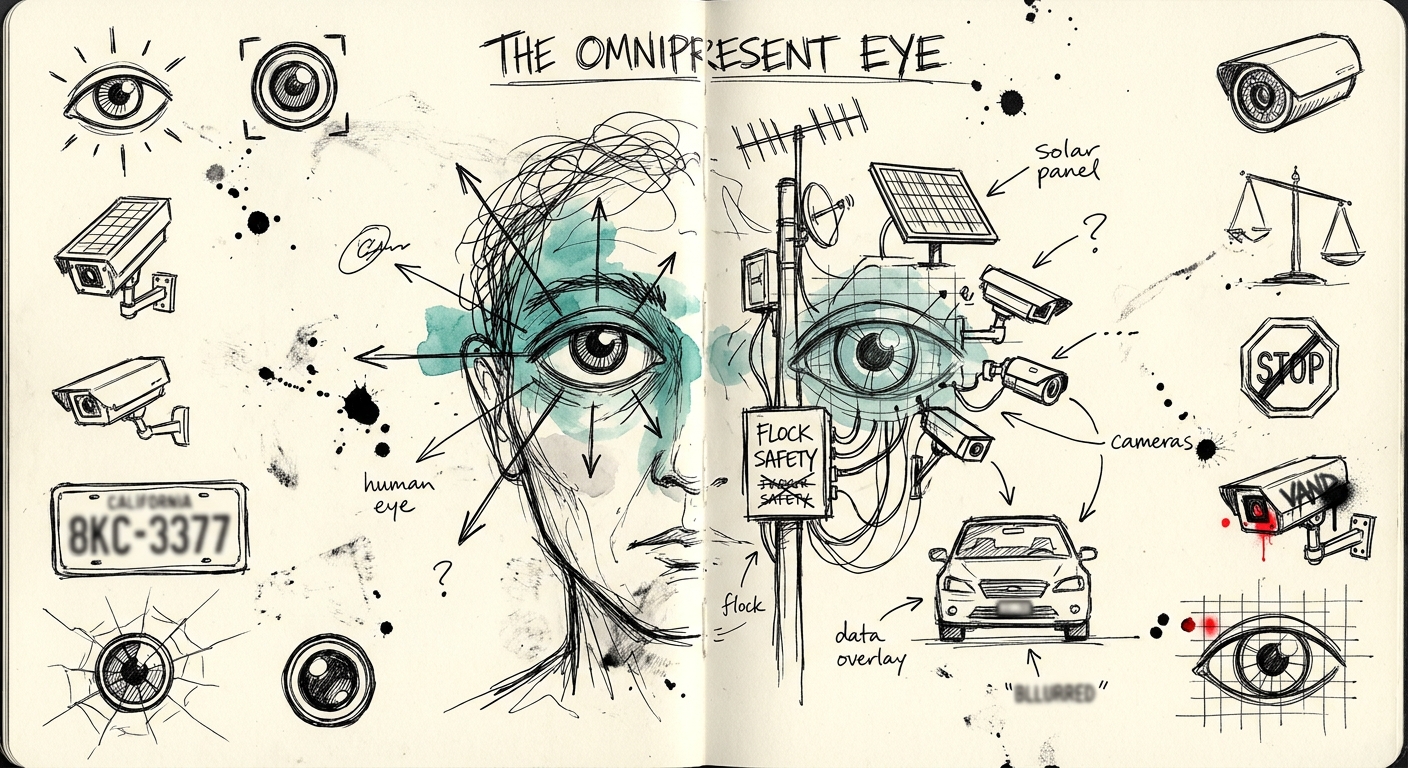
The Omnipresent Eye: An Exhaustive Analysis of Automated License Plate Readers, Flock Safety, and the Future of the Fourth Amendment
This report dissects the controversial proliferation of ALPR technology, examining Flock Safety's disruptive business model, its impact on policing, and the profound constitutional challenges it poses to American civil liberties.
Listen to this article
35 min listen
The Omnipresent Eye: An Exhaustive Analysis of Automated License Plate Readers, Flock Safety, and the Future of the Fourth Amendment
Introduction to the Panoptic Landscape
The modern public square is increasingly defined by the silent, ubiquitous presence of digital surveillance. Among the most pervasive and rapidly expanding technologies in this domain is the Automated License Plate Reader (ALPR). What began as a highly specialized and prohibitively expensive tool for counter-terrorism has evolved into an interconnected, nationwide dragnet utilized by local law enforcement, federal agencies, homeowners' associations, and private businesses. At the epicenter of this unprecedented expansion is Flock Safety, a technology firm that has fundamentally disrupted the surveillance market by combining low-cost, solar-powered hardware with sophisticated, cloud-based artificial intelligence.
The rapid proliferation of this technology has ignited a fierce, multifaceted debate spanning the realms of civil liberties, municipal governance, and constitutional law. Proponents, including thousands of police departments, argue that ALPRs are indispensable force multipliers that provide objective, actionable evidence to solve crimes ranging from property theft to homicides. The system’s ability to instantly identify suspect vehicles and track their movements has revolutionized modern policing, transforming it from a reactive enterprise into a highly proactive one.
Conversely, civil libertarians, privacy advocates, and a growing coalition of concerned citizens argue that unrestricted, warrantless mass surveillance poses an existential threat to American civil liberties. The capacity to track the movements of innocent civilians across state lines, combined with documented instances of data misuse, systemic false positives, unauthorized installations, and covert data-sharing with federal immigration and out-of-state law enforcement agencies, has thrust ALPR technology into a profound legal reckoning. This report provides an exhaustive analysis of ALPR technology, tracing its genesis, exploring the operational mechanics and business model of Flock Safety, and comprehensively dissecting the legal, ethical, and physical pushback against pervasive vehicular surveillance.
The Genesis and Evolution of ALPR Technology
The conceptual framework for automated vehicular tracking significantly predates the modern digital era, rooting itself in the mid-twentieth century. As early as 1966, optical character recognition (OCR) technology was being tested in the United States, supported by a $180,000 grant to develop automated license plate readers for surveillance on the bridges of New York City, which included early proposals for profiling and "wanted car" tracking. However, the practical invention and successful deployment of ALPRs—known internationally as Automatic Number-Plate Recognition (ANPR)—is credited to the Police Scientific Development Branch in the United Kingdom.
Motivated by the urgent need to combat domestic terrorism and track insurgent movements, British scientists developed working prototypes by 1979. The earliest industrial production contracts were awarded to EMI Electronics and Computer Recognition Systems, leading to the first real-world deployments along the A1 road and at the Dartford Tunnel. In 1981, the technology facilitated its first recorded arrest by successfully identifying a stolen vehicle. Despite this early success, these rudimentary systems were prohibitively expensive and highly localized. They relied on early closed-circuit television (CCTV) cameras, xenon flash lamps, and massive rack-based computers utilizing discrete transistor-transistor logic chips. Because of technological limitations, vehicles had to be completely stationary or moving at a crawl to prevent motion blur.
The technological landscape shifted dramatically throughout the 1980s and 1990s. The introduction of charged-coupled device (CCD) cameras, paired with shorter shutter speeds and continuous infrared illumination, allowed systems to capture moving vehicles with unprecedented clarity, regardless of lighting conditions. By 1993, the United Kingdom implemented the "Ring of Steel" around London's financial district, creating a dense network of cameras explicitly designed to deter terrorist bombings. Recognizing the power of aggregated data, the UK established the Police National ANPR Data Center in 1997, allowing law enforcement to share vehicular tracking data seamlessly across jurisdictional boundaries.
Observing the immense efficacy of the UK's centralized surveillance model, the United States Customs and Border Patrol (CBP) adopted ALPR technology in 1998 to enhance border security and monitor vehicular ingress and egress. Throughout the 2000s, the transition to complementary metal-oxide-semiconductor (CMOS) sensors and the advent of "edge computing"—a process where the algorithmic computation occurs within the camera hardware itself rather than relying entirely on remote servers—drastically reduced bandwidth requirements and improved real-time response capabilities. This miniaturization allowed for mobile ALPR units to be mounted within the lightbars of police cruisers, enabling patrol officers to scan thousands of plates per shift autonomously.
| Development Era | Technological Milestones | Primary Application |
|---|---|---|
| 1960s-1970s | Theoretical OCR testing; 1979 UK prototype development. | Experimental; Counter-terrorism (UK). |
| 1980s | CCTV adaptations; Xenon flash lamps; rack-based processors. | Toll enforcement; stationary vehicle identification. |
| 1990s | CCD cameras; infrared illumination; PC-based processing. | The "Ring of Steel" (London); border security (US). |
| 2000s | CMOS sensors; mobile cruiser integration; edge computing. | Widespread law enforcement adoption; active patrol alerts. |
| 2010s-Present | Solar power; LTE connectivity; AI-driven vehicle fingerprinting. | Decentralized, nationwide public-private surveillance networks. |
The Ascendance of Flock Safety: Democratizing Surveillance
Until the late 2010s, ALPR systems remained a premium asset, largely restricted to well-funded state and federal agencies or major metropolitan police departments. Traditional fixed LPR systems could cost upwards of $20,000 per unit, requiring extensive infrastructure, including hardwired electricity, deep trenching, and fiber-optic or high-speed Wi-Fi connections. This financial and logistical barrier effectively kept mass surveillance out of the hands of smaller municipalities and private neighborhoods.
This paradigm was aggressively disrupted in 2017 by Garrett Langley, Matt Feury, and Paige Todd, alumni of the Georgia Institute of Technology. Following a string of property crimes in his Atlanta neighborhood, Langley discovered that local police were utterly powerless to investigate without actionable evidence, specifically a license plate number. Grainy residential security cameras were insufficient for identifying perpetrators. A serial entrepreneur with a self-described "hyper-competitive" mindset, Langley recognized a massive market gap: traditional security recorded crime, but data solved it.
Langley and Feury built a prototype ALPR system by hand around Langley's dining room table. When a local DeKalb County detective utilized their rudimentary camera to solve a home break-in, the founders fully committed to the enterprise. Guided by the clarity and scaling principles of the Y Combinator accelerator program, Flock Safety engineered a camera that operated entirely off the grid. Powered by a small solar panel and connected to cloud servers via LTE cellular networks, the "Falcon" camera eliminated the need for trenching, electrical wiring, and fixed-internet costs.
Crucially, Flock shifted the industry from a traditional hardware sales model to a Security-as-a-Service (SaaS) subscription model. Customers lease the cameras for approximately $2,500 to $3,000 per year, a bundled cost that includes the hardware, ongoing maintenance, cellular data, and access to the sophisticated Flock OS software. This subscription economics model stabilized municipal budgets and radically democratized ALPR technology, making it immediately affordable for small-town police departments, homeowners' associations, apartment complexes, and retail businesses.
Flock explicitly targeted private entities in its early go-to-market strategy, eventually building a sprawling, interconnected "public-private safety network" where HOAs and businesses seamlessly share their data feeds with local police. Today, Flock operates in over 4,000 cities and 6,000 municipalities across the United States, scanning billions of license plates monthly. Driven by the highly ambitious mandate to "eliminate crime in America," Flock has achieved a valuation of $7.5 billion, heavily backed by venture capital firms, including substantial initial investments from funds associated with Peter Thiel—a detail that has drawn intense scrutiny given Thiel's perceived support for expansive surveillance technologies.
Technological Expansion: The Flock Product Ecosystem
Flock Safety's systems represent a massive evolutionary leap from early ALPRs. The AI algorithms powering the Flock OS do not merely read alphanumeric characters; they utilize patented "Vehicle Fingerprint" technology. This allows the cameras to categorize vehicles based on make, model, color, body style, and distinguishing physical alterations such as roof racks, broken taillights, custom wheels, or specific bumper stickers.
This capability fundamentally alters the investigative process. If a witness reports a "red Ford coupe with a roof rack," officers can query the Flock database using natural language parameters, even if the license plate is entirely unknown or obscured. When a scanned plate matches a "hot list"—such as the FBI’s National Crime Information Center (NCIC) database, local BOLO (Be On the Lookout) notices, AMBER alerts, or lists of stolen vehicles—the system sends a real-time alert to local dispatchers or patrol laptops in under ten seconds.
To achieve its goal of comprehensive public safety, Flock has rapidly expanded its hardware ecosystem beyond the Falcon ALPR, moving aggressively into multimodal surveillance:
| Product Name | Technology Type | Primary Functionality |
|---|---|---|
| Falcon / Falcon Flex | Fixed / Mobile ALPR | Captures high-speed license plates and vehicle fingerprints; cross-references hot lists in real time. |
| Sparrow | Private ALPR | Lower-cost ALPR designed exclusively for private communities; lacks real-time police dispatch alerts. |
| Condor | Pan-Tilt-Zoom (PTZ) Video | Live and recorded AI-driven video surveillance; capable of autonomously tracking human subjects and objects. |
| Raven | Audio Detection | Acoustic gunshot detection system that automatically cues nearby cameras and geotags the incident location. |
| Aerodome / DFR | Drone as First Responder | Automated drones dispatched to crime scenes upon alerts, providing aerial overwatch before ground units arrive. |
The Law Enforcement Calculus: Justifications for Ubiquitous Surveillance
The rapid, almost unprecedented adoption of Flock cameras by over 4,500 law enforcement agencies is driven by highly tangible operational benefits. Police departments, sheriffs' offices, and real-time crime centers justify the deployment of this extreme surveillance system on several foundational grounds.
First, agencies point to the critical need for force multiplication amid severe staffing shortages. Law enforcement agencies across the nation face declining recruitment numbers and tighter municipal budgets. ALPR networks act as a persistent, unblinking set of eyes, providing comprehensive geographic coverage without the need to deploy physical patrol units. The automated nature of the system allows a smaller force to actively monitor a vastly larger territory.
Second, law enforcement highlights the superiority of objective, actionable evidence over fragmented leads. Traditional CCTV footage is frequently grainy, poorly angled, and lacks identifiable markers, leaving investigators with little more than vague suspect descriptions. By focusing specifically on license plates and highly detailed vehicle characteristics, ALPRs provide highly objective, searchable leads that immediately connect an incident to a registered owner. The ability to search billions of historical data points allows detectives to reconstruct the path of a suspect vehicle leading up to, and fleeing from, a crime scene.
Third, the technology enables real-time proactive policing. Seamless integration with national and state hot lists allows police to intercept stolen vehicles, identify organized retail crime rings, or apprehend individuals with outstanding felony warrants the exact moment they enter a jurisdiction. This effectively shifts policing from a purely reactive model—responding to crimes after the fact—to a proactive interception model.
Finally, law enforcement agencies heavily emphasize the technology's success in solving exceptionally difficult crimes that traditionally yield few witnesses. Hit-and-run collisions, property theft, and abductions are notoriously difficult to clear. In Northport, Alabama, for example, a fatal hit-and-run crash with zero witnesses was at risk of going cold. Investigators utilized physical debris left at the scene, cross-referenced the vehicle type within the local Flock database, identified the matching car, and successfully located and arrested the suspect. Similarly, Flock systems are frequently credited with the rapid, safe recovery of abducted children following AMBER alerts, locating suspect vehicles within minutes of an alert being broadcast.
The Fallibility of the Machine: Misreads and False Positives
Despite their proven investigative efficacy, ALPR systems suffer from systemic technological limitations that precipitate severe real-world consequences. The optical character recognition technology utilized to read plates is highly sophisticated, but it is not infallible. Environmental factors such as dirt, heavy rain, poor lighting, obscured tags, and non-standard or temporary plate designs frequently cause algorithmic misreads. Independent data analysis indicates that ALPR systems misread the issuing state of a license plate in approximately 1-in-10 scans.
The implications of a misread are profoundly dangerous. When an algorithm incorrectly transcribes a license plate and erroneously matches it to a stolen vehicle database, the resulting "false positive" initiates an immediate, high-risk police response. Officers on patrol, relying entirely on the automated alert generated by the system, often conduct felony traffic stops. These stops typically involve officers drawing their service weapons, shouting commands, and ordering the vehicle's occupants to exit and lie on the pavement at gunpoint. There are heavily documented cases where entirely innocent individuals have been subjected to this trauma. In San Francisco, a mother and her children were held at gunpoint by police after an ALPR wrongly flagged their vehicle as stolen. In Colorado, a police officer wrongfully accused a woman of theft based on a false Flock hit, steadfastly refusing to review exculpatory evidence that immediately proved her innocence.
Furthermore, the technological ecosystem is highly vulnerable to upstream human error. Because Flock Safety does not maintain its own proprietary hot lists, its systems pull directly from the FBI’s National Crime Information Center and state databases. In a prominent incident involving an automotive journalist, a police officer manually entered an incomplete license plate into the NCIC database following an auto theft. When the entirely innocent journalist drove past a Flock camera in a vehicle with a plate resembling the flawed entry, the system generated a severe alert, resulting in a wrongful, high-stress police stop. While Flock’s executives correctly note that the initial error was human, civil liberties critics argue that the sheer scale, interconnectivity, and lightning speed of the Flock network exponentially amplifies minor clerical errors, instantly translating administrative mistakes into immediate, dangerous encounters with armed police.
Guardrails, Internal Abuse, and Cybersecurity Failures
Recognizing the inherent privacy concerns provoked by mass surveillance, Flock Safety publicly promotes a philosophy of "Public Safety by Design," outlining several technological and policy guardrails designed to protect the public. The company heavily advertises that all data is encrypted at rest and in transit, that customers exclusively own their data, and that data is never sold to private third parties. By default, non-hit data is automatically purged after 30 days unless preserved as evidence for an active criminal investigation, a limitation Flock claims aligns with constitutional protections. Additionally, Flock systems operate on an audit-based model; every query entered by a law enforcement officer is logged, timestamped, reviewable, and tied directly to a specific user.
Internal Stalking and Systemic Misuse
However, the historical record demonstrates that these guardrails have repeatedly failed to prevent intentional, systemic misuse by authorized operators. The fundamental lack of a warrant requirement for querying the nationwide database predictably allows officers to exploit the system for deeply personal, non-law enforcement reasons. A comprehensive survey conducted by the Institute for Justice documented 28 specific cases where police officers weaponized ALPR networks to stalk romantic interests, ex-partners, colleagues, and even strangers who caught their eye in public.
In Georgia, a sudden spike in internal audits led to the arrest, firing, or disciplining of at least 20 officers in a single year for unauthorized Flock usage. In Mooresville, North Carolina, a police officer was criminally charged after an internal audit revealed she accessed the Flock system 31 times to track the movements of her boyfriend's ex-wife, falsely listing the searches as routine motor vehicle infractions. In Lenexa, Kansas, police officers maliciously utilized the ALPR tracking network to target, monitor, and harass a civilian who had published an op-ed critical of the local department and Immigration and Customs Enforcement. While Flock points to its newly introduced AI auditing tools as proof of accountability, civil liberties advocates argue that audits are inherently reactive and insufficient; they only identify abuse after the severe privacy violation has already occurred, doing nothing to physically prevent the system's weaponization.
Cybersecurity Flaws and Internet Exposure
Beyond internal abuse by sworn officers, Flock has faced severe scrutiny regarding its fundamental cybersecurity architecture. In 2025, federal lawmakers formally requested the Federal Trade Commission (FTC) to launch an investigation into Flock Safety because the company did not strictly mandate multi-factor authentication (MFA) for law enforcement accounts. Consequently, numerous police logins were stolen by malware and sold on Russian cybercrime forums, potentially exposing billions of highly sensitive location data points to foreign hackers and malicious actors.
More alarmingly, severe security vulnerabilities were discovered in Flock’s "Condor" line of pan-tilt-zoom cameras. Unlike the ALPR-focused Falcon, the Condor is explicitly designed to track moving objects—including human bodies—in live video feeds. Security researchers discovered that dozens of Condor cameras across the country were actively livestreaming unencrypted feeds directly to the open internet. Anyone with an internet connection could access administrative control panels without a password, manipulate the PTZ cameras to autonomously zoom in on pedestrians, monitor children in playgrounds, peer into nearby windows, and freely download up to 30 days of archived, high-definition footage. This catastrophic exposure directly contradicted Flock's firm public assurances regarding strict encryption and restricted access, acutely highlighting the profound dangers of connecting AI-driven human tracking systems to the vulnerable internet of things.
The Asymmetrical Dragnet: Immigration, Abortion, and Unregulated Sharing
Perhaps the most contentious aspect of the Flock Safety ecosystem is its massive, inter-jurisdictional data-sharing capability. Through the centralized Flock OS, a local police department in one state can instantly share its local camera feeds with federal agencies and law enforcement departments across the entire country. While this interconnectivity is highly effective for tracking fugitive suspects across state lines, it creates a massive, unregulated loophole for enforcing highly polarized laws, specifically regarding federal immigration and reproductive healthcare.
Immigration and the Sanctuary City Loophole
Despite Flock's explicit claims that it does not directly partner with U.S. Immigration and Customs Enforcement (ICE), federal agents have successfully secured expansive "side-door" access to the network. Public records and search logs reveal that local police departments frequently perform nationwide Flock lookups on behalf of ICE as informal favors, completely bypassing federal oversight. In Danville, Illinois, search logs revealed that officers explicitly typed terms such as "ICE WARRANT," "ICE+ERO," and "illegal immigration" into the required search justification fields. Furthermore, an investigation revealed that U.S. Customs and Border Protection utilized a pilot program to directly tap into state camera data, while immigration agents also gained back-door access to a Houston school district's private Flock data through out-of-state police sharing.
This asymmetrical data sharing severely compromises "sanctuary" jurisdictions, where local ordinances strictly prohibit city employees and resources from assisting federal immigration enforcement. In Evanston, Illinois, the city council ordered the immediate removal of all 19 Flock cameras after discovering that out-of-state agencies and CBP were utilizing Evanston's local data to conduct immigration searches, violating both municipal sanctuary intent and state privacy laws.
The Prosecution of Reproductive Healthcare
Following the overturning of Roe v. Wade, the capacity to seamlessly track vehicles across state lines has been actively weaponized against individuals seeking reproductive healthcare. In a highly publicized and deeply concerning case, deputies in Johnson County, Texas, utilized the Flock network to conduct a nationwide search—querying over 83,000 cameras across 6,809 distinct networks—to track a woman suspected of self-administering an abortion.
Internal affidavits revealed that the lead detective was explicitly working a "death investigation of a non-viable fetus". In their pursuit, the Texas deputies searched for the woman's vehicle in states like Washington and Illinois, where abortion remains completely legal, entering the official search reason into the Flock database as "had an abortion, search for female". Following public outcry, the investigating desk sergeant filed a highly contradictory, belated supplemental report attempting to reclassify the search as a "welfare check," omitting any mention of the abortion. This incident underscored the dire warnings of privacy experts: a surveillance dragnet originally marketed to HOAs to deter petty package theft can be seamlessly repurposed by out-of-state actors to track, harass, and prosecute women seeking constitutionally protected healthcare in sanctuary states.
| Incident Category | Location / Agency | Nature of Unauthorized Use or Data Sharing |
|---|---|---|
| Federal Immigration (ICE) | Danville, IL Police Dept. | Officers searched network using justifications like "ICE WARRANT" and "ICE+ERO". |
| Federal Immigration (CBP) | Evanston, IL | CBP bypassed local sanctuary laws via a state-level data pilot program. |
| Reproductive Healthcare | Johnson County, TX | Deputies searched 83,000 cameras nationwide to track a self-managed abortion. |
| Internal Harassment/Stalking | Mooresville, NC | Officer conducted 31 unauthorized searches to stalk her boyfriend's ex-wife. |
| Political Retaliation | Lenexa, KS | Police used ALPR to target and follow a citizen who wrote an op-ed critical of ICE. |
Algorithmic Bias and Racially Motivated Tracking
While Flock cameras do not utilize facial recognition algorithms to determine a driver's demographic profile, the human operators interacting with the database are not immune to profound bias. An extensive audit conducted by the Electronic Frontier Foundation revealed that police officers in over 80 law enforcement agencies nationwide used the Flock system to conduct explicitly racist and discriminatory searches.
The audit logs demonstrated that officers frequently targeted the Romani and Traveller communities, inputting slurs and highly stereotypical terms such as "gpsy scam," "gpsy group," and "roma burglary" into the search justification fields. Crucially, in many instances, these searches were conducted utilizing these terms entirely on their own, without any reference to an actual underlying crime or active case number. Agencies including the Lake County Sheriff's Office in Illinois, the Sacramento Police Department in California, and the Fairfax County Police Department in Virginia ran hundreds of these racially targeted searches, querying tens of thousands of cameras across the nationwide network. The total failure of internal oversight to flag these blatantly discriminatory searches highlights the severe lack of accountability in decentralized surveillance networks.
Municipal Resistance and Unauthorized Deployments
The realization that every vehicular movement is being perpetually logged into a national database has sparked a multifaceted, highly organized municipal backlash. Privacy advocates and civic groups are increasingly winning arguments at city council meetings by systematically highlighting the unregulated nature of the technology, the severe risks of mass data sharing, the liability of cybersecurity failures, and the lack of procedural transparency.
Skeptics effectively argue the "dragnet" principle: because less than 1% of scanned vehicles are ever linked to a crime, 99% of the collected data constitutes the warrantless tracking of entirely innocent civilians. Pointing to the exposure of the Condor cameras and stolen law enforcement logins, critics successfully argue that municipalities are exposing themselves to immense legal liability and violating state privacy mandates, such as California's Senate Bill 34. These arguments have led to the outright cancellation of contracts. Major municipalities, including Mountain View, Richmond, and Berkeley in California, alongside Austin, Texas; Bandera, Texas; Sedona, Arizona; and Eugene, Oregon, have either terminated their Flock contracts, ordered cameras removed, or strictly curtailed data sharing capabilities.
The Crisis of Unpermitted Installations
Compounding Flock Safety's municipal troubles are startling revelations regarding aggressive, unauthorized installation practices. In their rush to deploy hardware rapidly and secure market dominance, Flock installation teams have frequently bypassed mandatory state permitting processes.
The South Carolina Department of Transportation (SCDOT) discovered over 200 Flock cameras installed illegally on state-owned highway rights-of-way. Flock attributed the violation to "misunderstood DOT jurisdiction lines" and defended their rapid deployment by citing the "life or death situation" of local crime. In response, SCDOT completely froze all new ALPR permits pending litigation, significantly stalling law enforcement deployments across the state.
Similarly, the North Carolina Department of Transportation (NCDOT) determined that while Flock's ALPR cameras possessed permits, the company had entirely failed to submit encroachment agreements for its live-view Condor cameras, leaving them standing in state rights-of-way in direct violation of statutory law. Furthermore, the NCDOT situation exposed a massive legal loophole: North Carolina law restricts ALPR data access strictly to law enforcement, but because the Condor cameras capture live video rather than converting images into alphanumeric data, NCDOT—a non-law enforcement agency—was able to sign an MOU with Flock to access the live video network. These incidents heavily feed the narrative that ALPR vendors operate with impunity, prioritizing rapid market expansion over legal compliance, structural safety, and community consent.
Subversive Resistance: The Physical Destruction of the Network
Beyond legal and civic action, a growing segment of the public has resorted to direct, physical resistance. Widespread, coordinated vandalism of Flock cameras has been reported across the United States, transforming surveillance infrastructure into a battleground.
In Minnesota, vandals have engaged in a systematic campaign to blind the network. In Winona, perpetrators used saws to cut down all eight of the city's newly installed Flock cameras overnight, causing $24,000 in damage. Similar incidents involving cut power cables, smashed solar panels, and spray-painted anti-surveillance messages have plagued installations in Faribault, Edina, Duluth, Plymouth, Eden Prairie, Minnetonka, and Nowthen. In Dallas, Texas, police reported 25 separate incidents of cameras being vandalized or stolen within a brief three-month span, while nearby Carrollton residents circulated petitions to strip the cameras from their neighborhoods. In Monterey County, California, a man utilized his pickup truck to violently topple a camera pole, and in St. Petersburg, Florida, citizens have erected signs on 14-foot poles specifically designed to block the lenses of the cameras from reading the street.
This systemic destruction of property underscores a deep-seated public resentment toward what researchers term "banal surveillance". Because Flock cameras are aesthetically designed to blend into the urban landscape, mimicking standard traffic infrastructure, many residents are entirely unaware of their presence until local media or transparency groups map them out. When citizens suddenly discover that their daily routines—the commute to work, the drive to the doctor, the trip to a political rally—are being autonomously logged by private hardware, the resultant feeling of violation frequently manifests as physical resistance against the machine.
The Fourth Amendment and the Slippery Slope of Pervasive Surveillance
At the philosophical and legal heart of the ALPR debate lies a profound constitutional question: Does the unrestricted, automated tracking of vehicles in public spaces constitute an unreasonable search under the Fourth Amendment?
Historically, Fourth Amendment jurisprudence relied heavily on the principle that individuals have no reasonable expectation of privacy regarding movements exposed to the public thoroughfare. Under this traditional view, a police officer standing on a corner observing a license plate is merely engaging in a "plain view" observation, which does not require a warrant.
However, the advent of digital mass surveillance has forced a critical reevaluation of this doctrine, giving rise to the "Mosaic Theory." This legal theory posits that while one data point (a single plate read at a single intersection) may not violate privacy, the aggregation of thousands of data points over an extended period creates a comprehensive mosaic of an individual's life. Tracking a vehicle continuously reveals deeply intimate details—where a person worships, what specialized medical facilities they visit, who they associate with, and what protests they attend.
The United States Supreme Court has cautiously begun to recognize this technological threat. In United States v. Jones (2012), the Court ruled that physically attaching a GPS tracker to a vehicle without a warrant violated the Fourth Amendment. Expanding on this, in Carpenter v. United States (2018), the Court ruled that the continuous tracking of historical cell-site location information (CSLI) requires a warrant, noting that such sweeping data provides an "all-encompassing record of the holder's whereabouts."
The Virginia Litigation: Bell, Church, and Schmidt
The direct application of Jones and Carpenter to ALPR surveillance is currently a fiercely contested legal frontier, best exemplified by recent litigation in Virginia.
| Case Name | Court / Year | Core Finding regarding ALPR and the 4th Amendment |
|---|---|---|
| Commonwealth v. Bell | Norfolk Circuit Court (2024) | Accessing ALPR databases without a warrant constitutes an unreasonable search, akin to GPS tracking. Suppressed evidence. |
| Commonwealth v. Church | VA Court of Appeals (2025) | Overturned Bell. Held that capturing public license plates does not constitute a search. ALPRs lack the pervasive intrusion of cell-site data. |
| Schmidt v. City of Norfolk | US District Court (2024/2025) | Granted summary judgment to the City, affirming warrantless ALPR use. Denied Flock Safety's motion to intervene in the case. |
In May 2024, a state circuit court judge in Norfolk, Virginia, issued a landmark ruling in Commonwealth v. Bell. The judge determined that accessing the Flock ALPR system to retroactively track a defendant's movements constituted a search under the Fourth Amendment, explicitly likening the centralized Flock database to the unconstitutional GPS tracking prohibited in Jones. The court suppressed the ALPR evidence, sending absolute shockwaves through the law enforcement and tech communities.
However, the victory for privacy advocates was rapidly dismantled. In October 2025, the Virginia Court of Appeals overturned this logic in Commonwealth v. Church. The appellate court strictly distinguished Flock cameras from cellular tracking, arguing that ALPRs only capture images of vehicle exteriors, not persons, and that the collected data is limited to what is already publicly viewable. The court maintained that 172 localized cameras in Norfolk do not constitute the same pervasive, continuous tracking as aerial surveillance or cell phone pinging.
Concurrently, a federal civil rights lawsuit, Schmidt v. City of Norfolk, challenges the constitutionality of the system on behalf of residents. Recognizing the existential threat a negative ruling would pose to its entire business model, Flock Safety attempted to legally intervene in the lawsuit to defend the warrantless use of its technology. In a striking rebuke, a federal judge denied Flock's motion, stating that the company's "eleventh-hour effort" to barge into the case was severely untimely and that their gamble to wait and see if the case would be dismissed meant the court would not allow them to "throw this case off the rails".
Conclusion
Automated License Plate Readers, catalyzed by the rapid market expansion of Flock Safety, represent an absolute paradigm shift in domestic surveillance. By drastically lowering the financial barrier to entry and leveraging decentralized solar and cellular technology, the capacity to autonomously track the movements of millions of citizens has been distributed away from federal intelligence agencies and handed directly to small towns, homeowners' associations, and private businesses.
While the technology undeniably provides law enforcement with incredibly powerful tools to solve difficult crimes and recover missing persons, its current implementation lacks the rigorous oversight necessary to protect fundamental civil liberties. The systemic issues plaguing the network—high rates of false positives, unencrypted PTZ cameras exposed to the open internet, the weaponization of the system by officers to stalk civilians, and the asymmetrical sharing of data to bypass sanctuary city laws to track immigrants and reproductive healthcare—demonstrate that internal vendor policies and retroactive "audit logs" are wholly insufficient safeguards.
As public resistance grows—evidenced by widespread physical vandalism and the successful cancellation of municipal contracts—the legal system must grapple with the realities of the Mosaic Theory. The outcome of ongoing federal appellate litigation will ultimately determine whether the Fourth Amendment possesses the elasticity to adapt to an era where the public square is constantly watched, recorded, categorized, and archived by an omnipresent, AI-driven eye. Until federal legislative frameworks establish definitive boundaries, the unchecked proliferation of ALPR technology will remain a highly volatile intersection of public safety, constitutional privacy, and corporate ambition.
Works cited
1. Automated License Plate Readers (ALPR) for New York Surveillance, https://www.flyingpenguin.com/1966-grant-for-180k-in-automated-license-plate-readers-alpr-for-new-york-surveillance/ 2. The History of License Plate Recognition Technology, https://ngscinc.com/history-license-plate-recognition 3. Automatic number-plate recognition - Wikipedia, https://en.wikipedia.org/wiki/Automatic\_number-plate\_recognition 4. Q&A: How LPR has changed law enforcement - Police1, https://www.police1.com/police-products/traffic-enforcement/license-plate-readers/articles/qa-how-lpr-has-changed-law-enforcement-W1ew2ZwYMOozVsMu/ 5. Automated License Plate Readers, Then and Now - GACP, https://gachiefs.com/ga-chief-magazine/policingtechnologies/?fbclid=IwY2xjawS-m69leHRuA2FlbQIxMABicmlkETJaSkVub0xwelpkQlIxQ0Q0c3J0YwZhcHBfaWQQMjIyMDM5MTc4ODIwMDg5MgABHptPevhmEX2CmeiK5tJgvAkkv8vkJKFbQs8nQ5DpcWwjwUzgRQ3i8KIShTDD\_aem\_G5ZcIlSEA6t2FWB5cZ1WpA 6. Automated License Plate Readers: Background and Legal Issues, https://www.everycrsreport.com/reports/IF13068.html 7. Report: Flock Safety Business Breakdown & Founding Story, https://research.contrary.com/company/flock-safety 8. What is Brief History of Flock Safety Company?, https://businessmodelcanvastemplate.com/blogs/brief-history/flock-safety-brief-history 9. Flock Safety Success Story: 5 Key Lessons For Founders- OrangeOwl, https://orangeowl.marketing/unicorn-chronicles/flock-safety-success-story/ 10. Flock Safety - Wikipedia, https://en.wikipedia.org/wiki/Flock\_Safety 11. Can a Camera on Every Corner Make Us Safer? | Garrett Langley, https://www.youtube.com/watch?v=v0BiDmPloBs 12. Garrett Langley of Flock Safety - Atlanta Ventures Stories, https://stories.atlantaventures.com/garrett-langley 13. Frequently Asked Questions | Flock Safety, https://www.flocksafety.com/faq 14. License Plate Reader Cameras: How LPR Technology Works, https://www.flocksafety.com/ebooks/license-plate-reader-cameras-overview 15. What's with all the new License Plate Readers? : r/HuntsvilleAlabama, https://www.reddit.com/r/HuntsvilleAlabama/comments/1g40bv3/whats\_with\_all\_the\_new\_license\_plate\_readers/ 16. What are Flock cameras, and why are they controversial in Berkeley?, https://www.berkeleyside.org/2026/07/13/flock-safety-cameras-berkeley-license-plate-readers 17. Baldwin County - Flock Safety Community, https://refer.flocksafety.com/community/baldwin-county-safe 18. What's the Story Behind Automated License Plate Readers?, https://www.caranddriver.com/news/a70792616/automated-license-plate-reader-explainer/ 19. Flock on campus: university police as appendages of a national, https://www.tandfonline.com/doi/full/10.1080/10439463.2026.2702635 20. Flock's CEO Faced Me After Its Cameras Led to My Wrongful Stop, https://www.thedrive.com/podcast/flocks-ceo-wants-zero-wrongful-stops-i-wasnt-the-first 21. Law Enforcement - Flock Safety, https://www.flocksafety.com/industries/law-enforcement 22. Improving law enforcement investigations through mobile ALPR, https://www.police1.com/police-products/traffic-enforcement/license-plate-readers/improving-law-enforcement-investigations-through-mobile-alpr-technology 23. Flock Safety, https://www.flocksafety.com/ 24. Flock Camera Helps Solve Deadly Northport Hit-and-Run, https://tuscaloosathread.com/flock-safety-cameras-tuscaloosa-northport/ 25. Fight Creepy ALPR Cameras | American Civil Liberties Union, https://www.aclu.org/campaigns-initiatives/get-the-flock-out 26. Are License Plate Readers Constitutional? The Case Law, https://www.flocksafety.com/blog/automated-license-plate-readers-and-the-fourth-amendment-a-public-safety-by-design-perspective-from-flock 27. A company installed license plate cameras without permission. SC, https://www.postandcourier.com/news/alpr-cameras-south-carolina-flock-safety-license-plate-readers/article\_787a262a-dbd2-11ee-a901-634acead588b.html 28. Flock Safety Privacy, Data & Civil Liberties Policies, https://www.flocksafety.com/trust 29. Police Have Reportedly Used License Plate Readers to Stalk, https://ij.org/police-have-reportedly-used-license-plate-readers-to-stalk-romantic-interests-at-least-14-times-in-recent-years/ 30. Use of Flock license plate reader cameras surges in Texas, https://www.texastribune.org/2026/08/03/texas-flock-cameras-law-enforcement-license-plate-readers/ 31. Another Georgia officer arrested over alleged Flock camera misuse, https://www.cbsnews.com/atlanta/news/another-georgia-officer-arrested-over-alleged-flock-camera-misuse-as-internal-audits-continue-uncovering-cases/ 32. What are Flock cameras, and which Waco-area police use them, https://wacobridge.org/2026/07/30/waco-flock-cameras/ 33. Officer Accused Of Using License Plate Cameras To Track, https://961therocket.iheart.com/content/2026-08-07-officer-accused-of-using-license-plate-cameras-to-track-boyfriends-ex-wife/ 34. Flock Safety faces investigations after unauthorized federal data, https://elestoque.org/2026/04/04/news/flock-safety-faces-investigations-after-unauthorized-federal-data-access/ 35. Flock Exposed Its AI-Powered Cameras to the Internet. We Tracked, https://www.404media.co/flock-exposed-its-ai-powered-cameras-to-the-internet-we-tracked-ourselves/ 36. Vulnerability in Flock Condor Cameras Lets Anyone Spy on the Public, https://www.independent.org/article/2026/01/14/flock-condor-camera-spy-public/ 37. Flock Safety Condor Cameras Exposed: What Businesses Need to, https://blog.camerasecuritynow.com/2026/03/24/flock-safety-condor-cameras-exposed-what-businesses-need-to-know-about-ai-surveillance-risks/ 38. Flock installed LPR's without permits and has now been banned, https://ipcamtalk.com/threads/flock-installed-lprs-without-permits-and-has-now-been-banned-from-operating-in-two-states.75013/ 39. NCDOT's Own Flock MOU and New Hanover's ALPR Encroachments, https://deflockilm.org/ncdot-flock-mou-encroachments/ 40. Law enforcement agencies report widespread ALPR vandalism, https://www.police1.com/arrests-sentencing/law-enforcement-agencies-report-widespread-alpr-vandalism 41. Flock cameras being vandalized, taken down in protest - MPR News, https://www.mprnews.org/story/2026/08/06/flock-cameras-being-vandalized-taken-down-in-protest 42. Someone Cut Down Every Single Flock Camera in This Town in a, https://www.reddit.com/r/technology/comments/1vgdhq8/someone\_cut\_down\_every\_single\_flock\_camera\_in/ 43. Carrollton residents call for removal of Flock license plate readers amid privacy concerns, https://www.keranews.org/texas-news/2026-07-30/carrollton-residents-remove-flock-license-plate-readers-privacy 44. Shape a safer future, together - Cottage Grove, https://www.vi.cottagegrove.wi.gov/AgendaCenter/ViewFile/Item/18601?fileID=35242 45. Commonwealth of Virginia v. Ronnie D. Church :: 2025 - Justia Law, https://law.justia.com/cases/virginia/court-of-appeals-unpublished/2025/0737-25-1.html 46. circuit court of the city of norfolk - Virginia Lawyers Weekly, https://valawyersweekly.com/wp-content/blogs.dir/1/files/2024/06/024-8-039.pdf 47. Case 2:24-cv-00621-MSD-RJK Document 113 Filed 09/15/25 Page, https://www.courthousenews.com/wp-content/uploads/2026/01/schmidt-v-norfolk-defendant-brief.pdf 48. Federal Court Rejects Flock Safety's Late Bid to Join and Block IJ's, https://ij.org/press-release/federal-court-rejects-flock-safetys-late-bid-to-join-and-block-ijs-lawsuit-challenging-norfolks-mass-surveillance-cameras/