
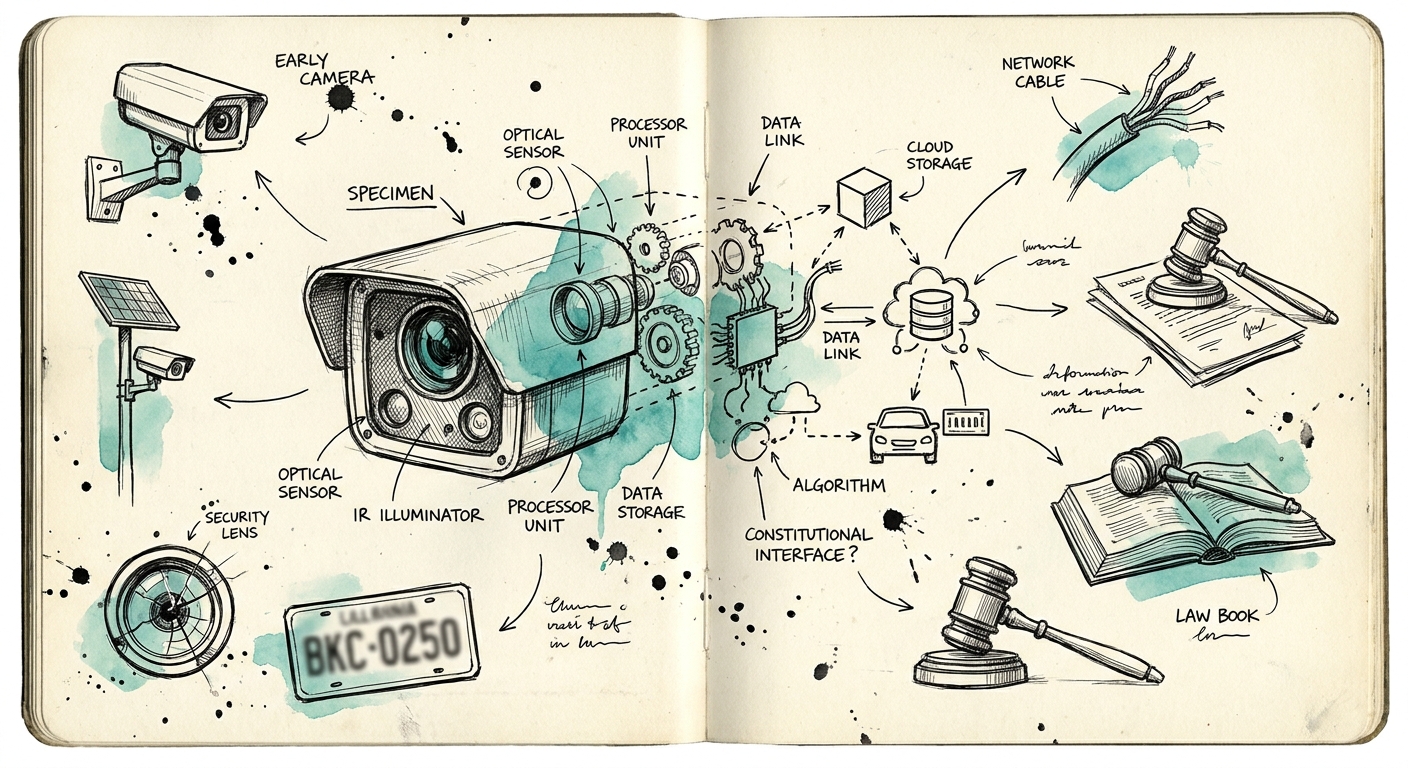
The Architecture of Automated Surveillance: Historical Development, Ecosystem Mechanics, and Constitutional Dynamics of Automated License Plate Readers
Explore how ALPR technology evolved from counterterrorism tools to a pervasive, cloud-hosted surveillance network, challenging privacy and legal frameworks.
Listen to this article
21 min listen
The Architecture of Automated Surveillance: Historical Development, Ecosystem Mechanics, and Constitutional Dynamics of Automated License Plate Readers
The Genesis and Technological Evolution of ALPR Systems
Automated License Plate Reader (ALPR) technology—known internationally as Automatic Number Plate Recognition (ANPR)—was not initially conceived as a tool for routine municipal traffic management or private property monitoring. Its inception was rooted in geopolitical counterterrorism operations during the mid-1970s in Western Europe. In 1976, researchers at the Police Scientific Development Branch (PSDB)—a specialized research unit within the United Kingdom’s Home Office—began exploring whether optical character recognition (OCR) algorithms could automatically extract vehicle registration identifiers from video feeds. Under the leadership of scientists such as Dr. Paul Wilkins and John Aston, early development was spurred directly by national security imperatives, specifically the threat posed by Provisional Irish Republican Army (IRA) bombing campaigns.
Early implementations were constrained by mid-20th-century computational limitations. Hardware prototypes developed by 1979 utilized primitive black-and-white closed-circuit television (CCTV) cameras linked to localized mainframes. Accurate character extractions required vehicles to be stationary or moving at extremely low speeds. The technology achieved its first operational milestone in 1981, when a prototype deployed along UK roadways successfully identified a stolen vehicle, leading to the first recorded arrest facilitated by automated optical surveillance.
Throughout the late 1980s and 1990s, industrial partnerships with defense and machine-vision contractors, such as EMI Electronics and Computer Recognition Systems Ltd, refined OCR accuracy, operational frame rates, and infrared illumination capabilities, enabling non-stop, multi-lane operation. The technology transitioned from experimental counterterrorism infrastructure into institutional traffic control and law enforcement operations through major public works projects. In 1978, early field trials at the UK's Dartford Tunnel demonstrated the viability of automated toll collection and cross-river vehicle tracking without physical barriers. Following major IRA bombings in London's financial district during the early 1990s, police established a security perimeter monitored by CCTV and eventually integrated ANPR cameras linked directly to national police databases, creating an automated surveillance cordon known as the "Ring of Steel". By 2003, London launched the Congestion Charge scheme, demonstrating that ALPR could operate at a massive urban scale by processing millions of daily plate reads under variable environmental conditions.
By the early 2000s, ALPR systems expanded across North America. Early domestic adoption in the United States relied primarily on mobile configurations—infrared cameras mounted directly onto patrol car light bars or bumpers. These mobile units scanned surrounding traffic and parked vehicles during routine patrols, running captured plates against localized "hotlists" of stolen cars or outstanding warrants. However, these systems remained expensive capital investments, often costing between $18,000 and $25,000 per vehicle, which limited widespread deployment to well-funded municipal police departments.
The Rise of Flock Safety and the Decentralized Surveillance Network
The business model and technical topology of ALPR technology underwent a structural shift with the founding of Flock Group Inc. (doing business as Flock Safety) in 2017. Founded by CEO Garrett Langley in Atlanta, Georgia, the company was established following an unresolved residential property crime. Langley observed that while law enforcement agencies frequently requested security footage from neighborhood residents, traditional video feeds lacked actionable identifiers, such as legible license plates or specific vehicle characteristics, necessary to identify fleeing suspects.
Flock Safety disrupted the traditional ALPR market by moving away from expensive, patrol-car-mounted hardware sold through legacy capital expenditure models. Instead, the company introduced a low-cost, fixed-location, Software-as-a-Service (SaaS) subscription model. Priced at roughly $2,500 per camera annually, Flock lowered financial barriers to entry, enabling small municipal police departments, Homeowner Associations (HOAs), business improvement districts, and private enterprises to deploy solar-powered, cloud-connected camera arrays.
Flock Safety’s technical ecosystem operates as a multi-tiered surveillance pipeline. At the hardware layer, the company deploys Falcon cameras—fixed-location, solar-powered units optimized to capture still images of vehicles traveling at high speeds—and Condor cameras, which provide pan-tilt-zoom (PTZ) live-video capabilities for real-time operational monitoring. Data captured at the edge undergoes processing via proprietary machine learning models that extract not only the license plate alphanumeric string, but also detailed vehicle attributes including make, model, color, roof racks, altered rims, and bumper stickers to create a distinct "vehicle fingerprint".
These localized reads are uploaded directly to a centralized, cloud-hosted national database encompassing tens of thousands of cameras across the country. The platform's software interface allows participating law enforcement agencies to execute multi-jurisdictional searches and receive real-time hotlist alerts across interconnected public and private feeds.
| Operational Vector | Legacy Mobile ALPR Systems (Pre-2015) | Flock Safety Network Model (Post-2017) |
|---|---|---|
| Deployment Model | Patrol-car mounted hardware; capital purchase. | Fixed street pole units; SaaS annual subscription. |
| Cost Dynamics | High upfront capital expenditure ($18k–$25k/unit). | Low barrier entry (~$2,500/camera/year). |
| Data Scope | Localized to individual patrol routes and localized hotlists. | Centralized, cloud-hosted network (>80,000 connected cameras). |
| Search Functionality | Specific plate searches against state/national criminal databases. | AI attribute queries ("red sedan with roof rack") across national feeds. |
| Client Base | Strictly public law enforcement agencies. | Hybrid: Police, HOAs, private businesses, and universities. |
Flock's primary innovation lies in its network effect. By default, cameras installed by private entities, such as HOAs or commercial retail centers, can feed their data directly into local police databases. Furthermore, Flock created a national search network that allows participating law enforcement agencies to search plate reads across geographical boundaries, constructing an interconnected national database comprising tens of thousands of cameras capturing hundreds of millions of vehicle movements daily.
Institutional Justifications vs. Public and Technical Pushback
Law enforcement agencies at federal, state, and local levels justify the widespread implementation of Flock networks through operational performance metrics, framing the systems as indispensable "force multipliers" during an era of nationwide police recruitment and retention shortages. Citing federal criminal justice statistics, law enforcement officials emphasize that over 70% of violent and property crimes involve the use of a motor vehicle. Industry and police data indicate that automated plate readers increase the recovery rate of stolen vehicles by up to 50%, intercepting auto-theft rings and reducing property loss. Furthermore, the integration of fixed ALPR networks with the National Crime Information Center (NCIC) and state law enforcement databases enables real-time alerts dispatched directly to patrol officers' computers when a vehicle linked to an active felony warrant, AMBER Alert, or Silver Alert passes a camera. Police departments frequently advocate for creating a complete "curtain of technology" around municipal borders, asserting that comprehensive coverage deters non-resident offenders from entering the jurisdiction.
Despite institutional advocacy, public and civil liberties opposition to Flock's expanding footprint has intensified. Organizations such as the American Civil Liberties Union (ACLU) and the Electronic Frontier Foundation (EFF) argue that Flock has built a pervasive, private surveillance infrastructure that logs the comings and goings of millions of law-abiding citizens who are not suspected of any criminal activity. Unlike traditional red-light or speed enforcement cameras—which trigger only upon a documented violation—Flock cameras photograph and log every passing vehicle indiscriminately, building a continuous historical database of public movements.
Multiple investigations have uncovered instances where law enforcement personnel accessed ALPR databases for unauthorized personal reasons. For example, in Kechi, Kansas, a police officer was arrested for using a regional ALPR system to illegally track his estranged wife. The Institute for Justice documented 28 separate incidents across the country where officers utilized ALPR networks to stalk romantic interests, colleagues, or acquaintances. In Georgia alone, over 20 officers were disciplined or criminally charged in a single year for unauthorized database queries.
Cybersecurity vulnerabilities have further fueled public pushback. Investigative reporting by 404 Media revealed critical infrastructure flaws, discovering at least 60 of Flock’s PTZ Condor cameras exposed directly to the open internet without basic password authentication. Anyone with a web browser could view live video feeds, access 30-day historical video archives, alter camera settings, and view system diagnostic logs. Further revelations indicated that Flock sales representatives had used live feeds from sensitive locations—including a Jewish Community Center housing a children's preschool, pool, and gymnastics room—to conduct commercial product demonstrations for potential clients, directly contradicting internal claims regarding strict access controls.
As public awareness of automated surveillance expanded, physical resistance transitioned from municipal hearings to direct action. Across several states, individuals have systematically damaged, cut down, or disabled Flock camera installations. Digital counter-surveillance initiatives like DeFlock, an open-source, user-generated mapping project, enable citizens to locate, map, and publish the precise GPS coordinates of ALPR cameras nationwide. While the platform advocates for transparency and policy reform, it has simultaneously provided a roadmap for physical intervention. Incident reports from municipalities in Texas (such as Hewitt, Waco, and Robinson) and across the broader Midwest confirm numerous instances where camera poles were severed using cordless power saws, solar panel power lines were cut, or lenses were covered with spray paint.
The corporate response to this physical backlash sparked further controversy. During a public discussion regarding anti-surveillance activities, Flock CEO Garrett Langley likened activists involved with the DeFlock mapping project to "terrorists" and "Antifa". Following severe public criticism from civil rights organizations, Langley formally retracted the statement, acknowledging the comparison was a significant mistake.
Systemic Vulnerabilities, False Positives, and Human Toll
While manufacturers frequently claim high optical recognition accuracy rates under controlled conditions, real-world deployment exposes systems to operational failure modes. OCR software errors typically arise from environmental conditions, physical obstructions, or algorithmic limitations. Deep learning OCR models routinely misinterpret alphanumeric characters with similar visual geometries, such as confusing the number 3 with a 7, the number 2 with a 7, or the letter B with the number 8.
Additionally, ALPR software frequently extracts the alphanumeric string correctly but fails to identify the issuing state jurisdiction. Because multiple states issue plates with identical alphanumeric sequences, a plate flagged as stolen in a distant state can trigger an active hotlist alert on an innocent driver operating a vehicle with the exact same plate characters issued by a local state agency. Systems also misinterpret vehicle classifications—flagging passenger SUVs for stolen motorcycle entries—or generate misreads due to license plate frames, tow hitches, dirt, and intense headlight glare.
When an ALPR system generates a false positive hotlist hit, law enforcement protocol often dictates executing a high-risk felony stop. Because officers are informed that the vehicle is potentially stolen or linked to a dangerous felon, these stops routinely involve drawing firearms, forcing occupants out of the vehicle, and placing them in handcuffs before the plate can be manually verified.
| Victim(s) & Location | Incident Mechanics | Harm Experienced | Legal Outcome / Financial Settlement |
|---|---|---|---|
| Brittney Gilliam & Family (Aurora, CO) | ALPR misread a Colorado SUV plate as a stolen motorcycle plate from Montana. | Gilliam, her daughters, and nieces (ages 6 to 17) held at gunpoint; children forced face-down on hot asphalt in handcuffs. | $1.9 Million federal civil rights settlement paid by the City of Aurora. |
| Denise Green (San Francisco, CA) | Mobile ALPR system misread a single character digit on Green's vehicle plate. | Held at gunpoint by multiple officers, handcuffed, and detained. | $495,000 settlement awarded for unlawful search and detention. |
| Jaclynn Gonzales & Sister (Española, NM) | Camera OCR misread the number "2" on a plate cover as a "7". | 21-year-old Gonzales and her 12-year-old sister stopped at gunpoint, handcuffed, and locked in a patrol vehicle. | Active civil rights litigation; internal police policy review. |
| Unnamed Resident (Denver, CO) | Incorrect manual entry into a Flock-linked database hotlist. | Driver was repeatedly pulled over and detained by armed officers across multiple jurisdictions over several weeks. | Civil rights claims filed against regional law enforcement agencies. |
In the landmark case involving Brittney Gilliam, an Aurora Police Department vehicle equipped with an ALPR system flagged Gilliam’s vehicle while she was taking her four young family members out for a salon visit. The system matched her Colorado license plate number to a stolen vehicle notice regarding a motorcycle registered in Montana with the same registration characters. Officers executed a high-risk traffic stop, ordered Gilliam and the children out of the car at gunpoint, and forced the children—aged 6, 12, 14, and 17—to lie face-down on hot pavement. Two of the young girls were handcuffed, and officers attempted to handcuff the 6-year-old whose wrists were physically too small for the restraints. Video of the traumatized children went viral, leading to systemic state investigations, policy updates requiring manual officer verification of plate state and vehicle type prior to initiating stops, and a $1.9 million municipal settlement. Legal analysts and advocacy groups like the Institute for Justice have documented at least 27 distinct cases across nine states where documented ALPR misreads led directly to false arrests, unlawful detentions at gunpoint, or severe trauma inflicted on innocent motorists.
Information Leakage and Federal Immigration Enforcement
A primary point of conflict surrounding Flock Safety concerns the transmission of locally gathered surveillance data to federal immigration agencies, specifically U.S. Immigration and Customs Enforcement (ICE) and U.S. Customs and Border Protection (CBP). Municipalities and HOAs frequently sign contracts with Flock under explicit promises that camera data will remain under local control and will not be shared with outside or federal authorities. In sanctuary jurisdictions—such as California, which enacted the Values Act (SB 54) prohibiting local law enforcement resources from aiding federal immigration enforcement—sharing ALPR data with federal immigration officers is illegal.
Despite these statutory guardrails, investigative reports by 404 Media and civil liberties organizations revealed that federal immigration agencies gained indirect, "side-door" access to Flock’s nationwide surveillance database. ICE agents regularly contact local or county law enforcement officers in cooperating jurisdictions. The local officer, who holds valid credentials to access the Flock national search portal, executes a query on behalf of the federal agent.
Audit records obtained from police departments across multiple states (including Georgia, Florida, and Washington) documented thousands of custom search entries where local officers explicitly typed search justifications such as "ICE," "Assist ICE," or "immigration" into the Flock system log before pulling historical location maps of target vehicles. Investigations revealed that even specialized law enforcement entities, such as local school district police departments, were utilizing their Flock network access to perform nationwide searches assisting federal agents with immigration tracking operations.
Flock’s corporate leadership initially denied holding formal contracts with federal immigration agencies. However, CEO Garrett Langley later acknowledged that Flock had executed a formal pilot contract with U.S. Customs and Border Protection. While Flock claimed the CBP pilot was halted in mid-2025 following widespread public exposure, massive volumes of historical driver location data had already been queried by federal border agents. This structural bypass rendered local sanctuary policies functionally ineffective; a municipality could enact strict local ordinances against immigration enforcement, yet its community-installed Flock cameras were systematically utilized by out-of-state or regional law enforcement partners acting as proxies for ICE.
Municipal Resistance and City Council Debates
The intersection of public safety claims, false positives, cybersecurity flaws, and unauthorized ICE access has turned local city council meetings into intense political battlegrounds over surveillance technology. Civil rights advocates, privacy scholars, and local community groups have successfully persuaded city councils to reject ALPR networks by relying on four core arguments.
First, opponents highlight that Flock’s widely cited marketing claims—such as assertions that their cameras "reduce crime by 30% to 50%" or "solve 10% of all US crime"—originate from self-funded customer surveys rather than independent, peer-reviewed academic research. Criminologists evaluating Flock’s claims have described its methodology as fundamentally flawed, noting that the company selected small, low-crime municipalities where minor statistical variations appeared as massive percentage drops. Independent analyses, including reporting by Forbes, demonstrated that crime rates actually increased in several towns after Flock cameras were installed.
Second, community advocates argue that local city councils cannot meaningfully regulate or oversee a third-party, out-of-state SaaS vendor. Public testimony in municipal hearings has emphasized that attempting to enforce local privacy policies on a private cloud provider operating an aggregated national database carries virtually no binding weight. Third, in sanctuary states and progressive municipalities, the revelation that Flock’s national network inherently exposes local residents to warrantless federal tracking (such as ICE deportations or out-of-state prosecutions for reproductive health services) has served as a decisive factor for contract cancellations. Finally, skeptics present evidence of multi-million-dollar legal settlements to demonstrate that the operational risks and legal liabilities of false-positive stops far outweigh the potential benefits of auto-theft recoveries.
As a result of these arguments, a growing number of municipalities across various states have formally voted to dismantle or terminate their Flock Safety ALPR deployments:
- Santa Cruz, California: Terminated its contract with Flock Safety after municipal audits revealed local camera data was accessed by federal and out-of-state agencies in violation of California's SB 54 sanctuary statute.
- Lynnwood, Washington: The City Council voted to terminate its 25-camera Flock pilot program after a University of Washington study revealed that U.S. Border Patrol agents had executed thousands of searches against Washington state ALPR data feeds.
- South Tucson, Arizona: Voted 5-1 to immediately terminate its contract with Flock, explicitly citing concerns over side-door ICE data access and the risks associated with private corporate control over public surveillance infrastructure.
- Denver, Colorado: Unanimously rejected a $666,000 contract extension for Denver's Flock pilot program due to growing community opposition regarding constant dragnet surveillance.
- Flagstaff, Arizona: Voted to cancel its Flock contract, resulting in the complete physical removal and powering down of all cameras across the municipality.
- Additional Municipalities: Contract terminations, rejections, or emergency contract revocations have been enacted in cities such as Mountain View (CA), South Pasadena (CA), Eureka (CA), Gig Harbor (WA), Austin (TX), Fitchburg (WI), and Oshkosh (WI)—where the council revoked approval shortly after learning the full extent of the national database architecture.
The Fourth Amendment, Mosaic Theory, and Judicial Trajectories
The rapid expansion of pervasive ALPR networks directly challenges traditional legal frameworks governing public surveillance under the Fourth Amendment to the United States Constitution. Traditionally, Fourth Amendment doctrine operated on the principle that individuals possess no reasonable expectation of privacy in what they knowingly expose to the public. Under classical jurisprudence, such as United States v. Knotts (1983), visually following a vehicle on public thoroughfares or observing a license plate in public view did not constitute a search, as police officers were simply observing what was visible to any member of the public.
However, the advent of AI-driven, automated surveillance networks capable of logging millions of data points indefinitely has tested this framework. Modern legal challenges argue that aggregating discrete, publicly visible snapshots into a centralized, searchable history fundamentally changes the nature of government surveillance.
| Legal Doctrine | Traditional Fourth Amendment Framework | The Mosaic Theory Framework |
|---|---|---|
| Core Premise | No expectation of privacy in public spaces; visual exposure is unrestricted. | Aggregation of discrete public data points creates an intimate portrait of life. |
| Key Precedents | United States v. Knotts (1983). | United States v. Jones (2012); Carpenter v. United States (2018). |
| Search Threshold | Single visual observation or snapshot does not constitute a search. | Prolonged, systemic tracking of physical location constitutes a Fourth Amendment search. |
| Warrant Standard | No warrant required for recording public license plates. | Warrant required based on probable cause for historical, aggregate tracking. |
To address the challenges posed by digital tracking technologies, legal scholars and courts have increasingly relied on the Mosaic Theory of the Fourth Amendment. The Mosaic Theory posits that while individual, discrete acts of surveillance do not violate an individual's reasonable expectation of privacy, the aggregation of thousands of such data points over extended periods constructs a comprehensive "mosaic" of an individual’s life. This aggregate reveals intimate details—including medical visits, religious attendance, political affiliations, romantic relationships, and daily routines—which constitutes a search under the Fourth Amendment.
The legal foundation for this theory rests on two Supreme Court rulings. In United States v. Jones (2012), the Supreme Court held that attaching a physical GPS tracking device to a suspect's vehicle to monitor its movements over a 28-day period constituted an unlawful search. In concurring opinions, Justices Alito and Sotomayor recognized that long-term electronic monitoring of a vehicle’s movements impinges on expectations of privacy, as society does not expect the government to secretly log every public movement over extended periods. Later, in Carpenter v. United States (2018), the Supreme Court formally applied the logic of the Mosaic Theory to digital location data, ruling that the government’s acquisition of historical Cell Site Location Information (CSLI) covering a seven-day period constituted a Fourth Amendment search requiring a warrant based on probable cause. Chief Justice Roberts noted that location data provides an unblinking chronicle of a person's physical movements that creates a dangerous risk of dragnet surveillance.
The primary legal battleground over ALPR networks is embodied in Schmidt v. City of Norfolk, a federal lawsuit filed by the Institute for Justice on behalf of Norfolk, Virginia residents Lee Schmidt and Crystal Arrington. The City of Norfolk established a network of 176 fixed Flock ALPR cameras. Over a four-and-a-half-month period, Norfolk’s Flock network photographed Lee Schmidt's car 475 times and Crystal Arrington's car 325 times, despite neither individual being suspected of any criminal activity. The lawsuit argued that Norfolk’s dragnet network performed prolonged, warrantless surveillance that effectively mirrored the historical location tracking struck down in Carpenter and Jones.
In January 2026, Chief U.S. District Judge Mark S. Davis ruled that Norfolk’s use of fixed Flock cameras did not constitute a Fourth Amendment search under current precedent. The court reasoned that unlike mobile phone CSLI or continuous GPS trackers—which continuously track an individual's movements in real time—fixed ALPRs only capture discrete, isolated snapshots at specific physical locations. Because the plaintiffs' vehicle captures occurred miles and 40 to 50 minutes apart, leaving gaps in movement history, the court concluded the network did not yet capture "the whole of physical movements" required to trigger Carpenter.
Significantly, Judge Davis acknowledged the slippery slope inherent in expanding automated surveillance infrastructure. In his opinion, Davis cautioned that as the density, coverage, and AI analytical capabilities of fixed ALPR camera networks expand, "the constitutional balancing could conceivably tip the other way" and become an unconstitutional dragnet. He wrote that while ALPR networks could cross the constitutional threshold into an illegal search at some point, "at least in Norfolk, Virginia, the answer is: not today". The Institute for Justice appealed the ruling to the U.S. Court of Appeals for the Fourth Circuit, positioning the case to test whether modern, AI-powered ALPR networks can continue to log public movements without judicial oversight.
Strategic Synthesis and Policy Outlook
The evolution of Automated License Plate Readers—from localized counterterrorism tools into pervasive, cloud-hosted private surveillance networks like Flock Safety—reflects a fundamental transformation in modern public spaces. While law enforcement agencies present these networks as essential operational tools to address officer shortages and track fleeing felons, their actual deployment reveals systemic challenges.
The integration of private community feeds into a centralized national database undermines local democratic oversight. Municipalities that enact strict privacy or sanctuary policies find their guardrails bypassed through inter-agency proxy queries and federal pilot programs. Simultaneously, algorithmic misreads introduce concrete operational risks, converting minor technical errors into high-risk traffic stops that infringe on the civil rights of innocent citizens. Furthermore, centralizing millions of location records within cloud networks creates severe cybersecurity vulnerabilities, exposing sensitive location histories to unauthorized access.
As municipal city councils increasingly vote to terminate vendor contracts and federal appellate courts evaluate the constitutional limits of aggregate tracking under the Mosaic Theory, the legal framework governing automated surveillance remains unstable. The ongoing judicial and political debates over Flock Safety highlight the necessity for comprehensive statutory standards, independent technical audits, mandatory warrant requirements for historical location queries, and binding municipal oversight over automated surveillance infrastructure.
Works cited
1. ALPR Technology: A Game Changer for Police Departments, https://www.policechiefmagazine.org/patrol-cars-poles-alpr/ 2. Automatic Number Plate Recognition (ANPR): The Definitive Guide |, https://www.aeroranger.com/blog-post/automatic-number-plate-recognition-anpr-the-definitive-guide 3. ALPR Technology in Law Enforcement | PDF | Image Segmentation, https://www.scribd.com/document/707522929/All-Chapters-anpr 4. FEATURE: Who invented ANPR? The untold British story behind a, https://www.traffictechnologytoday.com/features/feature-who-invented-anpr-the-untold-british-story-behind-a-global-traffic-technology-revolution.html 5. ALPR Systems: Your Essential Checklist Before You Buy, https://www.i-view.com.tw/anpr-system-overview/?lang=en 6. What you need to know about automatic license plate readers, https://apbweb.com/2023/10/what-you-need-to-know-about-automatic-license-plate-readers/ 7. Report: Flock Safety Business Breakdown & Founding Story, https://research.contrary.com/company/flock-safety 8. Flock Safety Success Story: 5 Key Lessons For Founders- OrangeOwl, https://orangeowl.marketing/unicorn-chronicles/flock-safety-success-story/ 9. Flock Safety - Wikipedia, https://en.wikipedia.org/wiki/Flock\_Safety 10. How Flock Safety Helps Communities Reduce Crime Rates, https://www.flocksafety.com/blog/how-flock-safety-stops-crime-in-communities 11. City of Burbank - Flock Safety Automated License Plate Reader Use, https://www.burbankca.gov/documents/d/police-department/flock-alpr-faq-1-pdf?download=false 12. Flock Safety ICE Data Sharing - Placa.ai, https://www.placa.ai/flock-safety-ice-hoa-board-guide/ 13. Flock AI security cameras spark concerns over privacy, misuse, https://www.wuft.org/text/public-safety/2026-06-22/flock-ai-security-cameras-spark-concerns-over-privacy-misuse-among-gainesville-residents 14. City of Mill Valley, https://www.cityofmillvalley.gov/2285/FLOCK-Safety-ALPR-and-Camera-Use 15. Rev April 2, 2026 9.37 FLOCK SAFETY CAMERA ... - Everett, WA, https://www.everettwa.gov/DocumentCenter/View/39080 16. What are Flock cameras, and which Waco-area police use them, https://wacobridge.org/2026/07/30/waco-flock-cameras/ 17. Lawsuit against automatic license plate reader cameras can move, https://therecord.media/lawsuit-against-automatic-license-plate-reader-moves-forward 18. 'Creepy surveillance': why some cities are shutting down Flock, https://www.theguardian.com/us-news/ng-interactive/2026/apr/06/flock-cameras-privacy-concerns 19. Flock's Five Arguments, Answered - DeFlockILM, https://deflockilm.org/flock-safety-arguments-wilmington/ 20. Judge Rules Lawsuit Challenging Norfolk's Use of Flock Cameras, https://ij.org/press-release/judge-rules-lawsuit-challenging-norfolks-use-of-flock-cameras-can-proceed/ 21. Lynnwood votes to terminate Flock Safety camera contract after, https://www.king5.com/article/news/local/lynnwood-city-council-terminates-flock-camera-contract/281-1e01df40-4c15-4251-9f27-2d27953305af 22. LPR (License Plate Recognition) cameras up in New Territory - Reddit, https://www.reddit.com/r/sugarland/comments/1ekpj6n/lpr\_license\_plate\_recognition\_cameras\_up\_in\_new/ 23. 'Get The Flock Out': The Fight Over License-Plate Readers Heats Up, https://www.kqed.org/news/12090103/get-the-flock-out-the-heated-debate-over-license-plate-readers 24. Across the US, people are dismantling and destroying Flock ... - Reddit, https://www.reddit.com/r/technology/comments/1rawriw/across\_the\_us\_people\_are\_dismantling\_and/ 25. Redditors Are Celebrating the Cutting Down of Flock Surveillance, https://www.reddit.com/r/technology/comments/1uzhnhb/redditors\_are\_celebrating\_the\_cutting\_down\_of/ 26. ALPR Accuracy: The Misread Problem | ObscureIQ - ObscureIQ, https://www.obscureiq.com/license-plate-surveillance-accuracy 27. Seven Flock False Plate Flag Settlements Map a Liability Spectrum, https://legalaiinsights.com/risk-digest/flock-false-plate-flag-settlements 28. IF YOU CRITICIZE FLOCK, AXON & TRUMP, YOU ARE A, https://billcooper.substack.com/p/if-you-criticize-flock-axon-and-trump 29. Guest Columnist Jeff Pierson: A Liberty Response — Policy, https://pocatellochubbuckobserver.com/2026/07/19/guest-columnist-jeff-pierson-a-liberty-response-policy-questions-and-answers-the-network-camera-state/ 30. November 10, 2025 - The City of Berkeley, https://berkeleyca.gov/sites/default/files/documents/2025-11-10%20Letter%20re%20Annual%20Surveillance%20Technology%20Report\_Final%20%28wAttachments%29.pdf 31. South Tucson to cancel license-plate reader contract, https://tucson.com/news/local/government-politics/article\_be952dde-dc68-49a2-827c-a2b0b1f4c63c.html 32. Federal Court Rejects Flock Safety's Late Bid to Join and Block IJ's, https://ij.org/press-release/federal-court-rejects-flock-safetys-late-bid-to-join-and-block-ijs-lawsuit-challenging-norfolks-mass-surveillance-cameras/ 33. Santa Cruz the First in California to Terminate Its Contract With Flock, https://www.reddit.com/r/Sacramento/comments/1qds0i3/sacramento\_we\_can\_do\_it\_too\_santa\_cruz\_the\_first/ 34. Flock Safety Credibility Lost as it Repeatedly Lies to City Councils, https://www.aclu.org/news/privacy-technology/tracking-alpr-cameras/flock-safety-credibility-lost-as-it-repeatedly-lies-to-city-councils-police-departments-and-public-across-the-country 35. Fitchburg Flock update : r/madisonwi - Reddit, https://www.reddit.com/r/madisonwi/comments/1p7g5z1/fitchburg\_flock\_update/ 36. The Mosaic Theory of the Fourth Amendment Post-Carpenter, https://www.bjcl.org/assets/files/Fairbanks-Masterpiece-or-Mess.pdf 37. Judge holds Norfolk's license plate reader use constitutional, https://courthousenews.com/judge-holds-norfolks-license-plate-reader-use-constitutional/ 38. Norfolk, VA Camera Surveillance - The Institute for Justice, https://ij.org/case/norfolk-virginia-camera-surveillance/ 39. Flock CEO Claims Its Cameras Aren't a Constitutional Violation: 'Cut, https://www.reddit.com/r/technology/comments/1va7u00/flock\_ceo\_claims\_its\_cameras\_arent\_a/ 40. The Mosaic Theory's Two Steps: Surveying Carpenter in the Lower, https://texaslawreview.org/the-mosaic-theorys-two-steps-surveying-carpenter-in-the-lower-courts/ 41. A federal judge ruled Norfolk's Flock surveillance cameras don't, https://www.whro.org/business-growth/2026-02-11/a-federal-judge-ruled-norfolks-flock-surveillance-cameras-dont-invade-peoples-privacy-yet