
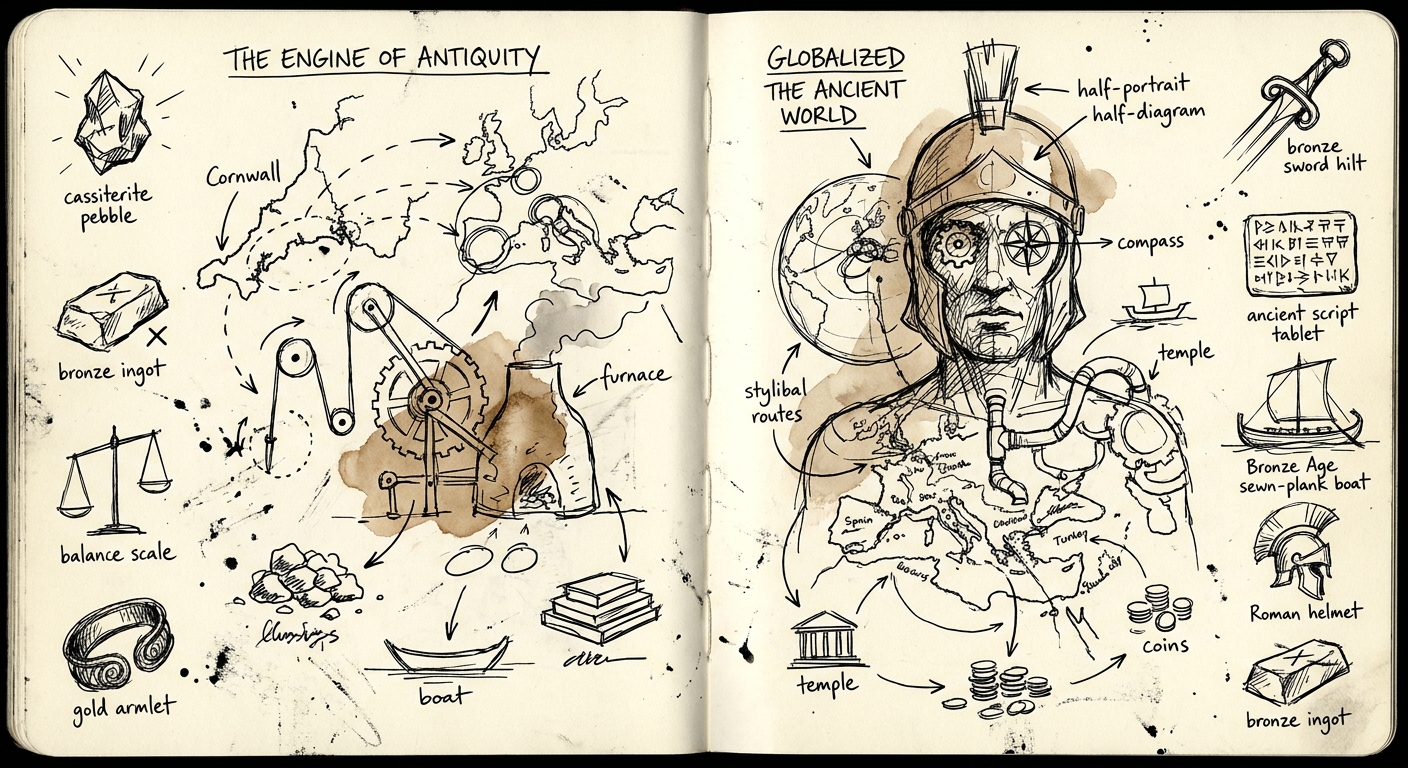
The Engine of Antiquity: How the Cornish Tin Trade Forged the Bronze Age and Globalized the Ancient World
Discover how the rare tin deposits of ancient Cornwall powered a technological revolution, connecting diverse cultures across thousands of miles and laying the groundwork for the first true global economy.
Listen to this article
34 min listen
The Engine of Antiquity: How the Cornish Tin Trade Forged the Bronze Age and Globalized the Ancient World
The Chronological and Geological Foundations of British Metallurgy
Archaeological evidence, supported by high-precision accelerator mass spectrometry and radiocarbon dating, firmly establishes the onset of the British Bronze Age during the late third millennium BCE, specifically between 2400 and 2200 BCE. This era marked the twilight of the Neolithic period and coincided with the arrival of the Bell Beaker culture, a phenomenon that introduced new cosmological concepts, distinctive pottery, and, most crucially, early metallurgical paradigms to the indigenous populations of the British Isles.
The transition from a lithic (stone) economy to a metallurgical one was not sudden, but rather a gradual evolution spanning centuries, during which stone tools remained in widespread use alongside the first copper and bronze implements. However, the defining characteristic that would elevate Britain from a peripheral island to the epicenter of an intercontinental economic network was its unique geological endowment. Tin is an exceptionally rare element within the Earth's crust, occurring at an average concentration of merely two parts per million (ppm). This stands in stark contrast to other foundational elements of antiquity, such as copper (70 ppm) and iron (50,000 ppm). Furthermore, tin deposits are not homogeneously distributed; they are restricted to highly specific, localized geological formations. In antiquity, the primary sources of tin were limited to Cornwall and Devon in southwestern Britain, the Brittany peninsula in France, the Iberian Peninsula, the Erzgebirge mountains on the German-Czech border, and remote regions of Central Asia.
The granitic intrusions of Cornwall and Devon, formed approximately 274 to 293 million years ago, hosted some of the richest and most accessible deposits of cassiterite, the primary ore of tin, in the prehistoric world. During the Early Bronze Age, this tin was not extracted through the deep subterranean hard-rock mining techniques that would characterize the region in the 18th and 19th centuries CE. Instead, early Britons exploited alluvial deposits through a process known as "tin-streaming". Natural weathering over millennia had eroded the cassiterite from its granite host rock, and the heavy ore was subsequently concentrated by water currents in riverbeds and valley floors.
Prehistoric miners utilized the flow of local streams to wash away the lighter river gravels, leaving behind the dense cassiterite pebbles. Evidence of this early extraction is robust. Recent microwear and X-ray fluorescence (XRF) analyses of stone tools recovered from Early Bronze Age pits at sites such as Sennen, Lelant, and Truro have detected localized traces of cassiterite processing dating as far back as 2300 to 2200 BCE. Furthermore, excavations in the Carnon Valley have yielded the earliest known tin mining tools in Europe, including an antler pick radiocarbon dated to approximately 1600 BCE and a wooden shovel, carved from a single piece of oak, dating to roughly 1200 BCE. Heavy stone hammers, recovered from sites like Gwithian and Trethellan, demonstrate that these early metallurgists systematically crushed the cassiterite pebbles prior to smelting.
This decentralized, small-scale extraction model—largely undertaken by agricultural communities supplementing their subsistence farming with seasonal mining—would soon spark a profound technological revolution. The abundant and easily extractable alluvial tin of Cornwall was about to transition from a localized curiosity into the most highly sought-after strategic resource on the planet, driving the creation of the first truly globalized trade network in human history.
The Metallurgical Imperative and the Phenomenon of "Bronzization"
To comprehend how the discovery of tin reshaped Europe and the broader ancient world, one must examine the specific chemical and metallurgical imperatives of the period. Prior to the widespread adoption of tin-bronze, the prevailing metallurgical technology relied on copper. The earliest copper tools and weapons were often forged from polymetallic ores that naturally contained trace amounts of arsenic, resulting in an alloy known as arsenical copper. While arsenical copper represented a significant technological advancement over Neolithic flint and obsidian, it possessed severe limitations. The arsenic content was highly variable, leading to inconsistent material properties, and the smelting process released highly toxic fumes that severely compromised the health of the early smiths.
The intentional alloying of copper with tin fundamentally altered human technological capability. By adding tin to copper, typically in an optimal ratio of approximately 10 percent tin to 90 percent copper, ancient metallurgists created full tin-bronze. The introduction of tin lowered the melting point of the metal, significantly easing the casting process and allowing for the creation of much more complex molds and shapes. More importantly, the resulting alloy was substantially harder, more durable, and capable of holding a much sharper edge than either pure copper or arsenical copper. A bronze knife, sword, or agricultural sickle was functionally superior in every metric, and the alloy possessed a highly prized, luminous golden hue.
The superiority of tin-bronze triggered a phenomenon that modern archaeologists classify as "bronzization"—a process analogous to modern globalization. Between 2200 and 2100 BCE, Britain and Ireland underwent a rapid shift, completely transitioning from copper to full tin-bronze metallurgy. Over the subsequent centuries, this technological paradigm spread exponentially. By 1800 BCE, bronzization had reached Scandinavia and Central Europe, and by 1500 to 1300 BCE, it had fundamentally transformed the major palatial civilizations of the Eastern Mediterranean, including the Mycenaeans, the Hittites, and the Egyptians.
These advanced, literate, and heavily urbanized empires of the Near East operated highly sophisticated economies and militaries that became entirely reliant on massive quantities of bronze for weaponry, tools, armor, and elite signaling. This created a profound geopolitical paradox. The centers of ancient civilization in the Levant, Mesopotamia, and the Aegean possessed virtually no domestic sources of tin. Consequently, the mighty empires of the Eastern Mediterranean became functionally dependent on the extraction capabilities of small, decentralized farming communities residing on the remote Atlantic fringe of Europe, over 4,000 kilometers away.
For over two centuries, the origin of the tin that supplied the Eastern Mediterranean Bronze Age was one of the most fiercely debated mysteries in archaeometallurgy, commonly referred to as the "tin problem". Some scholars hypothesized that the tin must have flowed westward from largely undocumented sources in Central Asia via overland routes into Mesopotamia and the Levant. However, recent revolutionary advancements in chemical fingerprinting have resolved this debate.
Research initiatives, such as Project Ancient Tin led by Dr. Alan Williams and Dr. Benjamin Roberts at Durham University, have utilized a novel combination of trace element analysis, lead isotope mapping, and tin isotope evaluation to trace the geological origins of ancient artifacts. The definitive proof emerged from the analysis of tin ingots recovered from 14th to 13th-century BCE shipwrecks off the coast of Israel, such as the Hishuley Carmel site, as well as the later Rochelongue shipwreck off the southern coast of France. The isotopic data from these Levantine ingots perfectly matched the isotopic ranges of the granitic mines of Cornwall and Devon, while simultaneously ruling out older European sources and Iberian deposits. Specifically, the uniquely high indium levels found in the shipwrecks' tin ingots were consistent only with the ores of southwestern Britain.
The volume of this transcontinental trade was monumental. Given that archaeological evidence indicates the existence of over 100 Bronze Age copper mines across Europe and the Mediterranean, producing hundreds of tons of copper annually, the demand for tin was proportionally massive. To maintain the 90:10 ratio required for bronze, researchers estimate that tens to perhaps hundreds of tons of Cornish tin were exported annually into the Mediterranean system. Consequently, Cornish tin represents the first commodity in British history to be exported across the entirety of the European continent, fundamentally underwriting the technological leap and military supremacy of Eastern Mediterranean kingdoms.
The Architecture of Prehistoric Trade: A Comparative Economic Analysis
To fully appreciate the historical importance and trade breadth of Cornish tin, it is necessary to contextualize it against other major commercial items of prehistoric antiquity, specifically amber, copper, salt, and obsidian. An analysis of these commodities reveals distinctly different paradigms of economic value, logistical complexity, and cultural significance.
Copper: The High-Volume Industrial Base
Copper was the essential partner to tin, representing 90 percent of the bronze alloy. However, unlike tin, copper deposits were widely distributed across Europe and the Near East. Major Bronze Age copper extraction sites have been identified from the Great Orme in Wales to the Mitterberg in Austria, the Iberian Peninsula, Cyprus, and the southern Urals in Russia. Because copper was heavier and required in vastly larger quantities than tin, its trade networks, while extensive, were often more regionalized. The abundance of copper meant that control of the resource, while profitable, did not confer the same level of absolute monopolistic leverage that tin sources provided. The tin trade, by virtue of its extreme geographic scarcity and absolute necessity, forced the creation of ultra-long-distance, intercontinental supply chains that copper alone would never have necessitated.
Obsidian: The Pre-Metallurgical Lithic Standard
Prior to the dominance of metallurgy, obsidian—a naturally occurring volcanic glass—was one of the most important trade commodities in the ancient world. Because of its physical properties, obsidian could be knapped to produce incredibly sharp cutting edges, making it the premier material for Neolithic knives, scrapers, and weaponry. Like tin, obsidian occurs only in highly specific geological locations, such as Melos in the Aegean, Sardinia, Anatolia, and specific volcanic flows in Mesoamerica and the Pacific Northwest.
Modern archaeometry utilizes handheld X-ray fluorescence (XRF) spectrometers to quantify trace elements like rubidium, strontium, and zirconium within obsidian artifacts, allowing researchers to trace tools back to their exact volcanic flow of origin. These studies have revealed massive, regularized trade networks operating as early as 8000 BCE in the Near East and Mediterranean. However, the historic importance of obsidian waned sharply with the advent of the Bronze Age. While obsidian was lethally sharp, it was inherently brittle, prone to fracture upon impact, and unlike metal, it could not be melted down, recast, or recycled. Consequently, while the geographic breadth of the obsidian trade was vast during the Neolithic, its economic dominance was entirely eclipsed by the superior durability and utility of tin-bronze.
Amber: The Currency of Elite Prestige
Baltic amber shares the most similarities with the tin trade in terms of its capacity to cross vast continental expanses. Amber, fossilized tree resin, was highly prized for its aesthetic beauty, supposed magical properties, and status as a luxury good. Infrared spectroscopy has demonstrated that the vast majority of amber found in Mycenaean Greece, Italy, and the Levant originated from the shores of the Baltic Sea.
The "Amber Road" moved this commodity southward through central Europe, often intersecting or paralleling the riverine and maritime routes utilized for the tin trade. In Mycenaean contexts, amber occurs almost exclusively in elite settings, such as the famous Shaft Graves (c. 1600 BCE), taking the form of complex spacer plates and jewelry. However, the economic paradigm of amber was fundamentally different from that of tin. Amber was a low-weight, high-value luxury good that functioned within the realm of elite signaling and ceremonial wealth. It was not a structural necessity for society. Tin, conversely, was an industrial requirement; without tin, the entire military and agricultural infrastructure of the Bronze Age empire would collapse. Thus, while amber trade networks were equally broad, the historic importance of tin was foundational rather than decorative.
Salt: The Bulk Survival Commodity
Salt, frequently referred to in antiquity as "white gold," represents a completely different vector of prehistoric commerce. Salt was an absolute biological necessity for human and animal health, but its primary historic economic value lay in its role as a preservative. In peasant societies and urban centers alike, the ability to preserve meat, fish, and dairy surpluses for long periods was the bedrock of survival and economic stability.
The prehistoric salt trade was a massive bulk industry. Salt was extracted via various methods across Europe: from deep mines in Hallstatt (Austria) and Transylvania, from the boiling of coastal seawater in localized regions, and from inland brine springs like Droitwich in England. The production often involved "briquetage"—coarse ceramic vessels used to boil brine until salt crystals formed, the fragments of which archaeologically map the distribution networks. Because salt was heavy and required in massive quantities, it was transported via ox-drawn carts, river boats, and pack animals. However, unlike tin, salt production centers were relatively widespread across the European continent. Therefore, while the salt trade generated immense regional wealth and shaped local settlement patterns, it did not dictate the creation of the singular, thousands-of-kilometers-long supply lines that characterized the British tin trade.
Comparative Commodities Matrix
| Commodity | Primary Ancient Source Regions | Principal Utility | Trade Breadth & Distance | Economic Paradigm |
|---|---|---|---|---|
| Tin | Cornwall, Brittany, Iberia, Erzgebirge, Central Asia | Chemical catalyst for bronze metallurgy; hardening agent | Intercontinental (up to 4,000 km) | Strategic industrial necessity; high-value, highly localized extraction |
| Copper | Cyprus, Alps, Wales, Iberia, Balkans, Urals | Primary base metal for bronze, tools, and weapons | Regional to Intercontinental | High-volume industrial base; widespread extraction |
| Amber | Baltic Coast, North Sea | Elite jewelry, prestige goods, ceremonial signaling | Intercontinental (Baltic to Mediterranean) | Low-weight, high-value luxury commodity |
| Obsidian | Anatolia, Melos, Lipari, Sardinia, Mesoamerica | Sharp edge-wear tools, Neolithic weaponry, ritual objects | Regional to Interregional | Specialized lithic precursor to metal; declined sharply in Bronze Age |
| Salt | Galicia, Transylvania, Alps (Hallstatt), Coastal areas | Biological necessity, food preservation, chemical processes | Regional to Intercontinental | Bulk survival commodity; wide geographic availability |
Subsidiary Commodities: The Cargoes of the Bronze Age Merchants
The complex infrastructure required to transport Cornish tin safely across the tempestuous waters of the Atlantic and the expansive European river systems (such as the Seine, Loire, and Rhône) did not operate to move a single commodity in isolation. The merchant networks established to facilitate the tin trade were highly diversified, carrying a wide array of goods that spurred unprecedented cultural and economic integration.
Archaeological evidence strongly indicates that gold was a primary companion export to tin. The river valleys of Cornwall, Wales, and Ireland were prolific sources of early alluvial gold, which moved seamlessly through the established tin exchange corridors. The most spectacular synthesis of these materials is evidenced by the Nebra Sky Disc, an artifact discovered in central Germany and dated to approximately 1600 BCE. Widely considered one of the most important archaeological finds of the 20th century and recognized as the world's oldest depiction of the cosmos, the disc is forged of bronze. Advanced chemical fingerprinting has revealed that not only did the tin used in the bronze matrix originate in Cornwall, but the gold utilized for the celestial inlays—depicting the sun, moon, and stars—also came from Cornish sources. This finding is revelatory, suggesting that prehistoric British merchants were not merely exporting raw industrial materials, but were actively pushing a highly valued "package" of precious metals deep into the heart of continental Europe.
The famous Uluburun shipwreck, which sank off the coast of modern-day Turkey around 1300 BCE, provides a pristine, time-capsule view of the Late Bronze Age maritime economy in the Mediterranean. Alongside the staggering cargo of 10 tons of copper (cast into approximately 300 oxhide ingots) and 1 ton of tin (approximately 40 ingots), the ship carried a treasure trove of international goods. The hold contained Baltic amber, African ebony and ivory, ostrich eggshells, Canaanite jars filled with terebinth resin, glass ingots, and exquisite gold jewelry. This staggering diversity indicates that tin merchants operated within a highly integrated, multi-lateral global market. Tin was exchanged for manufactured goods, textiles, wine, olive oil, and advanced ceramics.
Furthermore, terrestrial trade records corroborate the complexity of these exchanges. The extensive clay tablet archives of Kültepe-Kanesh in Anatolia (dating between 1975 and 1750 BCE) document massive donkey caravans transporting tin alongside vast quantities of high-value Mesopotamian textiles, confirming that finished luxury goods were the standard currency utilized by eastern empires to acquire strategic western metals. Later shipwreck depositions, such as the Rochelongue site off the southern coast of France (dating to the 7th or 6th century BCE), show that British lead also eventually became a heavily traded companion commodity alongside tin.
Social Stratification, Merchant Independence, and Knowledge Transfer
The logistical realities of the intercontinental tin trade exerted a profound transformational effect on the social stratification and political structures of antiquity. Traditional historical models of the Late Bronze Age rely heavily on the concept of the "palace economy" or the "temple-state". In this highly centralized system, prominent in the Near East and Mycenaean Greece, a monarchical or priestly elite controlled the means of production, forcefully collected agricultural and material output, and redistributed it to a dependent populace.
However, managing the high-risk, ultra-long-distance maritime trade of tin proved exceedingly difficult for rigid, land-based imperial bureaucracies to directly control. Consequently, the Bronze Age witnessed the rise of a highly powerful, independent class of merchant entrepreneurs and private trading firms. Textual evidence points to powerful merchant families, such as the "House of Zu-Ba'la" in Emar, who managed complex logistics, capital investment, and risk mitigation across borders, effectively operating outside the direct control of royal palaces. These merchants navigated the open seas and the fragmented tribal territories of the European continent, acting as autonomous economic agents.
As these merchants traversed the trade routes, they served as the primary vectors not only for physical commodities but for the rapid transmission of culture, ideas, and sophisticated technical skills. The necessity of negotiating complex trades over vast distances drove the standardization of economic practices. By 1300 BCE, sophisticated eastern technologies, including formalized systems of weights and measures, had been introduced to the small farming communities living along the Atlantic coasts.
The flow of metallurgical technology was similarly rapid and bidirectional. Human mobility was an inherent component of the trade, with evidence suggesting that apprenticeships, fosterage, and the exchange of skilled metalworkers occurred regularly along the Atlantic façade. This intense interaction led to the standardization of weapon typologies across vast geographic spaces. The discovery of a Mycenaean-style sword hilt in a barrow at Pelynt in Cornwall demonstrates that Mediterranean material culture and martial concepts were reaching the very edges of the known world, carried in the hands of those seeking tin.
Linguistic Metamorphosis: The Atlantic Lingua Franca
Perhaps the most profound, yet often overlooked, second-order effect of the Atlantic tin trade is its theorized role in fundamentally shaping the linguistic map of prehistoric Europe. For over a century, the orthodox historical consensus maintained that the Celtic languages emerged in central Europe, inextricably linked to the Iron Age Hallstatt and La Tène archaeological cultures (circa 800 to 450 BCE), and subsequently spread westward to the Atlantic fringe through elite dominance and military migration.
However, recent interdisciplinary synthesis combining archaeology, genetics, and historical linguistics has championed a radical paradigm shift known as the "Celtic from the West" hypothesis. Spearheaded by prominent scholars such as Professor Barry Cunliffe and linguist John T. Koch, this model posits that the Celtic languages did not arrive late in prehistory via Iron Age warriors, but rather emerged and disseminated along the Atlantic façade—stretching from the Iberian Peninsula, through Brittany, to the British Isles—during the deep Bronze Age.
The catalyst for this linguistic genesis was the maritime network established for the trade of tin, copper, and gold. The extraction, smelting, and trading of tin-bronze was the equivalent of a prehistoric industrial revolution. It required intense, sustained communication between diverse, geographically dispersed coastal communities. The transmission of complex metallurgical expertise necessitated a shared, highly specific vocabulary for technical parameters, trade negotiations, maritime logistics, and value standardization.
Under this model, Proto-Celtic evolved organically as the lingua franca—the commercial and technological language of the Atlantic Bronze Age network. It was spoken by the merchants, mariners, and smiths who plied the routes between the tin streams of Cornwall, the trading ports of Brittany, and the copper mines of Iberia. The discovery of early Tartessian inscriptions in southwestern Spain, dating to the Early Iron Age and exhibiting archaic Celtic linguistic traits, provides robust empirical support for this theory. These inscriptions indicate that a Celtic-speaking culture was deeply entrenched in the metal-producing regions of the Atlantic seaboard centuries before the classical expansion of the central European La Tène culture. Therefore, the pursuit of Cornish tin may have been the very mechanism that linguistically unified the ancient populations of western Europe.
Technological Advancements in Maritime Engineering
The logistical requirement to transport exceptionally heavy metal cargoes across the tempestuous waters of the English Channel and the Atlantic seaboard placed unprecedented demands on prehistoric maritime technology. For millennia, coastal communities had relied upon dugout logboats and light, skin-covered vessels (such as coracles) for local foraging and near-shore travel. However, these rudimentary craft were structurally inadequate for the reliable, high-volume transportation of the immense tonnage required by the Bronze Age intercontinental metal economy. The nature of the cargo directly dictated the engineering, sparking a revolution in naval architecture: the development of the sewn-plank boat.
The most spectacular and complete evidence of this technological leap is the Dover Bronze Age Boat, discovered in Kent and radiocarbon-dated to approximately 1550 BCE. Recognized as one of the most important wooden artifacts ever discovered in Europe, the Dover boat was an engineering marvel explicitly designed for the cross-Channel transport of heavy raw materials, likely linking the tin and copper supplies of Britain with the markets of northern France and the Low Countries.
Because bronze-age builders lacked iron nails or metal fastenings, they engineered an incredibly sophisticated alternative. The boat was constructed from massive oak planks, meticulously hewn using bronze adzes and axes. These planks were then intricately "stitched" together using highly flexible, twisted lashings of yew wood, passing through carefully aligned perforations. The seams were caulked with a dense mixture of moss and animal fat to ensure watertight integrity against the punishing seas.
The physical specifications of the Dover boat reveal its purely commercial and industrial purpose. The vessel measured approximately 18 meters (60 feet) in length and 2.5 meters (8 feet) in beam, giving it a massive structural weight of roughly 8 tonnes. To provide adequate propulsion for such a heavy craft in tidal waters, it was designed to accommodate a crew of approximately 18 to 20 paddlers. Most crucially, this configuration provided a staggering payload capacity of approximately two tonnes of cargo. Given that standard maritime shipments of the era required the movement of heavy copper and tin ingots, vessels of the Dover class were perfectly optimized to act as the vital heavy-lift freighters of the prehistoric economy.
Similar vessels, such as the suite of five Ferriby boats discovered in the Humber estuary and dating between 2030 and 1680 BCE, reinforce this pattern. The Ferriby craft featured complex box-scarfing joints to form a robust keel, and utilized thick ropes made from willow twigs for their sewn ligatures. For decades, some scholars debated the true seaworthiness of these sewn-plank designs. However, a major experimental archaeology project undertaken in 2012–2013 at the National Maritime Museum Cornwall definitively resolved the issue. Utilizing only Bronze Age tools and techniques, a team of shipwrights and historians constructed a full-scale replica named Morgawr. When launched into the open waters of Falmouth Harbour, the 50-foot, five-ton Morgawr proved to be highly stable, maneuverable, and entirely capable of undertaking the perilous cross-Channel voyages required by the tin trade. The extraction and trade of tin, therefore, was the direct catalyst that elevated humanity from coastal foragers to masters of open-ocean maritime logistics.
The Counterfactual Conquests: Assessing Resource Motivations in Roman, Germanic, and Norman Invasions
Given the profound geopolitical magnetism of the British Isles due to its tin wealth in prehistory, a compelling counterfactual question arises: would Britain have remained a prime target for the subsequent Roman, Germanic (Anglo-Saxon), and French (Norman) conquests if the tin deposits had not existed? An exhaustive analysis of the historical, economic, and political drivers of these later invasions strongly indicates that while tin was a recognized asset, Britain's strategic appeal had evolved far beyond its cassiterite reserves. Even without tin, the British Isles would have invariably fallen under the control of these later continental powers.
The Roman Conquest (43 CE)
During the Iron Age and the early classical period, Mediterranean awareness of Britain was still heavily tied to its mineral wealth. The Phoenicians and early Greek explorers, such as Pytheas of Massalia (circa 320 BCE), were drawn to the island specifically to document and trade for tin at coastal hubs like Ictis (likely St Michael's Mount). Classical writers routinely referred to the British Isles as the "Cassiterides" or the Tin Islands.
However, by the time Emperor Claudius launched the full-scale Roman invasion of Britannia in 43 CE, the strategic calculus of the Empire had shifted dramatically. While the Romans possessed an insatiable appetite for metals to fuel their coinage, military apparatus, and luxury markets, tin was no longer the sole, or even primary, economic driver. The Roman Empire was highly incentivized by Britain's other abundant geological endowments. The island possessed vast, untapped quantities of lead. Roman engineers prized British lead not only for the construction of their extensive plumbing and aqueduct systems, but critically because British lead ores were highly argentiferous (silver-bearing). Control of silver was the lifeblood of the Roman monetary system. The Romans acted with ruthless efficiency; within six years of the invasion, they had established massive, state-controlled lead and silver extraction operations in the Mendip Hills, overseen by the military. Furthermore, Britain was rich in iron, gold (which the Romans aggressively extracted using advanced hydraulic mining at Dolaucothi in Wales), salt, and crucial agricultural surpluses, specifically vast quantities of grain necessary to feed the Roman legions.
Beyond raw economics, the primary motivation for Claudius's invasion was grounded in domestic political survival. Claudius, a scholar who suffered from physical infirmities, had been unexpectedly elevated to the throne by the Praetorian Guard following the assassination of Caligula. He desperately lacked military credentials and required a massive, spectacular triumph to legitimize his rule, secure his precarious prestige among a hostile Senate, and pacify the Roman populace. Britain, viewed by the Roman psyche as a mysterious, semi-mythical island shrouded in fog on the absolute fringes of the known world (Oceanus), offered the ultimate propaganda victory. Conquering the unconquerable frontier was a political masterstroke.
Furthermore, there was a pressing strategic security imperative. Independent British tribes, such as the Catuvellauni, had a long history of providing sanctuary, resources, and military support to rebellious Celtic tribes in Roman Gaul. This cross-Channel interference created a persistent strategic vulnerability on Rome's northern frontier that necessitated pacification. Therefore, even in a counterfactual scenario entirely devoid of tin, the geopolitical necessity of securing the Gallic frontier, acquiring silver to mint denarii, and achieving unparalleled imperial prestige would have overwhelmingly guaranteed the Roman invasion.
The Anglo-Saxon and Norman Invasions
In the post-Roman era, the focus on tin receded even further as a primary driver for conquest, largely due to the collapse of the highly integrated transcontinental bronze economies of antiquity and the advent of the Iron Age, which democratized metallurgy due to the ubiquity of iron ore.
Following the withdrawal of the Roman legions in the early 5th century CE, the Germanic migrations—comprising the Angles, Saxons, and Jutes—were primarily motivated by the acquisition of highly productive agricultural land and the settlement of temperate territories. The breakdown of Roman civic defense left the fertile lowlands of eastern and southern Britain vulnerable to demographic shifts from the less agriculturally hospitable regions of northern Germany and southern Scandinavia. Their motivations were fundamentally agrarian and territorial, not driven by a desire to monopolize deep-vein mineral extraction.
Similarly, the Norman Conquest of 1066, initiated by William the Conqueror from France, was entirely divorced from the pursuit of tin. The conquest was fundamentally a complex dynastic and political dispute over the succession to the English throne following the death of the childless Anglo-Saxon King, Edward the Confessor. William's invasion was a massive military mechanism designed to enforce a feudal claim against his rival, Harold Godwineson, culminating at the Battle of Hastings.
While the victorious Normans rapidly and ruthlessly exploited the economic potential of their new kingdom, their resource priorities were drastically different from those of the Bronze Age merchants. The Normans operated within a feudal framework that required monumental architecture to project physical intimidation, military dominance, and spiritual supremacy over the newly conquered Anglo-Saxon populace. Consequently, Norman masons utilized immense quantities of dimension stone to construct an extensive, island-wide network of castles, cathedrals, and abbeys.
As the English Middle Ages progressed, the national economy relied heavily on agriculture, the immensely profitable wool trade, and the mining of iron, lead, silver, and increasingly, coal. While Cornish tin remained an important and highly lucrative domestic industry—one so vital that it eventually granted the miners unique legal self-governance through the establishment of the autonomous Stannary Parliaments —it was no longer the singular geopolitical magnet it had been three millennia prior. The British Isles had evolved into a strategically vital geopolitical entity in its own right, ensuring its place as a battleground for continental powers regardless of its cassiterite reserves.
Conclusion
The discovery and subsequent extraction of tin in Cornwall during the late third millennium BCE was not merely a localized industrial development; it was the catalyst for a cascade of technological, economic, and cultural transformations that fundamentally reshaped the trajectory of human civilization. The metallurgical necessity of alloying tin with copper to produce durable, lethal, and aesthetically prized bronze forged an unprecedented intercontinental dependency. It inextricably linked the agrarian, kin-based communities of the Atlantic fringe to the highly urbanized, palatial empires of the Eastern Mediterranean, effectively initiating the first era of globalization.
This trade operated on a scale and complexity that dwarfed the regional exchange of contemporary prehistoric commodities, such as obsidian and amber. It required the systematic movement of tens of tons of metal across perilous maritime environments and vast riverine networks. To satisfy this staggering logistical imperative, prehistoric societies were forced to innovate, engineering highly sophisticated, heavy-lift sewn-plank vessels that pushed the absolute boundaries of early maritime architecture.
Furthermore, the sustained, highly complex human interactions required to maintain this thousands-of-kilometers-long supply chain completely reorganized ancient social structures. It facilitated the rise of independent merchant classes, drove the standardization of technical skills and economic weights, and provided the ideal sociolinguistic crucible for the dissemination of a lingua franca, which likely resulted in the spread of the Celtic languages along the Atlantic seaboard. While the imperial ambitions of later Roman, Germanic, and Norman conquerors were driven by differing political, agricultural, and mineral priorities, the legacy of the Bronze Age tin trade remains unparalleled. By providing the essential chemical catalyst for "bronzization," the Cornish tin trade dragged Europe out of the Stone Age, permanently integrating the ancient world into a shared technological and economic destiny.
Works cited
1. Cornwall in the Bronze Age, https://www.cornwallheritagetrust.org/timeline/cornwall-in-the-bronze-age/ 2. Cornish Bronze Age - Wikipedia, https://en.wikipedia.org/wiki/Cornish\_Bronze\_Age 3. Tin sources and trade during antiquity - Wikipedia, https://en.wikipedia.org/wiki/Tin\_sources\_and\_trade\_during\_antiquity 4. Did local tin kickstart the European Bronze Age? | The Box Plymouth, https://www.theboxplymouth.com/blog/collections/did-local-tin-kickstart-the-european-bronze-age 5. How the ancient tin roads developed from 3200 BC to 700 BC, https://nuttersworld.com/ancient-trade-routes-mediterranean-sea/tin-roads/ 6. A Brief History of Mining in Cornwall - Wilderness England, https://wildernessengland.com/blog/mining-cornwall/ 7. Beaker and Early Bronze Age Tin Exploitation in Cornwall: Cassiterite Processing Identified through Microwear and pXRF Analyses | European Journal of Archaeology - Cambridge University Press & Assessment, https://www.cambridge.org/core/journals/european-journal-of-archaeology/article/beaker-and-early-bronze-age-tin-exploitation-in-cornwall-cassiterite-processing-identified-through-microwear-and-pxrf-analyses/80BA1EA542669DCEDEF5793A09307995 8. New carbon dating brings evidence of Bronze Age mining in Cornwall, https://cornwallmuseum.org/new-carbon-dating-in-cornwall/ 9. Britain's long-distance tin trade transformed the Bronze Age ..., https://www.durham.ac.uk/news-events/latest-news/2025/05/britains-long-distance-tin-trade-transformed-the-bronze-age/ 10. From Land's End to the Levant: did Britain's tin sources transform the ..., https://www.cambridge.org/core/journals/antiquity/article/from-lands-end-to-the-levant-did-britains-tin-sources-transform-the-bronze-age-in-europe-and-the-mediterranean/2330F3B6498B210DA61B89026A1F38EA 11. The metals of antiquity – tin - MINING.COM, https://www.mining.com/the-metals-of-antiquity-tin/ 12. Mineral Empires: How Obsidian, Bronze, and Iron Sparked the Ancient World's Wars, https://rubblerockandgem.com/blogs/mining-history-economics/mineral-empires-how-obsidian-bronze-and-iron-sparked-the-ancient-world-s-wars 13. Cornish tin was sold all over Europe 3000 years ago, say archaeologists - The Guardian, https://www.theguardian.com/science/2025/may/07/cornish-tin-was-sold-all-over-europe-3000-years-ago-say-archaeologists 14. British tin might have fueled the rise of some Bronze Age civilizations - Science News, https://www.sciencenews.org/article/british-tin-bronze-age-civilizations 15. Israel's Bronze Age Tin From Britain | ArmstrongInstitute.org, https://armstronginstitute.org/1338-israels-bronze-age-tin-from-britain 16. Bronze-age Britain traded tin with the Mediterranean, shows new study – settling a two-century debate - Durham University, https://www.durham.ac.uk/research/current/thought-leadership/2025/05/bronze-age-britain-traded-tin-with-the-mediterranean-shows-new-study--settling-a-two-century-debate/ 17. Study reveals vast Aztec trade networks behind ancient obsidian artifacts, https://news.tulane.edu/pr/study-reveals-vast-aztec-trade-networks-behind-ancient-obsidian-artifacts 18. Renfrew, Dixon, and Cann Reconstruct Ancient Near Eastern Trade Routes | History | Research Starters - EBSCO, https://www.ebsco.com/research-starters/history/renfrew-dixon-and-cann-reconstruct-ancient-near-eastern-trade-routes 19. Obsidian and Stone Sourcing – Keys to Prehistoric Trade Networks - Bruker, https://www.bruker.com/en/applications/academia-materials-science/art-conservation-archaeology/archaeology-and-archaeometry/obsidian-and-stone-sourcing-keys-to-prehistoric-trade-networks.html 20. CHAPTER 11 Ancient Trade Routes for Obsidian Cliffs and Newberry Volcano Toolstone in the Pacific Northwest, https://npshistory.com/publications/usfs/newberry/tgpn-2015.pdf 21. How the Amber Trade Transformed Prehistoric Europe - YouTube, https://www.youtube.com/watch?v=k5je7IkR5Wk 22. Lesson 22: Narrative – Aegean Prehistoric Archaeology - Sites at Dartmouth, https://sites.dartmouth.edu/aegean-prehistory/lessons/lesson-22-narrative/ 23. Expedition Magazine | Tin in the Ancient Near East, https://www.penn.museum/sites/expedition/tin-in-the-ancient-near-east/ 24. Salt trade roat | European Heritage Days, https://www.europeanheritagedays.com/node/539105 25. Salt in Prehistoric Europe - Sidestone Press, https://www.sidestone.com/openaccess/9789088902017.pdf 26. Full article: Morgawr: an experimental Bronze Age‐type sewn‐plank craft based on the Ferriby boats - Taylor & Francis, https://www.tandfonline.com/doi/full/10.1111/1095-9270.12058 27. Prehistory: Commerce - English Heritage, https://www.english-heritage.org.uk/learn/story-of-england/prehistory/commerce/ 28. The Rise of Bronze Age Empires alongside Trading Networks - Nuttersworld, https://nuttersworld.com/civilisations-that-collapsed/bronze-age-empires-and-networks/ 29. Trading and weighing metals in Bronze Age Western Eurasia - PNAS, https://www.pnas.org/doi/10.1073/pnas.2110552118 30. Chapter Nine Celtic origins: Archaeologically speaking, https://www.abdn.ac.uk/sll/documents/Ch9-Gallacher.pdf 31. Ancient Britain and the Atlantic Zone | University of Wales, https://www.wales.ac.uk/cawcs/research/ancient-britain-and-atlantic-zone 32. Tracing the spread of Celtic languages using ancient genomics - bioRxiv, https://www.biorxiv.org/content/10.1101/2025.02.28.640770v2.full-text 33. Was the Celtic language and culture spread by La Tène elites or was it the reverse in the Atlantic fringe? (Didn't get a response in the other sub so I'm crossposting here) - Reddit, https://www.reddit.com/r/Celtic/comments/1mu6nhu/was\_the\_celtic\_language\_and\_culture\_spread\_by\_la/ 34. Beaker Culture Metal and Mobility in Atlantic Europe: Some Implications for Genetic and Language Origins (Chapter 10) - The Indo-European Puzzle Revisited, https://www.cambridge.org/core/books/indoeuropean-puzzle-revisited/beaker-culture-metal-and-mobility-in-atlantic-europe-some-implications-for-genetic-and-language-origins/B79D33534F5ADF83646931E4B669E881 35. Atlantic Bronze Age - Wikipedia, https://en.wikipedia.org/wiki/Atlantic\_Bronze\_Age 36. Building Morgawr: seafaring Bronze Age-style - The Past, https://the-past.com/feature/building-morgawr-seafaring-bronze-age-style/ 37. Internet Archaeol. 34. Robinson. Plank-built boats, https://intarch.ac.uk/journal/issue34/2/3-2.html 38. Dover Bronze Age Boat - Wikipedia, https://en.wikipedia.org/wiki/Dover\_Bronze\_Age\_Boat 39. Dover Bronze Age Boat | Canterbury Archaeological Trust, https://www.canterburytrust.co.uk/dover-bronze-age-boat 40. Sailing in the Bronze Age | Musée d'Archéologie nationale, https://musee-archeologienationale.fr/en/sailing-bronze-age 41. Bronze Age sewn-plank boat replica ready to launch - The History Blog, http://www.thehistoryblog.com/archives/23809 42. Cornwall: tin, pasties and the world - MetageologistMetageologist - All-geo, https://all-geo.org/metageologist/2013/03/cornwall-tin-pasties-and-the-world/ 43. Mining in Roman Britain - Wikipedia, https://en.wikipedia.org/wiki/Mining\_in\_Roman\_Britain 44. International Trade in Outland Resources: the Mining and Export of Lead in Early Medieval England in Light of New Isotope Data From York, https://commercial.yorkarchaeology.co.uk/wp-content/uploads/2024/01/International-Trade-in-Outland-Resources-the-Mining-and-Export-of-Lead-in-Early-Medieval-England-in-Light-of-New-Isotope-Data-From-York.pdf 45. History of lead mining | Minerals and mines | Foundations of the Mendips, https://www2.bgs.ac.uk/mendips/minerals/mins\_mines\_2.htm 46. Why did the Romans invade Britain? - History Skills, https://www.historyskills.com/classroom/ancient-history/claudius-invasion-of-britain/ 47. Why did Rome decide to invade and hold Britain rather than using the resources to push further into Europe? : r/history - Reddit, https://www.reddit.com/r/history/comments/eioh95/why\_did\_rome\_decide\_to\_invade\_and\_hold\_britain/ 48. Why Did the Romans Invade Britain, and What Happened Next? - History Hit, https://www.historyhit.com/why-did-the-romans-invade-britain/ 49. The Roman invasion of Britain: The earliest campaigns, AD 43–7 - English Heritage, https://www.english-heritage.org.uk/learn/story-of-england/romans/invasion/ 50. Norman Conquest | Definition, Summary, & Facts | Britannica, https://www.britannica.com/event/Norman-Conquest 51. A ONCE AND FUTURE EXTRACTIVE HISTORY OF BRITAIN THE ..., https://nora.nerc.ac.uk/id/eprint/507339/1/A%20once%20and%20future%20extractive%20history%20of%20Britain.pdf 52. Economics of English mining in the Middle Ages - Wikipedia, https://en.wikipedia.org/wiki/Economics\_of\_English\_mining\_in\_the\_Middle\_Ages 53. A Complete History Of Tin: From The Ancient Era To Today - Brian D. Colwell, https://briandcolwell.com/a-complete-history-of-tin-from-the-ancient-era-to-today/