Exhaustive Analysis of the Alabama Democratic Conference
Explore how the Alabama Democratic Conference evolved from a civil rights movement into a dominant political force, shaping the state's electoral landscape and legal frameworks.
Listen to this article
63 min listen
Exhaustive Analysis of the Alabama Democratic Conference: Historical Formation, Electoral Influence, and Legal Frameworks
I. Introduction and Historical Context of African American Political Disenfranchisement in Alabama
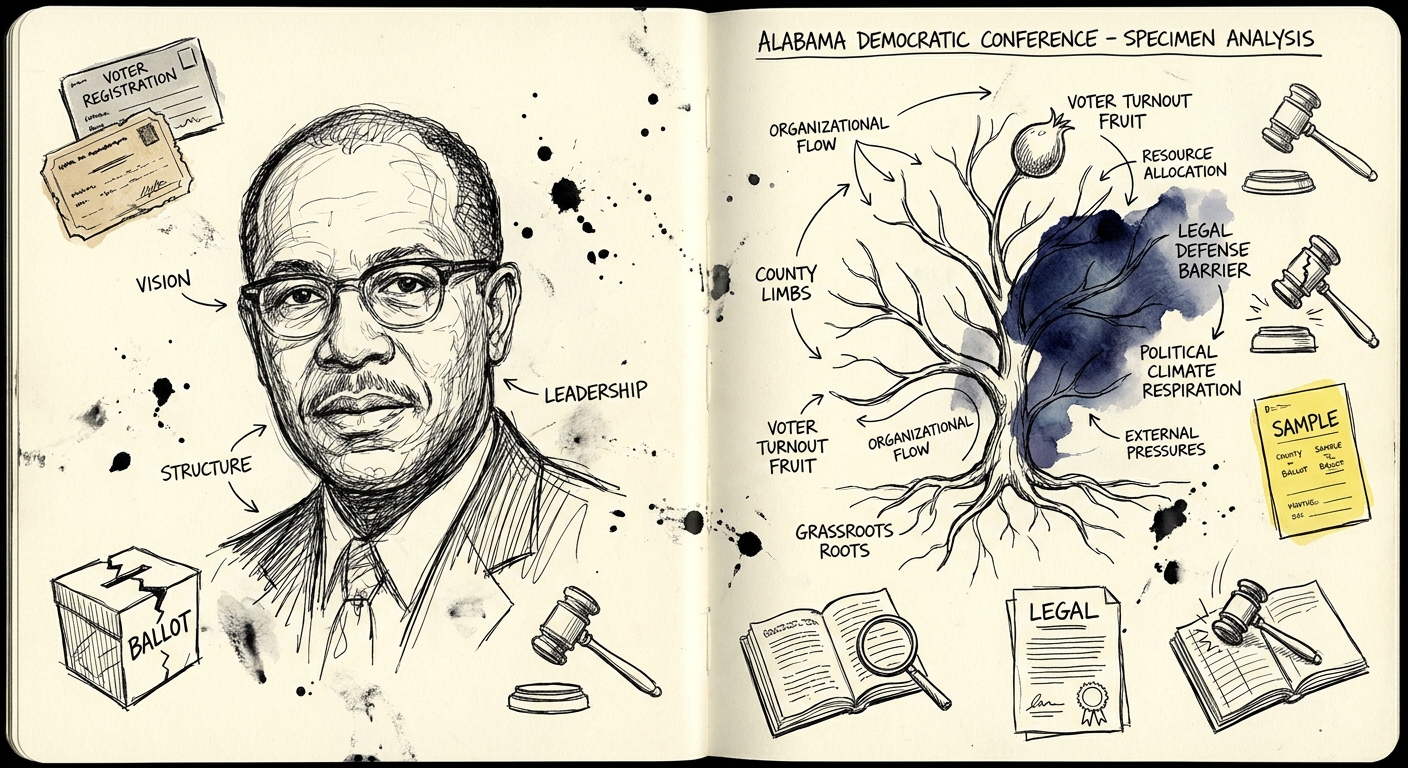
The political architecture of the American South is fundamentally defined by the historical struggle for civil rights, the structural transformation of institutional political parties, and the ongoing, highly technical battles over campaign finance and electoral access. Within the State of Alabama, no single organization has exerted as profound and sustained an influence over these intersecting domains as the Alabama Democratic Conference (ADC). Governed for decades by Dr. Joe L. Reed, the ADC has evolved from a nascent grassroots coalition formed in the crucible of the Civil Rights Movement into a highly institutionalized political action apparatus that dictates the trajectory of the Alabama Democratic Party (ADP).
To comprehend the genesis and the enduring necessity of the Alabama Democratic Conference, one must first examine the historical void it was created to fill. During the Reconstruction Era, a biracial Republican Party briefly dominated Alabama politics, allowing African American leaders such as Benjamin Turner (who served in the 42nd Congress) and James Rapier (who served in the 43rd Congress and advocated for the Civil Rights Act of 1875) to attain federal office. However, this period of representation was systematically dismantled by the resurgence of conservative "Bourbon Democrats," who appealed to white supremacist sentiments and utilized paramilitary violence to regain control of the state in 1874. This systematic suppression culminated in the Alabama Constitution of 1901, a document explicitly designed to disenfranchise almost all Black voters and many poor white voters through the implementation of poll taxes, literacy tests, and restrictive registration requirements. The effectiveness of the 1901 Constitution was devastating; the number of registered Black voters in Alabama plummeted from over 180,000 in 1900 to fewer than 3,000 by 1903.
For the first half of the twentieth century, the Alabama Democratic Party functioned as an exclusively white institution. The white primary system ensured that the Democratic nomination—the only election of consequence in the one-party South—was barred to African Americans. Even after the United States Supreme Court outlawed the all-white primary in the 1944 case Smith v. Allwright, systemic disenfranchisement persisted through localized intimidation and arbitrary registrar practices. It was not until the emergence of the modern Civil Rights Movement and the impending shifts in national party platforms that the environment became ripe for a statewide, organized Black political apparatus. The Alabama Democratic Conference emerged directly from this volatile historical context, transitioning from a localized struggle for basic enfranchisement into a dominant institutional force that would eventually capture control of the very party that had historically excluded its members.
II. The Genesis: Formation of the Black Political Caucus of Alabama
The imperative to mobilize the disenfranchised Black population coincided with the national Democratic Party’s shifting platform on civil rights during the mid-twentieth century. The specific catalyst for organized statewide action in Alabama was the 1960 presidential campaign of John F. Kennedy and Lyndon B. Johnson. Polling in the final months before the November 1960 general election indicated that Kennedy and Richard Nixon were running neck-and-neck globally, and the Kennedy campaign recognized the untapped potential of the Southern Black electorate.
Louis Martin, a highly respected journalist often referred to as the "godfather of black politics" and a key operative for the Kennedy campaign, sought to consolidate Southern Black leaders to support the Democratic ticket. During the summer of 1960, Martin convened a strategic meeting at Paschal’s Restaurant in Atlanta, Georgia. Paschal’s was a renowned sanctuary and gathering place for Black intellectuals, civil rights leaders, and the so-called "black bourgeoisie," frequently hosting strategic sessions for figures such as Dr. Martin Luther King Jr.. At this meeting, Martin challenged the attendees to return to their respective states and organize the fragmented, localized voters' leagues, civic leagues, and community improvement associations into unified, statewide political forces capable of delivering a bloc vote.
Responding directly to this challenge, a coalition of prominent Alabama civil rights figures established the first statewide political organization for African Americans in Alabama, originally named the Black Political Caucus of Alabama. The founding members represented a cross-section of the state's Black intelligentsia, legal vanguard, and labor leadership. The principal architects included:
- Orzell Billingsley: A prominent civil rights attorney who provided crucial legal defense during the movement.
- Arthur Shores: A pioneering civil rights attorney from Birmingham who relentlessly challenged segregation laws in the courts.
- Rufus Lewis: A Montgomery activist and businessman who famously required patrons of his establishment, the Citizen's Club, to present their voter registration cards before gaining entry. Lewis was known for his profound belief in the ballot, frequently driving several hours to rural counties simply to teach one or two individuals how to properly complete voter registration forms.
- Dr. C.G. Gomillion: A Tuskegee educator and the lead plaintiff in the landmark Gomillion v. Lightfoot Supreme Court case, which struck down racial gerrymandering designed to exclude Black voters from the Tuskegee city limits.
- Beulah Johnson: A dedicated educator and activist from Tuskegee.
- Q.D. Adams: A Gadsden salesman and leader of the Etowah County Voters' League (formed in 1938), who viewed the acquisition of a voter registration card as a fundamental rite of passage into manhood and civic responsibility.
- Isom Clemon: A Mobile dockworkers' union leader who provided vital labor organizing expertise.
The organization was explicitly designed to bring newly registered Black voters into the Democratic ranks, leveraging collective voting power to demand representation, policy concessions, and the dismantling of Jim Crow electoral barriers. When these founders began their organizing work, there were exceptionally few Black voters on the rolls, and the climate of white resistance to Black voter participation remained violently strong. Nevertheless, they coalesced around the political activism of the 1960 campaign, drawing from a network of local organizations that had existed in various counties since the early twentieth century.
III. Strategic Evolution: The Name Change and the Schism of 1968
The transition of the organization's name from the "Black Political Caucus of Alabama" to the "Alabama Democratic Conference" occurred gradually throughout the 1960s, a period marked by intense factionalism within the Civil Rights Movement regarding the optimal strategy for political integration. This nomenclature shift was not merely a cosmetic rebranding; it represented a profound strategic calculation regarding how African Americans could most effectively wield power in Alabama.
By the late 1960s, African American activists faced entrenched resistance from conservative white Democrats who actively thwarted civil rights goals and fiercely opposed the participation of African Americans within the state party apparatus. This hostility led to a severe ideological schism among Black political leaders in Alabama. One faction, led by figures such as Dr. John L. Cashin Jr., concluded that the Alabama Democratic Party was irredeemably racist and fundamentally incompatible with the goals of Black liberation. In 1968, this separatist faction abandoned the traditional party apparatus entirely and formed the National Democratic Party of Alabama (NDPA). Modeled after the Mississippi Freedom Democratic Party, the NDPA sought to operate outside the traditional Democratic structure, eventually running Cashin for governor against the arch-segregationist George Wallace in 1970. The NDPA was designed to enable African Americans to participate in local politics completely independent of white conservative interference.
Conversely, the faction that formalized the title "Alabama Democratic Conference" chose a strategy of internal institutional conquest—an approach rooted in "entryism." By aligning explicitly with the national Democratic Party and adopting the "Conference" moniker, the ADC signaled its firm intent to operate as a formalized, recognized caucus within the established Democratic apparatus rather than as a third-party alternative. This institutionalist approach yielded immediate and historic dividends. In 1968, utilizing its formal alignment with the national party, the ADC successfully brokered a deal with the Democratic National Committee leadership to bypass the segregated state party and seat the very first Black delegates from Alabama at a Democratic National Convention.
The adoption of the name "Alabama Democratic Conference" served multiple strategic purposes. First, it legitimized the organization in the eyes of national party powerbrokers in Washington, D.C., distinguishing the ADC from the perceived radicalism of third-party secessionists like the NDPA. Second, it provided an organizational umbrella under which local county affiliates could be systematically established across all 67 Alabama counties, creating a shadow party infrastructure that would eventually eclipse the traditional white party apparatus.
IV. Dr. Joe L. Reed: The Architect of Institutional Hegemony
To comprehend the sheer magnitude of the Alabama Democratic Conference's influence, one must understand its long-serving chairman, Dr. Joe Louis Reed Sr. Born in 1938 in Evergreen, Conecuh County, Alabama, Reed's political maturation occurred concurrently with the height of the Civil Rights Movement. Following his graduation from the segregated Conecuh County Training School in 1956, Reed served in the integrated U.S. Army, experiencing a level of racial egalitarianism that stood in stark contrast to the segregated reality of his home state. Upon returning to Alabama, he attended Alabama State University (ASU), a historically Black institution, where he served as student body president.
Reed’s early foray into direct civil rights action occurred on February 25, 1960, when he participated in a lunch counter sit-in at the Montgomery County courthouse. Following this protest, Reed and his peers faced severe disciplinary action and expulsion from ASU. This event became the catalyst for the landmark federal court case Dixon v. Alabama, which resulted in a groundbreaking ruling that public institutions of higher education cannot arbitrarily discipline or expel students without providing constitutional due process. Reed was placed on probation but eventually graduated with a baccalaureate degree in 1962.
The ASTA-AEA Merger and the Construction of a Legal Powerhouse
Reed’s ascent to political hegemony began not in traditional electoral politics, but in the realm of education advocacy. Two years after his graduation, in 1964, Reed became the executive secretary of the Alabama State Teachers Association (ASTA), the professional organization representing the state's Black educators. Concurrently, the state's white educators were represented by the Alabama Education Association (AEA), led by a politically astute former superintendent named Paul Hubbert.
Recognizing that separate associations diluted the political power of public educators and clearly violated the impending federal mandates of integration, Reed and Hubbert orchestrated a historic, immensely consequential merger of the ASTA and the AEA on March 1, 1969. Hubbert assumed the role of Executive Secretary of the newly integrated organization, while Joe Reed was named Associate Executive Secretary. This dual-leadership dynamic lasted for over four decades, ending only when both men retired from the AEA on December 31, 2011.
The 1969 merger was a masterstroke of political engineering that transformed the AEA from a mere professional club into the most feared and respected political powerhouse in Montgomery. For Reed, the merger provided direct access to a massive, well-funded statewide network. Crucially, Dr. Reed assumed leadership over the AEA's litigation division. He built this division into an extraordinary legal powerhouse, utilizing direct control over the AEA's growing litigation budget, as well as access to the massive legal war chest of the National Education Association (NEA). This strategic positioning gave Reed the resources to launch relentless legal challenges aimed at dismantling the state's dual school systems and aggressively enforcing desegregation orders.
The partnership between Hubbert and Reed was synergistic. Hubbert—who was voted the "Most Influential Alabamian" in 2009—was known for his iron-fisted control over the state legislature, famously sitting in the gallery and using hand signals to dictate how lawmakers should vote on education and budgetary bills. Meanwhile, Reed utilized his position to inextricably link the organizational muscle and Political Action Committee (PAC) funds of the teachers' union (such as A-VOTE) with the political mobilization objectives of the ADC. This created an environment where the political aspirations of the state's Black electorate and the immense lobbying power of the public education sector were fused into a single, unified political machine.
The Controversies of Power
Reed's uncompromising leadership style and relentless deployment of litigation inevitably generated controversy and political blowback. In the late 1980s and 1990s, Reed served on the Montgomery City Council, further expanding his local influence. However, his aggressive tactics sometimes alienated even his own institutional allies. A prominent example occurred at his alma mater, Alabama State University. In 2008, the ASU Board of Trustees voted to remove Reed's name from the university's academic and sports arena, the Acadome. The board cited claims that Reed had generated negative publicity for the university and wasted taxpayer money by filing numerous allegedly frivolous lawsuits against the institution's administration. The trustees renamed the facility the Dunn-Oliver Acadome in honor of two successful basketball coaches, sparking intense debate and protests from Reed's loyal supporters. Despite such controversies, Reed's power within the broader political ecosystem remained largely unchallenged.
V. Solidifying Institutional Control: Hawthorne v. Baker and the State Democratic Executive Committee
While his base of operations was the AEA and the ADC, Joe Reed’s most profound impact on the Democratic Party itself was achieved through his position as Vice-Chair of Minority Affairs of the Alabama Democratic Party (ADP), an office he was appointed to in 1972 by then-Chair Robert Smith Vance. Reed held this position continuously until 2019. Though he never formally served as the overarching Chairman of the state party, Reed was universally recognized as the de facto leader of the ADP, a status he achieved through meticulous manipulation of party bylaws and federal litigation. The architecture of Reed's control over the state party was formalized through the litigation surrounding Hawthorne v. Baker (750 F. Supp. 1090, M.D. Ala. 1990). In April 1989, Black Democrats in Alabama, heavily supported by the ADC, filed a lawsuit in federal court against the State Democratic Executive Committee (SDEC) and various county committees. The plaintiffs alleged that the existing methods for selecting committee members violated Section 2 of the Voting Rights Act of 1965 and the Fourteenth and Fifteenth Amendments, effectively denying African Americans an equal opportunity to participate in party governance.
Under the SDEC's prior structure, each of the state's 105 House districts elected two members (one male, one female), and the committee authorized the ADC to appoint 23 additional at-large members. When the party attempted to alter these rules to restrict the ADC's appointment powers and force them to select only from unsuccessful Black candidates, the U.S. Attorney General refused to preclear the plan under Section 5 of the Voting Rights Act.
The resulting 1990 consent decree approved by the federal court fundamentally and permanently restructured the governance of the Alabama Democratic Party. The decree mandated that the proportion of Black persons serving on the SDEC must be at least equal to the proportion of Black voters in the general population, or the proportion of Black voters participating in the Democratic electoral primaries.
Operationally, this decree empowered the ADC—and by direct extension, Joe Reed—to select and appoint a massive bloc of at-large members to the SDEC to fulfill these strict racial quotas. Because African Americans reliably constitute the vast majority of the Democratic voting base in Alabama (often exceeding 80% of the primary electorate), the consent decree effectively guaranteed that the ADC faction would maintain an unbreakable mathematical majority on the state party's executive committee. Through this mechanism, Reed was able to personally select over 30 individual members to the SDEC, providing him with a loyal voting bloc capable of dictating party leadership, platform decisions, and resource allocation.
The Legal Strategy Extends: Poll Workers and Electoral Access
The ADC’s legal strategy under Reed was not limited to internal party governance; it aggressively targeted the administration of general elections. In 1984, the ADC backed the litigation in Harris v. Graddick (593 F. Supp. 128, M.D. Ala. 1984), challenging the disproportionately low number of African American poll workers appointed across Alabama's 67 counties. The plaintiffs argued that the overwhelming presence of all-white polling staffs, particularly in a state with a profound history of racial violence and intimidation at the ballot box, served as a psychological barrier that deterred Black citizens from voting, violating Section 2 of the Voting Rights Act.
The federal court agreed, issuing an injunction requiring that the number of Black poll officials at each polling place reasonably correspond to the percentage of Black registered voters in the county. District Judge Myron Thompson noted that the visible presence of Black poll workers was a "significant indication to many black persons that voting places are now open to all" and directly increased confidence in the electoral process. This victory not only expanded electoral access but also provided the ADC with thousands of patronage positions for its members, further solidifying its grassroots organizational strength in local precincts across the state.
VI. Modern Factional Warfare: The Battle for the ADP (2018-Present)
The institutional hegemony established by the Hawthorne v. Baker consent decree remained largely unchallenged until the late 2010s, when demographic shifts and a changing political landscape sparked intense internal factional warfare within the Alabama Democratic Party. As the party base expanded to include younger voters, LGBTQ+ individuals, and other ethnic minorities, these emerging cohorts increasingly felt marginalized by a power structure exclusively dominated by Reed's Black caucus.
The conflict erupted following the 2017 special election of U.S. Senator Doug Jones, the first Democrat to win a statewide race in Alabama in decades. Bolstered by this victory, a coalition of progressive, younger, and non-black Democrats—often referred to by Reed as "Challenging Democrats" or "Rogue Democrats"—attempted to oust the Reed-backed ADP Chairwoman, Nancy Worley, and Vice-Chair Randy Kelley during the August 2018 organizational meetings. Reed utilized his SDEC majority to defeat this challenge, with the votes splitting almost entirely along racial lines.
However, the opposition escalated the conflict to the national level. In February 2019, the Democratic National Committee (DNC) Credentials Committee, prompted by Chairman Tom Perez and Senator Jones, intervened directly in Alabama's party affairs. The DNC ruled that the ADP must update its bylaws to reflect the broader diversity of the modern Democratic voter base. Specifically, the DNC mandated the creation of new, independent "diversity caucuses" (including LGBTQ+, Hispanic, Asian/Pacific Islander, Native American, and Youth caucuses) and ordered new elections for the SDEC and party leadership. Crucially, this directive threatened to dilute the ADC's exclusive power to dictate minority appointments and broke Reed's mathematical stranglehold on the committee.
By November 2019, the reform faction succeeded in electing State Representative Chris England as the first Black chairman in ADP history, temporarily sidelining Worley and the Reed faction. Yet, Joe Reed demonstrated the resilience of his political machine. Retained in his position as Vice-Chair of Minority Affairs, Reed orchestrated a meticulous, multi-year counter-offensive. Utilizing his deep institutional knowledge and loyal grassroots network, Reed re-consolidated his base.
In August 2022, Reed’s preferred candidate, Randy Kelley, successfully won the chairmanship, returning functional control of the party apparatus to the ADC. Immediately upon regaining power, the Reed faction moved to revise the DNC-mandated bylaws. In early 2023, Chairman Kelley and Reed proposed reclassifying the independent diversity caucuses as "diversity constituencies" and combining the Hispanic, Native American, and Asian/Pacific Islander groups into a single "Ethnic Minority Committee". The opposition vehemently argued this was a transparent maneuver to reduce the voting power of these groups on the SDEC and preserve the absolute primacy of the Black caucus.
This ongoing, bitter factional warfare highlights Joe Reed's central, unwavering political philosophy: the belief that because African Americans constitute the unquestionable demographic backbone of the Alabama Democratic Party, Black leadership (exclusively via the ADC) must possess unequivocal control over its direction, resources, and candidate selection.
VII. The "Yellow Sheet": Electoral Gatekeeping and the Impact on Non-Black Democrats
The internal battles over SDEC bylaws are ultimately about controlling the party's electoral machinery. The Alabama Democratic Conference exercises its most tangible and formidable power through its candidate endorsement process. This endorsement is famously manifested in a printed sample ballot, colloquially and historically known as the "Yellow Sheet". Distributed by the tens of thousands outside polling places across the state on Election Day, the Yellow Sheet serves as a definitive voting guide for the ADC's fiercely loyal grassroots base.
The Mechanics of the Endorsement and the Financial Imperative
The influence of the Yellow Sheet is absolute in Democratic primaries. Fifty-seven years after the passage of the Voting Rights Act, African Americans constitute a massive voting majority in the Alabama Democratic electorate. Consequently, the ADC endorsement is frequently the singular determining factor between victory and defeat in a primary election.
This demographic reality creates a highly complex environment for non-black Democrats (white, Hispanic, or Asian candidates) seeking to run for office. To secure a viable path to victory—whether for a local judicial seat, a state legislative district, a seat on the State Board of Education, or a federal congressional nomination—non-black candidates must aggressively court the ADC.
The endorsement process involves formal screenings, rigorous interviews regarding policy positions, and, critically, significant financial commitments. Candidates seeking the ADC’s backing are typically expected to contribute substantial funds to the organization. These payments are officially designated to offset the costs of printing the Yellow Sheet and funding the extensive grassroots "Get Out The Vote" (GOTV) operations executed by local ADC affiliates.
State campaign finance disclosures routinely document candidates—both Black and non-black—transferring significant sums directly to the Alabama Democratic Conference to secure their place in this electoral ecosystem. An analysis of recent state election cycles highlights these financial transactions:
| Candidate | Office Sought | Election Cycle | Top Payees / Expenditures to ADC | Citation |
|---|---|---|---|---|
| Billy Beasley (D) | State Senate, Dist. 28 | 2022 / 2026 | $1,125 to Alabama Democratic Conference | |
| Chad "Chig" Martin (D) | Local / State Office | Various | $5,000 to Alabama Democratic Conference | |
| Will Boyd (D) | U.S. Senate | 2017 / 2022 | $2,696 to Alabama Democratic Conference | |
| Tonya S. Chestnut (D) | State Board of Education | 2020 / 2024 | $633 to Alabama Democratic Conference | |
| Berry Forte (D) | State House, Dist. 84 | 2022 / 2026 | $750 to Alabama Democratic Conference |
Strategic Implications and Vulnerabilities for Non-Black Candidates
For non-black Democrats, the ADC's influence acts as both a necessary lifeline and a severe political vulnerability.
The Lifeline: In majority-minority districts, or in statewide Democratic primaries, a white Democrat has virtually no mathematical chance of securing the party's nomination without the ADC's blessing. The Yellow Sheet acts as an institutional seal of approval, signaling to Black voters that a non-black candidate is trusted on issues of civil rights, education funding, and economic equity. When Joe Reed noted in his historical narrative that "every White Democrat who ran for state-wide office [was] defeated" following the 2008 and 2010 partisan realignments, he underscored a stark political reality: the survival of the state Democratic party rests almost entirely on Black turnout. Therefore, non-black Democrats must integrate themselves into the ADC's ecosystem, adapting their platforms to align meticulously with the Conference's priorities.
The Vulnerability: The highly transactional nature of securing the ADC endorsement often subjects candidates (particularly non-black candidates) to intense criticism from both the political right and rival Democratic factions. Opponents frequently characterize the required financial contributions to the ADC as coercive "candidate fees," "dues," or a corrupt "pay-to-play" prerequisite for ballot access. Furthermore, conservative media and Republican opponents aggressively utilize a candidate's alignment with Joe Reed and the ADC as a wedge issue in general elections, characterizing the candidate as beholden to a "radical" or racially exclusive political machine.
The ADC's dominance has also spawned internal Black political rivalries. The most notable challenge came from State Senator Hank Sanders, who, frustrated by Reed's control, formed the Alabama New South Coalition (ANSC) in the mid-1980s. The ANSC began issuing its own rival sample ballots to compete with the Yellow Sheet, leading to fierce proxy wars in Democratic primaries throughout the 1990s and 2000s, though the ADC ultimately retained its position as the premier political force. More recently, the ADC's endorsement remains highly coveted; in the high-profile 2024 Democratic primary for Alabama's newly redrawn 2nd Congressional District, Joe Reed and the ADC officially threw their weight behind Shomari Figures over State House Minority Leader Anthony Daniels, helping propel Figures to the nomination.
VIII. Campaign Finance Frameworks: Is the ADC Operating Outside of Election Law?
A central analytical inquiry regarding the vast operations of the Alabama Democratic Conference is its legal status under state campaign finance laws, specifically the Alabama Fair Campaign Practices Act (FCPA). Records indicate that while the ADC engages in heavy financial activity related to state elections, it may not register as a traditional Political Action Committee (PAC) with the Secretary of State. However, affiliated entities, such as the "ALABAMA DEMOCRATIC CONFERENCE INDEPENDENT EXPENDITURES FUND," exist but have exhibited dormant filing statuses since 2021. This raises the critical question: Is the ADC operating outside of election law?
An exhaustive review of the FCPA, administrative exemptions, and federal appellate jurisprudence suggests that the ADC is not operating outside the law; rather, it operates through a highly sophisticated, legally engineered exploitation of statutory carve-outs and constitutionally protected independent expenditure frameworks.
The Alabama Fair Campaign Practices Act (FCPA) and the PAC Definition
The FCPA (Ala. Code § 17-5-1 et seq.) strictly governs how candidates and PACs raise and spend money in state and local elections. Under § 17-5-2(a)(13), a "political action committee" is broadly defined as any committee, club, association, or group of persons that receives or anticipates receiving contributions, or makes expenditures, in excess of $1,000 to influence the result of an election. Any entity meeting this threshold is legally required to file a Statement of Organization with the Secretary of State and submit rigorous monthly, weekly, and daily financial disclosure reports, as well as an annual report, through the state's electronic filing system.
The "Slate Card" and "Sample Ballot" Statutory Exemption
If the ADC meets the definition of a PAC, how does it process millions of dollars in candidate contributions for the Yellow Sheet without triggering standard PAC expenditure reporting? The answer lies in a specific, powerful statutory exemption embedded deep within the FCPA definitions.
According to Ala. Code § 17-5-2, the legal definitions of both a "contribution" and an "expenditure" expressly exclude specific party-building activities. The statute explicitly exempts:
"The payment by a state or local committee of a political party of the cost of preparation, display, or mailing or other distribution incurred by the committee with respect to a printed slate card or sample ballot, or other printed listing of two or more candidates for any public office for which an election is held...".
Because the ADC is officially and legally recognized as the Black Caucus of the Alabama Democratic Party (and its leaders hold official roles on the SDEC), it functions legally as a local or state committee of a political party. Therefore, the massive influx of funds from candidates designated specifically for the production, printing, and grassroots distribution of the Yellow Sheet (which is, legally, a sample ballot containing a printed listing of two or more candidates) is wholly exempted from the standard legal definitions of campaign expenditures. This vital loophole allows the ADC to operate a multi-million-dollar endorsement machine and GOTV operation without triggering the strict, itemized reporting mechanisms that would apply to a standalone corporate PAC executing the exact same activity.
The 11th Circuit and Alabama Democratic Conference v. Attorney General
Beyond the sample ballot exemption, the ADC leverages federal constitutional protections regarding independent expenditures, often operating through affiliated 501(c)(4) nonprofit structures. In 2016, the ADC fundamentally altered Alabama's campaign finance landscape through aggressive federal litigation.
In the case of Alabama Democratic Conference v. Attorney General of Alabama (838 F.3d 1057, 11th Cir. 2016), the ADC filed suit to challenge a provision of the FCPA (Ala. Code § 17-5-15(b)) that made it unlawful for any PAC to make a contribution or transfer funds to another PAC. The State of Alabama had enacted this PAC-to-PAC transfer ban to prevent donors from circumventing campaign finance transparency through "shell game" money laundering between allied committees.
The ADC argued that this ban violated its First Amendment rights to freedom of speech and association, specifically when applied to organizations wishing to pool resources for independent expenditures (political spending that expressly advocates for a candidate but is not coordinated with any candidate's campaign). Drawing on the Supreme Court's jurisprudence in Citizens United v. FEC, the 11th Circuit Court of Appeals issued a nuanced ruling. The court upheld the ban on PAC-to-PAC transfers intended for direct candidate contributions, agreeing with the State that such a ban was "closely drawn" to prevent quid pro quo corruption. However, the legal environment surrounding this litigation firmly established the constitutional right of organizations like the ADC to maintain separate, uncoordinated "Independent Expenditure Funds" that can accept unlimited funds, provided they do not coordinate with candidates.
Assessing the Dormant Independent Expenditure Fund
This brings the analysis to the specific entity in question: the "ALABAMA DEMOCRATIC CONFERENCE INDEPENDENT EXPENDITURES FUND," which records indicate exists but has not filed required paperwork with the state since 2021.
Under FCPA administrative rules, PACs that do not reach the $1,000 threshold of receipts or expenditures in a given election cycle are exempt from filing the standard monthly or weekly pre-election reports. However, all active PACs, regardless of their financial activity level during the year, are statutorily required to file an Annual Report by January 31st of the succeeding year to maintain their active status.
If the ADC Independent Expenditures Fund has been entirely dormant (raising $0 and spending $0) since 2021, its failure to file an Annual Report is an administrative violation of the FCPA. This dormancy does not necessarily indicate massive illegal political spending; rather, it is highly probable that the ADC simply shifted its financial operations back into its primary organizational accounts (utilizing the unassailable sample ballot exemptions) or into federal accounts governed by the Federal Election Commission (FEC), rendering the state-level independent expenditure fund obsolete.
However, if an investigation were to reveal that this specific fund has been actively raising and spending money in excess of $1,000 to influence state elections while simultaneously failing to file disclosures since 2021, it would be operating in direct, flagrant violation of state election law.
IX. Statutory Consequences for Violating State Election Law
When political action committees, candidates, or independent expenditure funds deliberately or negligently fail to adhere to the Alabama Fair Campaign Practices Act—such as by refusing to file required financial disclosure forms—they expose themselves to a graduated, severe system of civil, administrative, and criminal penalties. Enforcement of these statutes is divided among the Secretary of State, the State Ethics Commission, and the Attorney General.
The Mandatory Civil Penalty Schedule
Enforcement of late or missing filings primarily falls under the purview of the Alabama Secretary of State, who is statutorily mandated to levy civil penalties without discretion under Ala. Code § 17-5-19.1. The statute establishes a strictly punitive, escalating schedule based on the frequency of the offenses within a single election cycle:
| Offense Level | Statutory Civil Penalty Imposed by Secretary of State |
|---|---|
| First Offense | The lesser of $300 or 10% of the amount of contributions/expenditures not properly reported. |
| Second Offense | The lesser of $600 or 15% of the amount of contributions/expenditures not properly reported. |
| Third (or Subsequent) Offense | The lesser of $1,200 or 20% of the amount of contributions/expenditures not properly reported. |
Data Source: Alabama Code § 17-5-19.1(b).
The law provides a brief grace period: failure to file a timely report is forgiven for a first offense if the committee rectifies the error by voluntarily filing the report within 48 hours of its original deadline. Furthermore, the State Ethics Commission possesses the authority to levy administrative penalties against any PAC that files a materially inaccurate report (as opposed to merely a late report), assuming the filer does not voluntarily correct the error prior to being prompted by state officials. Penalties collected are distributed to the State General Fund, and the Secretary of State may institute legal proceedings to recover unpaid fines.
Escalation: Rebuttable Presumption and Criminal Prosecution
While civil fines handle routine administrative tardiness, the most severe consequences for a PAC operating outside of election law occur upon persistent, systemic non-compliance. Under Ala. Code § 17-5-19.1(c), a fourth failure to timely or accurately file a report in a single election cycle triggers a critical legal escalation: it creates a statutory "rebuttable presumption of intent to violate the reporting requirements" of the FCPA.
Upon a fourth offense, the Secretary of State is legally obligated to notify the Alabama Attorney General and the appropriate local district attorney. This notification transitions the violation from a civil administrative oversight to a potential criminal investigation. Because the law legally presumes the PAC intentionally hid its financial activities, the burden of proof shifts dramatically to the PAC's officers, who must prove to prosecutors that the failure to file was not a willful, malicious subversion of transparency.
The Attorney General possesses full authority to prosecute these violations criminally, and historical precedent exists for such aggressive enforcement. In a notable case prosecuted by former Attorney General Luther Strange, the state presented evidence to a jury in Talladega County against a candidate (Smithwick) for intentionally failing to file an annual campaign finance report, in direct violation of Ala. Code § 17-5-8(b). The jury convicted the candidate of criminal violations for failing to file the annual report and for improperly reporting a campaign contribution, resulting in court-ordered fines, assessments, and a permanent criminal record for campaign finance subversion.
Consequently, if the officers of an entity like the ADC Independent Expenditures Fund were found to be actively moving money without filing required reports for multiple years, they would not only face compounding civil fines reaching tens of thousands of dollars (calculated as 20% of the total unreported expenditures), but they would also face significant criminal liability and prosecution by the Attorney General for willful subversion of the FCPA.
X. Conclusion
The Alabama Democratic Conference represents a fascinating, unparalleled study in the evolution and maintenance of political power in the Deep South. Forged in 1960 as an outsider movement—the Black Political Caucus of Alabama—to combat brutal systemic disenfranchisement and white supremacy, the organization systematically transformed itself into the ultimate insider institution under the relentless, brilliant stewardship of Dr. Joe L. Reed. By orchestrating the historic 1969 merger of the state's segregated teachers' unions, expanding access to polling locations, and leveraging the federal judiciary through the Hawthorne v. Baker consent decree, Reed ensured that the ADC would not merely participate in the Alabama Democratic Party, but would fundamentally control its executive machinery.
Today, the ADC's enduring power is operationalized through the "Yellow Sheet," a tactically masterful device that exploits the "sample ballot" exemptions within state campaign finance laws. This mechanism allows the ADC to act as an undisputed kingmaker for non-black Democratic candidates, dictating platforms and collecting vast sums of political capital while legally bypassing the restrictive PAC expenditure definitions that constrain rival political entities.
While anomalies such as the dormant ADC Independent Expenditures Fund raise valid administrative concerns regarding FCPA compliance, the ADC has historically demonstrated profound legal acumen. It has aggressively utilized federal courts—as evidenced by its 11th Circuit First Amendment victory—to carve out ironclad protections for its financial architecture. Should any political action committee run afoul of these complex statutes, however, the State of Alabama maintains a stringent, escalating enforcement mechanism capable of transforming administrative tardiness into severe criminal liability. Ultimately, the Alabama Democratic Conference stands as a definitive testament to the reality that in modern American politics, ideological resilience must be paired with absolute mastery of institutional bylaws, federal litigation, and campaign finance statutes to achieve lasting supremacy.
Works cited
1. How Black Political Leaders Changed Alabama - 1956 Magazine, https://1956magazine.ua.edu/how-black-political-leaders-changed-alabama/ 2. Alabama Democratic Party - Wikipedia, https://en.wikipedia.org/wiki/Alabama\_Democratic\_Party 3. Documenting Discrimination in Voting: Judicial Findings, https://www.law.berkeley.edu/archive/files/kats\_discrimination\_in\_voting.pdf 4. VOTING RIGHTS IN ALABAMA: 1982–2006, https://gould.usc.edu/students/journals/rlsj/issues/assets/docs/issue\_17/04\_Alabama\_Macro.pdf 5. The Alabama Democratic Conference - Trenholm State Library, https://library.trenholmstate.edu/sites/default/files/2025-09/1b\_adc\_history\_by\_larry\_mclemore\_2011.pdf 6. Alabama Democratic Conference, https://theadc.org/wp-content/uploads/2023/05/Narrative-by-JLR.pdf 7. Alabama Democratic Conference - Wikipedia, https://en.wikipedia.org/wiki/Alabama\_Democratic\_Conference 8. Alabama Democratic Conference: Home, https://theadc.org/ 9. History of ADC - Alabama Democratic Conference, https://theadc.org/history-of-adc/ 10. About - Alabama Democratic Conference, https://theadc.org/about/ 11. Joe L. Reed - Wikipedia, https://en.wikipedia.org/wiki/Joe\_L.\_Reed 12. Joe L. Reed - Middle District of Alabama, https://www.almd.uscourts.gov/oral-histories/joe-l-reed 13. Once Upon a Time, Black Men Had Real Courage: The Story of Dr, https://www.donaldwatkins.com/post/once-upon-a-time-black-men-had-real-courage-the-story-of-dr-joe-l-reed 14. State Sen. Shelnutt legislation would require school boards to allow, https://1819news.com/news/item/state-sen-shelnutt-legislation-would-require-school-boards-to-allow-automatic-payroll-deductions-for-teachers-associations 15. Paul Hubbert Obituary (1935 - Montgomery, AL - The Daily Advocate, https://www.legacy.com/us/obituaries/dailyadvocate/name/paul-hubbert-obituary?id=17329813 16. Paul Hubbert Has Died - Alabama Political Reporter, https://www.alreporter.com/2014/10/15/paul-hubbert-has-died/ 17. Gadsden Times Profiles Paul Hubbert - Yellowhammer News, https://yellowhammernews.com/gadsden-times-profiles-paul-hubbert/ 18. Collapse of Alabama teachers union complete as AEA officially halts, https://yellowhammernews.com/collapse-of-alabama-teachers-union-complete-as-aea-officially-halts-political-donations/ 19. Paul Hubbert - College of Education | The University of Alabama, https://education.ua.edu/alumni-and-giving/college-of-education-hall-of-fame/paul-hubbert/ 20. Hawthorne v. Baker, 750 F. Supp. 1090 (M.D. Ala. 1990) - Justia Law, https://law.justia.com/cases/federal/district-courts/FSupp/750/1090/1473657/ 21. filed - ACLU, https://assets.aclu.org/live/uploads/2021/11/485-Pls.-Corrected-PFOF-COL.pdf 22. Fortis MORSE, Kenneth Curtis Bartholomew and Kimberly J, https://www.law.cornell.edu/supremecourt/text/517/186 23. Harris v. Graddick, 593 F. Supp. 128 (M.D. Ala. 1984) - Justia Law, https://law.justia.com/cases/federal/district-courts/FSupp/593/128/2138308/ 24. Descriptive Representation in Election Administration - Hein Online, https://heinonline.org/hol-cgi-bin/get\_pdf.cgi?handle=hein.journals/enlwjr18\§ion=4 25. Alabama Democratic Party factions fight over proposed bylaw changes, https://www.alreporter.com/2023/01/23/alabama-democratic-party-factions-fight-over-proposed-bylaw-changes/ 26. United States Senate special election in Alabama (August 15, 2017, https://ballotpedia.org/United\_States\_Senate\_special\_election\_in\_Alabama\_(August\_15,\_2017\_Democratic\_primary) 27. Democrats approve new bylaws amid internal feud, https://www.washingtontimes.com/news/2019/oct/5/democrats-approve-new-bylaws-amid-internal-feud/ 28. Inside Alabama Politics – July 29, 2020, https://aldailynews.com/inside-alabama-politics-july-29-2020/ 29. Joe Reed: To survive, the Alabama Democratic Party needs youth, https://www.alreporter.com/2022/10/21/joe-reed-to-survive-the-alabama-democratic-party-needs-youth-and-white-people/ 30. England elected first Black Chairman in Alabama Democratic Party, https://www.alreporter.com/2019/11/04/england-elected-first-black-chairman-in-alabama-democratic-party-history/ 31. Joe Reed back at the helm — 'We are the backbone of the, https://1819news.com/news/item/joe-reed-back-at-the-helm-we-are-the-backbone-of-the-democratic-party 32. Sidney Roger - UC Berkeley, https://digicoll.lib.berkeley.edu/record/286800/files/roger.pdf 33. Proceedings of a Workshop on - DTIC, https://apps.dtic.mil/sti/tr/pdf/ADA391013.pdf 34. September 22, 1971 - GovInfo.gov, https://www.govinfo.gov/content/pkg/GPO-CRECB-1971-pt25/pdf/GPO-CRECB-1971-pt25-3-3.pdf 35. Recounting the Past - Department of History - Illinois State University, https://history.illinoisstate.edu/downloads/recounting-the-past/Spring%202019.pdf 36. Political Participation - U.S. Commission on Civil Rights, https://www.usccr.gov/files/historical/1968/68-007.pdf 37. Cumulative Voting in the United States - Chicago Unbound, https://chicagounbound.uchicago.edu/context/uclf/article/1185/viewcontent/11\_1995UChiLegalF241\_1995\_.pdf 38. 2024 United States House of Representatives elections in Alabama, https://en.wikipedia.org/wiki/2024\_United\_States\_House\_of\_Representatives\_elections\_in\_Alabama 39. December 2019 – Page 2 - The Vetting Room, https://vettingroom.org/2019/12/page/2/ 40. Chad Chig Martin - Ballotpedia, https://ballotpedia.org/Chad\_Chig\_Martin 41. Will Boyd (Alabama) - Ballotpedia, https://ballotpedia.org/Will\_Boyd\_(Alabama) 42. Billy Beasley - Ballotpedia, https://ballotpedia.org/Billy\_Beasley 43. U.S. District Court Northern District of Alabama (Northeastern) CIVIL, https://clearinghouse-umich-production.s3.amazonaws.com/media/doc/153926.pdf 44. The Civil Rights Movement Is Going in Reverse in Alabama, https://newrepublic.com/article/119019/civil-rights-movement-going-reverse-alabama 45. Alabama in the Twentieth Century (Modern South) - epdf.pub, https://epdf.pub/alabama-in-the-twentieth-century-modern-south.html 46. FILED - All About Redistricting, https://redistricting.lls.edu/wp-content/uploads/AL-singleton-20230821-D-fof.pdf 47. Case 2:21-cv-01536-AMM Document 191 Filed 08/04/23 Page 1 of 73, https://vhdshf2oms2wcnsvk7sdv3so.blob.core.windows.net/thearp-media/documents/AL\_221-cv-1536\_191.pdf 48. Tag: SECOND CONGRESSIONAL DISTRICT - 1819 News, https://1819news.com/tag/second-congressional-district 49. ADC ENDORSES FIGURES IN AL- 02 RACE DESPITE EARLIER, https://speakinoutweeklynews.net/2024/03/26/adc-endorses-figures-in-al-02-race-despite-earlier-concerns/ 50. Super Tuesday preview: Primary ballot features critical state and, https://1819news.com/news/item/super-tuesday-preview-who-what-is-on-the-ballot 51. Bracy endorses Figures in AL-02 runoff - Figures For Congress, https://www.figuresforcongress.com/post/bracy-endorses-figures-in-al-02-runoff 52. Alabama Fair Campaign Practices Act - CANDIDATE FILING GUIDE, https://www.sos.alabama.gov/sites/default/files/voter-pdfs/cfg-15th-edition.pdf 53. Contents - Alabama Secretary of State, https://www.sos.alabama.gov/sites/default/files/election-2026/2026CandidateFilingGuide.pdf 54. 2025 Code of Alabama :: Title 17 - Elections. :: Chapter 5 - Justia Law, https://law.justia.com/codes/alabama/title-17/chapter-5/ 55. The Alabama Democratic Conference v. Attorney General, State of, https://law.justia.com/cases/federal/appellate-courts/ca11/15-13920/15-13920-2016-09-27.html 56. PAC Filing Guidelines - Alabama Secretary of State, https://www.sos.alabama.gov/sites/default/files/2024%20PAC%20Filing%20Guidelines.pdf 57. Alabama Fair Campaign Practices Act & Related Acts Unofficial, https://ethics.alabama.gov/docs/Alabama%20FCPA%20-%20Unofficial%20Restated%20Version%20(2022).pdf 58. Candidate Filing Guidelines - Alabama Secretary of State, https://www.sos.alabama.gov/sites/default/files/fcpa/CandidateFilingGuidelines.pdf 59. Candidate Registration for Political Action Committee - Alabama FCPA, https://fcpa.alabamavotes.gov/page.request.do?page=page.acfPublicPoliticalActionCommitteeRegistration 60. CHAPTER 20 FAIR CAMPAIGN PRACTICES ACT, https://alison.legislature.state.al.us/files/pdf/lsa/ALI/election\_handbook/Elect\_Hndbk\_20th\_edition/chapters/law-institute-final-chapter-20.pdf 61. Stop This Insanity, Inc., et al., Petitioners, v. Federal Election, https://scholarship.law.wm.edu/cgi/viewcontent.cgi?article=1019\&context=appellateclinic 62. United States Court of Appeals, https://www.supremecourt.gov/DocketPDF/18/18-896/73281/20181126172026836\_Appendix%20A.pdf 63. Closing the "Political Action Committee Loophole", https://scholarship.law.unc.edu/cgi/viewcontent.cgi?article=1285\&context=falr 64. Alabama Democratic Conference v. Attorney General of Alabama, https://uk.practicallaw.thomsonreuters.com/Document/Ia7342d70851911e69e6ceb9009bbadab/View/FullText.html?originationContext=docHeader\&contextData=(sc.PracticalLaw)\&transitionType=Document\&needToInjectTerms=False 65. United States Court of Appeals - Missouri Ethics Commission, http://www.mec.mo.gov/WebDocs/pdf/misc/FFEF8thCircuitOpinion.pdf 66. Plaintiffs' Reply Brief on Second Motion for Injunction and Response, https://clearinghouse-umich-production.s3.amazonaws.com/media/doc/153917.pdf 67. Candidate Filing Guide - Morgan County, Alabama - Probate Office, http://www.morgancountyprobate.com/media/24098/candidate-filing-guide.pdf 68. I am pleased to present the 16th edition of our Elections Division's, https://www.sos.alabama.gov/sites/default/files/Candidate%20Filing%20Guide%2008-2-2019.pdf 69. Alabama Code § 17-5-19.1 (2025) - Civil Penalties. - Justia Law, https://law.justia.com/codes/alabama/title-17/chapter-5/section-17-5-19-1/ 70. alabama, https://www.c4integrity.org/wp-content/uploads/2022/06/Alabama-State-Report-FINAL-2022.pdf 71. ETHICS COMMISSION - Alabama.gov, https://ethics.alabama.gov/docs/pdf/AO%202018-11%20Robichaux,%20Ryan.pdf 72. AG Announces Sentencing For Campaign Law Conviction, https://www.alabamaag.gov/ag-announces-sentencing-for-campaign-law-conviction/